After the massive success of the first Dalek story requests for the monsters return flooded the BBC and so naturally they were brought back, not just one, but two encore appearances in season 2.
The Dalek Invasion of Earth not only upped the scales from the first Dalek story, but also brought the monsters into everyday surroundings, marking the first ever invasion earth story in Doctor Who’s long history.
Plot
The TARDIS takes the Doctor, Ian, Barbara and Susan to Earth in the 22nd Century. They discover London in ruins with a strange sign that says “It is forbidden to dump dead bodies in the river”.
They soon spot a flying saucer flying over London, but before they can investigate Barbara and Susan are captured by a group of strange men who tell them its not safe on the streets of London. The Doctor and Ian meanwhile are ambushed by mysterious foot soldiers before being cornered by a Dalek that emerges from the Thames.
They discover much to their horror that the Daleks have not only invaded but conquered the earth. The Daleks take the Doctor and Ian back to their saucer where they learn from a fellow prisoner how the Daleks invaded the earth, as do Barbara and Susan from the rebels.
The Daleks apparently invaded the earth by launching plague missiles hidden in asteroids. The resulting plague killed billions and split the earth up later allowing a full Dalek invasion force to conquer the planet easily. They destroyed entire continents of people and enslaved the few unlucky survivors. Most were hearded into work camps, whilst a few were experimented on and transformed into slaves of the Daleks, the Robomen.
The Daleks transform people into Robomen by wiping their minds and cutting pieces of their brains out and replacing them with metallic components.
The rebels who are led by a wheelchaired man named Dortmun launch an attack on the Dalek saucer, but unfortunately Dortmun’s weaponry is of no use and the rebels are massacred. Nevertheless they are able to save the Doctor from being robotized.
The Doctor escapes into the sewers with Susan and a man named David who Susan begins to develop feelings for.
Barbara meanwhile escapes with a young woman named Jenny and Dortmun through the Dalek occupied London. Dortmun believing he is holding them back sacrifices himself to the Daleks. Barbara and Jenny are later captured by the Daleks when a Dalek collaborator sells them out. Ian meanwhile having stowed away on board the Dalek saucer makes his way to the main Dalek camps.
Ian later after making his way past the Dalek’s mutant, flesh eating pet the Slither is able to make his way to the Dalek base where he discovers their plan. The Daleks wish to remove the magnetic core of the earth and replace it with a giant motor effectively allowing them to turn the planet into a giant spaceship.
Barbara is able to escape the Dalek camps by tricking the Daleks, telling them she knows of a planned rebellion against them and uses Dortmun’s old plans as proof. After being taken to meet the black Dalek she finds out that the Daleks control all of the Robomen through only one device. Though she attempts to take control of it, the Daleks stop her, but The Doctor soon rescues her and together they use the device to give the Robomen new orders to turn on the Daleks leading to a worldwide rebellion. The Doctor also with Susan and David’s help shuts off the Daleks power leaving them trapped in their machines. Finally Ian also blocks their bomb which they intended to drop down a shaft into the earth’s crust higher up the shaft, resulting in it destroying the Daleks main base instead.
With Earth now freed the Doctor heads off to allow humanity to rebuild, but Susan decides to stay behind having fallen in love with David.
Quotes
Dalek Supreme/ Rebels of London! This is our last warning! Our final offer! Show yourselves in the open streets. You will be fed and watered, but work is needed from you. The Daleks offer you life! Rebel against us and the Daleks shall destroy London completely. Rebels of London, come out of your hiding places. The Daleks offer you life!
David/ They dare to tamper with the forces of creation.
The Doctor/ Yes they dare and we have got to dare to stop them.
The Doctor/ During all the years I’ve been taking care of you, you in return have been taking care of me. You are still my grandchild and always will be. But now, you’re a woman too. I want you to belong somewhere, to have roots of your own. With David you will be able to find those roots and live normally like any woman should do. Believe me, my dear, your future lies with David and not with a silly old buffer like me. One day, I shall come back. Yes, I shall come back. Until then, there must be no regrets, no tears, no anxieties. Just go forward in all your beliefs and prove to me that I am not mistaken in mine. Goodbye, Susan. Goodbye, my dear.
Review
The Dalek Invasion of Earth is not as strong as the first Dalek story in my opinion.
Its purely let down by the production values. Normally of course Classic Doctor Who of all things is something that you can’t let be spoiled by its production values, however The Dalek Invasion of Earth I think is a special case. Its meant to be a big, extravagant story, full of action and excitement and sadly it just doesn’t deliver as the action sequences are restricted by the budget.
It also feels more padded in places than the first Dalek story too, even with its shorter length. The direction is also somewhat more inconsistent than the first story as well.
The action sequences are quite sloppy and underwhelming. I don’t think action sequences were ever Richard Martin’s strong point to be honest.
That said the sequences of Barbara, Jenny and Dortmun fleeing through the Dalek infested streets of London are very well shot. Not only do the Daleks seem large and imposing, but its a genius idea having them march down so many familiar London landmarks as it really gets across the idea that these monsters have completely conquered humanity.
I think Richard Martin’s strength as a director was always in the more atmospheric, low key moments.
Arguably the scene that suffers the most from the poor budget is the Slythers attack. I think the Slyther was a truly terrifying idea, and its presence is built up effectively. Also Ashton’s death is probably one of the most horrible in all of 60’s Who as he is dragged away by the creature and eaten alive!
Sadly however the Slyther in contrast to the mutants from the first Dalek story is just too crummy looking.
Despite these short comings however I still would rate this story as a classic nonetheless.
To begin with the Daleks are on top form here. Terry Nation really does his best to make them seem not only powerful but utterly pitiless too.
In their first story whilst they were menacing, its true that they were greatly limited by not being able to leave the city. Here however we get to see them hunt down people in the streets, feed them to giant mutants, torture and brutalize them in their camps and perform horrific experiments on them.
The Robomen are a truly chilling concept. They play on the old idea of being turned into a monster, body horror, as well as a man being transformed into a machine a good few years before the more famous Cybermen would.
I always remember being scared of this story more than many other Dalek adventures because here it wasn’t just a simple case of the Daleks would zap me. The Daleks capture people, strap them to tables, and cut out bits of their brain, before turning them into living dead men, who would then violently kill themselves a few weeks later!
The parallels with the Nazi’s are strong in this story too with the Daleks marching down familiar London landmarks waving their sucker cups in the Nazi salute evoking the fear many had during the war of a full scale German invasion.
Whilst the message of the previous Dalek story was to make a stand against people who hate you just for who you simply are, this story is more about never giving up even after all seems lost.
As a result this story tends to draw on later periods of the Second World War, such as the Nazi occupation of France with the Dalek resistance fighters having clearly been based on Le Resistance.
This adventure is somewhat darker, and more pessimistic than the first Dalek serial. The first Dalek story saw all of the Thals unite to fight the Daleks, but here we see many humans such as Ashton who are only in it for themselves, others who simply give up, and even some who work with the Daleks and betray their fellow humans, such as the mother and daughter who sell Barbara and Jennie out to the Daleks. These people can be seen as metaphors for real life Nazi collaborators like Quisling.
Many have criticised the idea of the Daleks turning the earth into a spaceship, but personally I don’t mind that plan. I admit it is a bit far fetched, but I think it ties quite nicely into the idea of the Daleks trying to mess around with nature that we saw in the first story.
However the most important thing about this story is how the Doctor is handled. Here I think we see the beginning of the character we come to know and love in the later years. The hero who never gives up and always finds a way round even the most impossible problems.
This marks the first story where we see the Doctor actually save the earth. Unlike the first Dalek story he actually takes an active role in stopping the Daleks and risks his own life many times to save others.
I think its fair to say that this could very well be Hartnells best performance as the Doctor. The finale scene where he says goodbye to Susan is definitely one of the most beautiful and poignant moments in Who history.
Once again Terry Nation also makes sure that all of the other regulars get plenty to do in this story as well. Susan and David’s romance is well handled. Unlike Leela’s romance with a time lord that comes out of nowhere, here they build it up quite nicely and the two have great chemistry with one another.
Barbara meanwhile gets many of her best moments here too such as when she smashes the Daleks in with a truck. On top of that she able to escape the Dalek camps herself and figure out their main weakness and come up with the plan that stops their invasion!
I’d say along with The Keys of Marinus (another Terry Nation story) this is probably Barbara’s best story in Classic Who
Overall whilst it may not be my favourite Dalek story and it may not have aged as well as some other examples of 60s Who, its still a classic none the less.
Final Rating
4 and a half stars
Legacy
The Dalek Invasion of Earth marked the first time we saw aliens invade the earth in Doctor Who and therefore served as something of a template for many future invasion earth stories across both old and new who.
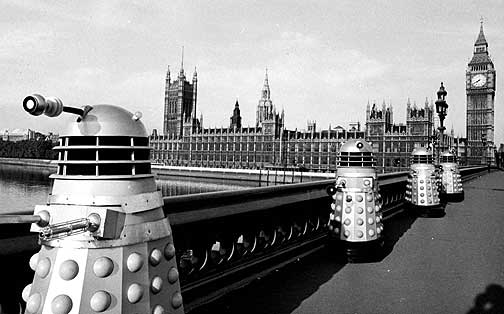
The idea of monsters marching down familiar London landmarks as seen in this story with the Daleks marching down Westminster Bridge would be something many more 60s stories would later use, such as the Invasion with the Cybermen marching down St Paul’s, The Web of Fear and the Yetis in the London Underground.
Elements of this story would also resurface in many subsequent Dalek adventures too. Day of the Daleks features an alternate version of the events of this story where the Daleks invasion of earth was never repelled, whilst the 2008 adventure The Stolen Earth/Journey’s End was inspired by this adventure and even featured a similar plot of the Daleks moving the earth through space.
Notes
This was story editor David Whitaker’s last adventure as story editor, though he would continue to write for the series until Jon Pertwee’s first season. He wrote the famous “one day I shall come back” speech at the end of the story not Nation.
This story served as an influence on Futurama the game where the villain Mum turns the earth into a space ship to conquer the universe.
Having originally written a tale of the Indian mutiny for the show, Nation still had the country on his mind when writing this story. The mutiny is mentioned in “Flashpoint” and the original script had a fourteen-year-old Indian girl named Saida (played by Pamela Franklin) stow away aboard the TARDIS. Saida eventually became Jenny and the importance of the role decreased.
This story was inspired by the Dan Dare comic “The Reign of the Robots”. The Reign of the Robots sees Dan and his companions return to earth after a 10 year absence only to discover that his archenemy the Mekon has conquered the earth in his absence and enslaved humanity. The Mekon rules the human race with his robot servants that he controls with a speaker in his chair. At the end of the story Dan and his friends are able to take control of the speaker and give the robots new orders to turn on each other, bringing about the end of their invasion.
The first Dalek story. Its no exaggeration to say that without this serial Doctor Who probably would not have lasted more than 13 weeks, never mind 50 plus years. A massive success and cultural phenomenon when it first aired. The Daleks still holds up 5 decades on as one of of the greatest sci fi stories of all time.
Plot
The TARDIS takes the Doctor, Ian, Barbara and Susan to a seemingly dead planet. They discover both a petrified jungle (as well as the remains of petrified animals) and an apparently abandoned city. The Doctor wishes to explore the city, but the other three time travellers want to leave. Later that night as they hear a tapping on the TARDIS door (with Susan having spotted something moving in the distance earlier.) Susan, Ian and Barbara become scared and demand to leave right away, but the Doctor, still desperate to explore, pretends that something has gone wrong with the TARDIS.
He claims the fluid link’s top has come undone and that the mercury has poured out. The Doctor tells his companions that the only chance they have of finding any mercury to replace it is in the city.
The foursome explore the city the next morning, but they quickly become separated and Barbara is taken by mysterious and hostile metallic creatures.
The Doctor, Susan and Ian meanwhile discover a giga counter that reveals the air of this planet is polluted with radiation. With all of them having been poisoned by the radiation, the Doctor reveals his bluff to a furious Ian and Susan. The Doctor is all set to leave Barbara, but Ian forces him to stay by stealing the fluid link.
The Doctor, Ian and Susan are captured by the same mysterious metallic creatures who took Barbara. The Doctor is then questioned by the creatures who reveal that they are called the Daleks and that they were originally humanoids.
The Daleks also shared their world with another race of humanoids called the Thals. Both species waged a nuclear war with each other which eventually destroyed the surface of their planet (Skaro.) Both species where horribly mutated as a result of the war, and the Daleks now house themselves inside robotic shells as a form of protection from the polluted air.
The Thals meanwhile managed to create a drug that allowed them to survive the polluted air. The Doctor realizes that the box that was left outside the TARDIS earlier is a sample of the Thals anti radiation drugs. He makes a deal with the Daleks that one of them will go outside the city and retrieve it. The Doctor promises that they will split the drug with the Daleks. The Daleks who want the drug so that they can leave their machines agree. Of course they really have no intention of allowing their prisoners to have any of it.
The Daleks are unable to leave their own city, as their machines that keep them alive are powered by the metal floors of the city.
Susan is sent outside, as being the youngest she is the least affected (Ian was also shot by a Dalek whilst trying to escape earlier, which left his legs temporarily paralysed.) Outside in the jungle Susan retrieves the box, but is cornered by a Thal. She discovers that the Thals mutation cycle has come full circle and that they have evolved back into their original forms, blonde haired humanoids.
The Thals have become pacifists as well and want to make peace with the Daleks, however they still don’t entirely trust their aged old adversaries, and so they give Susan a second supply of anti radiation drugs. The Thals had left the first supply earlier specifically for the Doctor and his friends.
When Susan reaches the city the Daleks discover the second supply, but allow her to keep it because they want to use her to help set a trap for the Thals; after having discovered that she made contact with them.
The Daleks get Susan to write a note to the Thals, saying that the Daleks want to make peace with them and that they are to collect food from their city tomorrow. However the Daleks actually intend to exterminate the Thals as soon as they enter the city.
The Doctor and his friends are able to escape by killing the Dalek guarding them, by pulling it over a cloak, separating it from the metal floors. The Doctor is once again happy to leave the Thals to their fate, but Ian remains behind and warns the Thals, though not before the Daleks manage to kill the leader of Thals in cold blood.
The rest of the Thals escape to the jungle. They foolishly believe that they can make peace with the Daleks, but Ian warns the Thals that the Daleks will not rest until they have destroyed their entire race, as the Daleks fundamentally hate the Thals, simply for being different.
After failing to convince the Thals to stand up for themselves the Doctor and his companions prepare to leave, but ironically the Doctor discovers that the Daleks took the fluid link from Ian whilst they were in the city.
The Thals agree to help the Doctor and his friends retrieve their fluid link after some persuasion from Ian
Meanwhile the Daleks discover that the anti radiation drugs are like a poison to them. The Daleks have in fact evolved to become dependant on radiation and the reason they can’t survive outside of their metal casings, is because there isn’t enough radiation in the air to sustain them.
The Daleks decide to explode another neutron bomb that will pollute the air, not only to the extent that they will be able to survive on their own, but also to the point where the Thals will not be able to survive, even with their anti radiation drugs.
The Thals meanwhile split off into two groups to attack the Dalek city. One side led by Ian and Barbara attack the back of the city making their way past the lake of mutations and through a treacherous cave system, where several of Thals are killed along the way. The other team led by The Doctor and Susan meanwhile attack from the front, though the Daleks are able to capture the Doctor and Susan. Eventually all of the Thals launch an all out attack on the city.
The Daleks have the upper hand at first, but the Thals are able to get the better of the metal monsters by knocking out the power source to their machines. With their power source shut off the Daleks die and their bomb does not go off. Having retrieved their fluid link the Doctor and friends soon set off for new adventures leaving the Thals to rebuild their world.
Hopefully that’s the last The Doctor will see of those metal bastards.
Quotes
Dalek / We do not have to change to suit the environment, we will change the environment to suit us.
Dalek / The only interest we have in the Thals is their total extermination.
The Doctor/ You wanted advice you said. I never give it. Never. But I might just say this to you. Always search for truth. My truth is in the stars and yours is here.
Alydon/ There is no indignity in being afraid to die, but there is a terrible shame in being afraid to live.
Alydon/ If only I knew why the Daleks hated us. If I knew that, I, I could alter our approach to them, perhaps. Ian/ Your leader, Temmosus. Alydon/ Yes? Ian/ Well, he appealed very sensibly to them. Any reasonable human beings would have responded to him. The Daleks didn’t. They obviously think and act and feel in an entirely different way. They just aren’t human. Ganatus/ Yes, but why destroy without any apparent thought or reason? That’s what I don’t understand. Ian/ Oh, there’s a reason. Explanation might be better. It’s stupid and ridiculous, but it’s the only one that fits. Alydon/ What? Ian/ A dislike for the unlike. Alydon/ I don’t follow you. Ian/ They’re afraid of you because you’re different from them. So whatever you do, it doesn’t matter. Dyoni/ What would you have us do? Fight against them? Ian/ I didn’t say that. But you must teach them to respect you. Show them some strength.
Review
The first Dalek story was a truly groundbreaking piece of television when it was first broadcast in 1963 that still holds up, by and large, to modern audiences.
On the surface its a fun, rip roaring, boys own adventure, filled with evil robots, a journey through a perilous cave system, lake monsters; and even a a bit of romance between Barbara and one of the Thals.
Underneath however its a very deep story that tackles issues such as race hatred, xenophobia, the threat of nuclear power, and standing up for yourself.
The Daleks were very clearly based on the Nazi’s. They are consumed with race hatred for the Thals (who in quite a nice touch are all portrayed as Aryans, the Nazi’s idea of the perfect human being). At one point in the story the Daleks even perform the Nazi salute!
The Doctor and friends meanwhile serve as quite a good parallel for Winston Churchill’s role in the Second World War. In both cases we have a fascist xenophobic society that is a threat, but both Britain and the Thals refuse to do anything about it due to the memories of a previous conflict. In Britain’s case it was the first world war, whilst in the Thals case it was a global conflict with the Daleks. Both conflicts were pointless and have caused both sides to never even consider the possibility of war again. However now ironically a war is the only choice they have. The enemy they are facing is beyond reason as it has a “dislike for the unlike” and therefore cannot possibly be appeased.
The Doctor and his friends meanwhile much like Winston Churchill have to convince the war weary society to abandon their policy of appeasement against the enemy and fight them.
The story does not glorify war however. It shows many of the Thals die horrible, pointless deaths, and it even manages to make us show some sympathy for the Daleks too in the final moment where the Thals stare round bitterly at the dead Daleks and comment. “If only there had been another way”.
Whilst the Daleks primarily serve as a metaphor for the Nazis, I feel they can also be seen as representing many of histories other greatest monsters. Perhaps unintentionally.
I have compared the beliefs of the Daleks in this story to those of General Chivington’s many times in the past and I still say there are valid comparisons. The Daleks don’t even look on the Thals as their enemies in this story. The Daleks much like how Chivington looked on the Native American’s he slaughtered during the Sand Creek Massacre, view the Thals as nothing more than pests to be stamped out.
“It was also reported that following the massacre, some members of Congress had confronted Chivington and the Governor, before members of the public at the Denver Opera House. At one point it was asked whether it would be better to civilize or exterminate the Indians. In a letter from one of the senators to a friend, he wrote that “there suddenly arose such a shout as is never heard unless upon some battlefield—a shout almost loud enough to raise the roof of the opera house—’EXTERMINATE THEM! EXTERMINATE THEM!”
You can see how the Daleks are every bit as similar to monsters like Chivington as they are to the Nazis. I always thought it would have been brilliant if they had done a historical story set during the time of the Sand Creek massacre and had the Doctor witness this event. Viewers ironically would probably think the producers were making it up when everybody started chanting like Daleks, but it would be completely true.
The Daleks also plays on contemporary cold war fears too. The barren, dead irradiated world of the Daleks not only represents what our world could have become had the cold war led to a third world war; but the Daleks planning to poison the air of Skaro just to eradicate the Thals is comparable to the British’s use of agent orange to destroy the crops, bushes and trees of communist insurgents in Malaya during the Malayan Emergency and later the American’s attempts to bomb Vietnam “back to the stone age” during the Vietnam war. In all three cases we have people who are willing to destroy their enemies entire environment in order to make sure that there is no chance they can survive afterwards.
In much the same way as Skaro’s environment was still polluted centuries after the war, then certain areas of Vietnam are still polluted after the Vietnam war 4 decades on.
I think the reason The Daleks works just as well as a metaphor for the likes of Chivington is because Nation whilst drawing inspiration from the Nazis and World War 2, ultimately made the Daleks into more than just a metaphor for Nazis. The Daleks in this story (as well as many others penned by Nation) represent race hatred and man’s inhumanity to man in general. This has in turn also allowed this story to remain relevant in the decades since. For today’s audiences the Daleks can be seen to represent ISIS for instance just as much as the Nazis.
When you look at this article which explains why ISIS wants to destroy the west, its not too dissimilar to Ian’s explanation to the Thals as to why the Daleks hate them.
Whilst Terry Nation wrote a fantastic story, credit must also go to Raymond Cusick who designed both the Daleks and their city.
The Dalek design is really a work of art. It works on just so many levels. On the one hand its the only genuinely alien looking creature in almost all of sci fi. There is absolutely nothing even remotely human about it. It has no legs, no arms, no face. Its also not like anything else we can really relate to either. Its not just a giant reptile, insect or animal of any kind. Its really not like anything on earth.
At the same time there is a certain attractive aspect to the Daleks design. Its so striking and unusual that you can’t help but be drawn to it.
It cannot be denied that there is a certain ridiculous aspect to the Dalek design too, with their sink plunger arms, egg whisk guns etc. Still I think that actually works in their favour.
The thing about the Daleks is that they are meant to be pathetic creatures, essentially a crippled race who despise others like the Thals because they are scared of them. A Thal can kill a Dalek by pushing it over a rug! With this in mind you can see why they would be scared even with all of their technology that the Thals could kill them. Of course its a brilliant example of a self fulfilling prophecy, as if the Daleks hadn’t been so desperate to destroy the Thals, then the Thals would never have harmed them.
The designs for the jungles of Skaro and the Daleks city are also spectacular. The jungles are suitably dark and gloomy and the creatures that inhabit them are utterly repulsive. We only get fleeting glimpses of these mutations, but it gives you an idea of the horrors that lurking in these petrified woods, and you really feel Susan’s terror when she is forced to go through them alone.
The city’s design meanwhile much like the Daleks themselves is attractive in some respects the way its so futuristic and advanced looking. It evokes the classic Metropolis look from the outside, yet on the inside its actually quite claustrophobic and smothering. Everything looks so cramped and barren and sterile, and there are all of these tiny little corridors that almost look like never ending caves, where the Daleks can emerge from at any moment.
Finally the voices of the Daleks are also superb in this story too. David Graham and Peter Hawkins, two of the most acclaimed voice actors from the 60’s, voice the Daleks in this adventure (and would go on to for the rest of the 60’s). The two actors from the start don’t just make them sound like robots, but add a real hysterical quality to the monsters, giving the impression right away that there is something trapped in there, almost like a disembodied spirit wanting to get out.
Its not just the Daleks however that make this story so great. It also features a very important development in the character of the Doctor too. At the start of the adventure the Doctor could not be a more unsympathetic character. He tricks his friends into exploring the city (risking all of their lives in the process), and he is also shown to be prepared to leave the Thals and even Barbara to die just to save his own life.
However by the end of the story the Doctor is shown to take a more moral stance against the Daleks. We even see him at one point be willing to give up the TARDIS to the Daleks to spare the Thals.
I often thought it was this battle against the Daleks that helped change the Doctor. Up until now the Doctor had never bothered to interfere in the affairs of other life forms. The battle between the Daleks and the Thals at first might seem no different to the fight between the two cavemen tribes in the preceding story to the Doctor. Its just more primitives squabbling, but he soon comes to see that the Daleks are actually willing wipe out an entire race just for existing. This finally makes the time lord realize that there are times he needs to get involved, and really begins to shape the hero we know and love from the later stories.
The Doctors companions Ian, Barbara and Susan are always all used very well here. I think Terry Nation was always able to find something for all of the companions to do unlike a lot of other writers for the show. Indeed often the Doctor would be limited to only having 1 companion because most writers struggled to think of anything to do with more than two main characters.
Ian gets many strong moments from standing up to the Doctor when he discovers his deception, to forcing the Doctor to face the consequences of his actions and save Barbara, to arguably the characters defining moment when he manages to convince the Thals to fight against the Daleks.
At the same time Barbara isn’t wasted either. She’s shown to be every bit as strong as Ian or any of the men around her are as she ventures through the treacherous caves and battles Daleks head on. It does annoy me when people go on about how the female companions in Classic Who always just being useless screaming damsels. Barbara the first ever female companion alone disproves this cliche in this adventure.
Susan meanwhile sadly was often a more useless companion. There was certainly potential for her to be interesting, but it was often squandered. In this story however we get to see a more courageous side to Susan, when she has to venture out into the hostile jungles of Skaro on her own. I like the way we see her scared, but she ultimately manages to overcome her fear and do the right thing. She is also the one who is able to make contact with the Thals first, and therefore plays one of the key roles in the story too.
I don’t mind the fact that the Doctor doesn’t play as heroic a role in this story compared to Ian, Barbara and even Susan. Unlike with the later Doctors the character is not meant to be a hero here. He is meant to be a more morally grey, almost villainous character. He is still by far and away the smartest member of the team, its just that at first he is only in it for himself.
The Daleks is also very well directed too. Not many fans have time for Richard Martin, who directed some of the episodes of this story, but I think the Daleks is his best work on the series. One of my favourite moments is when the Daleks slowly advance on the Thal leader as he is trying to plead with them.
This scene always creeped me out as a child. Richard Martin makes use of the fact that the Daleks are almost able to blend in with their surroundings, to make it appear as though they are emerging from nowhere.
I also loved the effect when the Dalek blasts the wall too. The production values all around for this story are brilliant, with the sequence involving the mutant pulling the Thal into the lake holding up even by today’s standards.
Of course this is not to say that the first Dalek story is perfect. It definitely drags a bit after the Doctor and his companions escape the city. Originally this story was to have been just 6 episodes, but it was extended at the last minute to 7 and it definitely shows in the final product.
Still other than this there really is very little to fault with this adventure, and I’d not only rate it as one of the best Doctor Who stories from the 60’s, but one of the best stories in Doctor Who’s long history.
Final Rating
5 stars
Legacy
The Daleks is arguably one of the most influential pieces of British television ever made. It was this story that really made Doctor Who a national phenomenon. Prior to this, though the reaction to the first serial, “An Unearthly Child” had been mostly positive, it had not been a big ratings success. By the end of this serial however Doctor Who was pulling in viewers of over 10 million.
The main reason for this was the Daleks themselves who were an instant hit with viewers (particularly children.) They were unlike anything seen on tv before or since. Totally inhuman monsters with no redeeming features whatsoever, instantly imitable, and with a striking and totally unique look.
For the next few years Britain would be gripped in what has become known as Dalekmania.
Not only would the monsters be brought back to Doctor Who 6 times over the next three years ( including in a 12 episode serial, The Daleks Masterplan.) There were also Dalek toys, comic books, water pistols, films, and even a song released to cash in on their fame.
Examples of Dalekmania.
Dalekmania was more than just a fad. It not only ensured Doctor Who’s success for decades to come, but it also helped to make science fiction mainstream in the United Kingdom for the first time.
Prior to Doctor Who there were a few successful mainstream Science Fiction series such as Quatermass and the comic book series Dan Dare. Neither of these had quite the reach that Doctor Who did during Dalekmania.
Dan Dare’s sales for instance at the absolute height of its popularity were over 3 million. For a comic book this was absolutely exceptional (and dwarfed those of any of its rivals, including even Batman, Superman and Wonder Woman.) However thanks to the Daleks, Doctor Who was seen by almost 5 times as many people through the 60s.
At one point in the United Kingdom the Daleks actually exceeded the Beatles in terms of popularity.
“They were so hot at that time, you couldn’t avoid The Beatles. I remember with great pride that the commercial channel was running the Beatles when they were really at their peak, at the same time as a ‘Doctor Who’ episode with the Daleks, and ‘Doctor Who’ got the ratings. I was pretty pleased with that.”
-Terry Nation creator of the Daleks.
Naturally as a result of this Sci Fi was no longer seen as niche in the United Kingdom and for the next 20 years there would be many more mainstream Science Fiction series.
These included the various Gerry Anderson series such as Thunderbirds and Sting Ray, as well as Moonbase 3, Doomwatch, Adam Adamant Lives, The Prisoner, Space 1999, Blake’s 7, UFO and The Survivors.
People like to act as though its only in the last 10 or so years that Science Fiction has become mainstream, but that is certainly not the case. Throughout the 60s, 70s and even 80s many of the most popular television series in the United Kingdom were genre shows. Though its true that this did come to an end in the 90s (thanks in no small part to the then heads of the BBC’s dislike for genre series.)
Still the 60s- 80s definitely represents a golden age for sci fi and fantasy in the United Kingdom and it was definitely Doctor Who that kick started it all off, with the Daleks in turn being what led to Doctor Who’s massive success in the first place.
In addition to its important place in Doctor Who history, The Daleks would also later be remade as a film, set outside of the tv series continuity titled “Doctor Who and the Daleks” starring Peter Cushing as Doctor Who, a human scientist who had built a time machine in his back yard.
The movie proved to be tremendously successful, so much so that a sequel was made Daleks Invasion Earth 2150 AD.
Elements of this story would also be reused in the third Doctor story Planet of the Daleks as well.
Finally scenes from this story including the Doctors first historic meeting with the Daleks would later be remade for the 2013 drama An Adventure in Time and Space.
Influences
The Daleks as we have seen drew from real life historical events with the monsters being based on the Nazis.
However in terms of creative influences there are really two major sources. HG Wells The Time Machine and Dan Dare.
Wells Time Machine revolves around two splinter groups of humanity. The Morlocks, deformed, but more advanced humanoids, and peaceful, beautiful, but placid Eloi. The Daleks similarly revolves around one more advanced, but withered race persecuting a more physically beautiful, but weak race.
Other than the following the same very basic premise, there are not that many similarities between the two stories. The Daleks and the Thals are not after all from the same race like the Morloks and the Eloi. Furthermore I feel The Time Machine is more about class struggles and society, where as the Daleks explores race hatred instead.
Of the two them I’d say Dan Dare is the bigger influence. I think people tend to over look the massive influence Dan Dare had on Doctor Who in comparison to other things like H.G Wells, because Dan Dare is sadly completely overlooked today. Also Dan Dare being a comic book is somewhat looked down on too.
The first Dan Dare story Voyage to Venus sees Dan and his friends encounter two races on the planet Venus.The evil, cold and logical Treens, and the blonde haired, peaceful and beautiful Therons.
The Treens are commanded by The Mekon, and live in a cold sterile city, surrounded by a lake of hideous monsters.
Many centuries ago the Therons interfered in the development of the Treens in an effort to help them which instead results in the Treens becoming more powerful to the point where they conquered the earth and destroyed Atlantis.
The Therons vowed to never interfere in the affairs of other life forms again, and at first refuse to help Dan fight against the Treens until Dan shames them into doing so.
As you can see there are a lot of strong similarities between the two stories, and furthermore both also tackle the same themes of race hatred, fascism and standing up for yourself too.
The Treens much like the Daleks were based on the Nazis, but much like the Daleks they can also be used as a metaphor for other evil men throughout history. Voyage to Venus for instance has often been seen as a metaphor for the Apartheid regime in South Africa as much as it is for the Nazis, with the Treens living in a society that is segregated from the brown skinned Therons, whilst also at the same time keeping a race of similar life forms, the Atlantines as their slaves.
The Treens were really the Daleks predecessors in British popular culture. A race of utterly pitiless xenophobes who managed to capture the very worst aspects of humanity in general. Its worth noting that their leader, The Mekon even inspired the creator of the Daleks, Davros in both personality and appearance.
In many ways the Daleks and Davros really replaced the Mekon and the Treens in popular culture.
Trivia
Originally Ridley Scott the director of “Alien” who worked on this story was to have designed the Daleks.
Ironically Sydney Newman the creator of Doctor Who hated the Daleks. He wanted there to be no bug eyed monsters in Doctor Who. The only reason the story was made was on the insistence of then producer Verity Lambert and story editor David Whitaker.
This story was saved from being wiped by Ian Levine in the late 70’s. Levine said that if he had arrived at the BBC just a few hours later he would have been too late to save this adventure.
Originally this story was to have revealed that the war between the Daleks and the Thals had been started by a third alien race who would have shown up at the end and taken responsibility for the conflict, before bringing peace between the two races. Though this idea was abandoned, it would later be revisited in the Doctor Who Unbound story “Masters of War” set in an alternate universe where the third Doctor is played by David Warner. This story sees the Doctor discover that a race known as the Quatch started the war between the Kaleds and the Thals. However unlike the unnamed aliens in Nations original draft, the Quatch are anything but friendly, and try to conquer both the Daleks and the Thals with Davros’ help.
It is not clear when this story is set. It is stated by the first Doctor in “The Dalek Invasion of Earth” that this story took place a million years into the future. However this is contradicted in “Planet of the Daleks”, when we discover the Thals refer to the events of this story as a legend, with “Planet of the Daleks” being set only a few hundred years in the future.


 burrunjorsramblesandbabbles