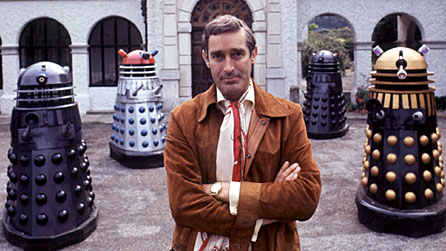
Why A Daleks Spin Off Series Should Happen

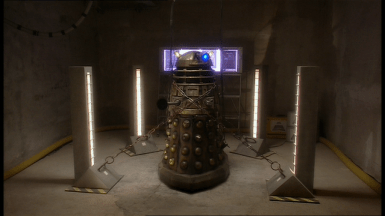
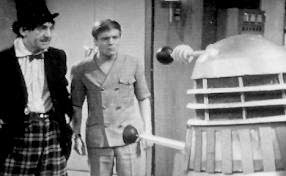
The Daleks are the Doctors most iconic enemies. It could be argued that the image of a Dalek is far more iconic than that of any incarnation of the Doctor himself.

Not surprisingly over the years many have wondered if the monsters could actually have a life outside of the show that spawned them.

Back in the 1960’s Terry Nation the creator of the Daleks tried to get a Dalek spin off series made. At one point even tried to sell the series to America. This was why the creatures vanished from Doctor Who for 5 years from 1966 to 1972.

Sadly Nation’s attempts to launch the creatures in their own series was ultimately a failure.

I raised a million dollars to privately make a picture. A spokesman for the BBC said they would become co-partners in the venture. I wrote the script.I came here to ABC, who expressed considerable interest in it. This is not to say they were making a commitment, but they were very interested. I went back and I started in to east and get a director and a designer. The designer started working, I booked the studio, and then my finance man went to conclude things with the BBC, and the man who had committed BBC for the other million bucks had no authority so to do, and suddenly my fifty percent backer was gone!

The BBC actually didn’t have that – or the man that I had been dealing with did not have the power to do that. Whether he realized it or not  I don’t know, but I then had to cancel the studio. It cost me personally a lot of money to pull that operation out. And I had a studio that was standing by, and I was going to be shooting in a weeks time – that’s how close we got when we lost the money – and I was not about to put up my own money, because its traditional that you never finance your own things.

-Terry Nation on why the Dalek spin off series was never made.

As you can see we came very close to having a Dalek spin off show. The series would have seen the SSS an organisation introduced in Nation’s Doctor Who story Mission to the Unknown battle the Daleks. The SSS were essentially MI5 in space.

Mission to the Unknown and The Daleks Masterplan were meant to set up Nation’s Dalek series. Not only did they introduce the SSS, but also Sara Kingdom played by Jean Marsh who despite dying at the end of The Daleks Masterplan would have been the main character in the Daleks spin off series.

Among the other main characters in the series would have been David Kingdom her brother and Mark Seven a humanoid android been based on the Mr Spock character from Star Trek.

Whilst Nation’s show was never made, many decades later the Daleks would get their own series when Nicholas Briggs the voice of the Daleks in the revival produced the Dalek Empire spin off audio series. David Tennant who played the Tenth Doctor actually appeared in this series as one of the main characters prior to landing the role of the Doctor. Noel Clarke who played Mickey Smith also appeared in the series too.

Apparently whilst working on this series Nicholas Briggs told his friend Tennant that he should audition for the role of the 10th Doctor unaware that he had already got it!

In addition to this Briggs would also later produce the unfinished script for the pilot episode of Nation’s Dalek series, with Jean Marsh who played Sara in The Daleks Masterplan even reprising her role as Sara Kingdom.

As you can see from the examples I have given the monsters have already through Nicholas Briggs Dalek Empire series proven strong enough to carry their own series. So its not such an outlandish idea it can in the right hands of course be done. Personally I think now is the best time to make a series all about the monsters and hopefully after reading you may agree with me.

1/ It Would Help Expand Doctor Who’s Profile

During the late 00’s Doctor Who was more than just a popular series it was a massive franchise. There was always something DW related on during the year and for all age groups too. In 2008 for instance you had Torchwood on in the winter for adults, Doctor Who across the spring and summer for the whole family, and finally the Sarah Jane Adventures in the Autumn just for children. All three of these series during this time were very popular too.

Sadly the Doctor Who franchise came to an end in the early 10’s due to a number of real life behind the scenes tragedies. Elizabeth Sladen who played Sarah Jane passed away in 2011, whilst Russell T Davies’s partner Andrew Smith was diagnosed with brain cancer, forcing Davies to return from America, which consequently brought an end to Torchwood.

Since then the Doctor Who universe’s output has naturally decreased to just one series, until recently when it was announced that a new spin off titled Class set within Coal Hill School would be produced.

I think a Dalek spin off in addition to Class could help restore Who to the position it was in during the late 00’s, as a full franchise which would obviously be a good thing all around.

Two spin off series I think would really boost its profile as these two shows could help draw new audiences to the show, as they both would be brand new and people who may not have wanted to watch Doctor Who could become more interested in it after becoming fans of the spin off.

2/ It Could Allow The Daleks To Be Much More Menacing

Now as Class is going to be aimed at a teenage audience then I think that the Dalek spin off should be aimed at a more adult audience like Torchwood was.

This I think would allow the writers to do things with the Daleks that they couldn’t really do in Doctor Who.

Doctor Who is not a kids show. It is aimed at a family audience, however whilst it is not exclusively for children, at the same time it is something that children obviously do watch and thus it can’t be too violent or scary.

Giving us a Dalek spin off series that was aimed mostly at adults could allow the Daleks to do far more horrible things than in Doctor Who. We could really show them as space Nazi’s like never before which I think could help to restore a lot of their menace.

We could really see the gory details of the Dalek death camps in a way that we never could in Doctor Who for instance. We could see piles of the Daleks victims corpses just left to rot that would evoke similar terrifying images from the second world war of the Nazi’s victims in the concentration camps.

3/ It Could Help Fill In A Lot Of The Gaps In Dalek History

There are a few unanswered questions about the Daleks in the revival. Like for instance what happened to the paradigm? How did Davros survive the destruction of the crucible?

A spin off series could give us the answers to these questions. We could get an episode that revealed that after the destruction of the crucible Davros managed to create another race of Daleks that destroyed the paradigm, and we could even have the main characters be forced to form a reluctant alliance with the paradigm Daleks to destroy Davros’s new race. This series could even serve as something of a prequel to The Magician’s Apprentice as we could see Davros get injured by the Paradigm Daleks.

4/ There Are A Wealth Of Fascinating Characters That Could Appear

There are so many Dalek related and Dalek characters that could pop up in this series or be the main characters.

Looking at Dalek characters we have the Cult of Skaro, Dalek Sec, Dalek Caan, Dalek Thay and Dalek Jaast. Now I know what you are thinking that they all died so we can’t have them back. Well we could always go back to before they died. Maybe even show an origin story for them that could be quite interesting. Or we could perhaps have clones of them appear. Maybe Davros sent a squad of Daleks to retrieve their corpses from the black archive. That’s where I reckon they ended up and he produced clones of them. I think that the Cult would be good antagonists for the main characters in the series as they are Daleks but you could give them more of a personality as we saw already with Sec’s cutting remarks to the Cybermen.

At the same time we could also have the Dalek Time Controller, a very popular Dalek character from the Big Finish Dark Eyes series appear as a recurring antagonist.

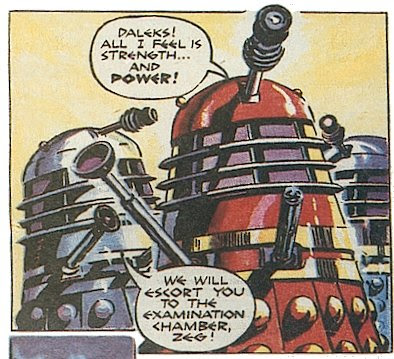
Dalek Zeg is another Dalek character that could be interesting. He came from the Dalek Chronicles comic book series and was a Dalek who had become mutated after an accident in a lab. His mutation made him virtually indestructable and he sought to take control of the Daleks from the Emperor himself. I think it would be interesting to have a Dalek who was a complete rogue, wasn’t aligned to any other Daleks just simply looking out for himself and was perhaps a bit unstable. Think of what Nicholas Briggs could do with that Daleks voice!

Dalek X the Dalek that loves to torture people would be a great Dalek to feature in the series. I’d love to see an episode that revolved around his death camps.

You could also bring the Emperor who hasn’t been featured on tv since The Parting of the Ways 10 years ago back as well.

On the other side of the spectrum we could have some more benevolent Dalek characters too.

We could have the Oswin Dalek appear in the series. Again even though she apparently died, we could always have it that she survived somehow. Maybe she found another teleportation device and teleported up to the ship or to a nearby planet. I think a Dalek that was once human would be an interesting idea. We’d see a character that still had human emotions and feelings but was trapped in a cold metal cage as a freak forever. We could also explore more of her past before she became a Dalek too.

I would also like to see Rusty in this series too. Rusty would be a different type of good guy Dalek to Oswin as he would be one full of rage and hatred for the Daleks. If he met Oswin he would even try and kill her.

There are plenty of human characters that could be interesting too. Journey Blue would be an interesting character to have in the series. Journey Blue would have to be the lead character. Absolam Daak meanwhile a character from the expanded universe would also be an excellent character to appear in the series as well. He and Journey would be quite a good two to put together as he is lowlife, criminal who kills Daleks for fun, whilst she is a very serious, dedicated and honourable soldier.

At the same time we could have plenty of Whoniverse characters who have not been associated with the Daleks. For instance Psi and Saibra. Those two characters who appeared in Time Heist last year proved to be very popular. So much so that many people have called for them to be the next companions. Personally I’d rather see them as regulars in the Dalek series. According to Time Heist they come from round about the same time as Absolam Daak as he appeared among the list of greatest criminals in that episode.

You could also have guest appearances from Jack and even River Song too as they are after all time travellers.

I’d also like to see Mark Seven appear in the series. It would be nice to finally realise Nation’s somewhat odd creation and through him we could find out more about the SSS who I felt were a somewhat interesting creation.

Then of course finally there is Davros who could appear too. Its always a good thing to have Julian Bleach reprise his role as Davros.

Conclusion

As you can see there is a lot of mileage in a Dalek spin off series. I hope that the BBC decides to make this the second spin off for Moffat era Who after Class or third if we ever get that Paternoster Gang spin off.

Which Companions Have Met The Daleks

As the Doctors most recurring enemies the Dalek have encountered more of his companions and friends than any other villain.

In this article I am going to run through which companions have actually had the pleasure of meeting Skaro’s finest face to face throughout the television series run.

Ian, Barbara and Susan

The Doctors original companions encountered the pepperpots 3 times each. Ian and Barbara met them in The Daleks, The Dalek Invasion of Earth, and The Chase. Susan had left by the time of The Chase but she got to encounter them again (lucky her!) in The Five Doctors.

Vicki

She encountered them just once in The Chase.

Steven Taylor

He encountered them 2 times in The Chase and The Daleks Masterplan.

Katarina

She encountered them just once in The Daleks Masterplan that led to her death.

Sara Kingdom

She encountered them in her only story The Daleks Masterplan.

Ben and Polly

They encountered them only once in The Power of the Daleks.

Jamie

He encountered them just once in The Evil of the Daleks. Frazer Hines who played Jamie said he was always desperate to work with the Daleks, but sadly his character only got one story with them.

Victoria

She met them in The Evil of the Daleks where they also killed her father..

Jo Grant

She encountered them 3 times, Day of the Daleks, Frontier in Space and Planet of the Daleks.

Brigadier Alistair Gordon Lethbridge Stewart, Sergent Benton, Captain Mike Yates

All of the UNIT regulars encountered the monsters in Day of the Daleks.

Sarah Jane Smith

She encountered them in Death to the Daleks, Genesis of the Daleks and The Stolen Earth/Journey’s End.

Harry Sullivan

He encountered them in Genesis of the Daleks.

Romana

She encountered them in Destiny of the Daleks.

Tegan Jovanka

She encountered them in Resurrection of the Daleks.

Turlough

He encountered them in Resurrection of the Daleks.

Peri Brown

She encountered them in Revelation of the Daleks.

Ace

She encountered them in Remembrance of the Daleks.

Rose Tyler

Counting individual episodes as individual stories then Rose encountered the Daleks more often than any other companion in the show’s 50 plus history. She encountered them in Dalek, Bad Wolf/The Parting of the Ways, Army of Ghosts/Doomsday and The Stolen Earth/Journey’s End. 7 stories in total.

Captain Jack Harkness

Captain Jack met the Daleks on 4 occasions. Bad Wolf/The Parting of the Ways and The Stolen Earth/Journey’s End.

Martha Jones

She met them in Daleks in Manhatten/Evolution of the Daleks and The Stolen Earth Journey’s End.

Donna Noble

She encountered them in The Stolen Earth/Journey’s End.

Mickey Smith

He encountered them in Army of Ghosts/Doomsday and The Stolen Earth/Journey’s End.

Jackie Tyler

She encountered them in Army of Ghosts/Doomsday The Stolen Earth/Journey’s End.

Pete Tyler

He encountered them in Army of Ghosts/Doomsday.

Harriet Jones

She encountered them in The Stolen Earth which ended in her death.

Wilfred Mott

He met them in The Stolen Earth/Journey’s End.

Sylvia Noble

She met them in The Stolen Earth/Journey’s End.

Francine Jones

She met them in The Stolen Earth Journey’s End.

Amy Pond

She met them in Victory of the Daleks, The Pandorica Opens/The Big Bang and Asylum of the Daleks.

Rory Williams

He met them in The Pandorica Opens/The Big Bang and Asylum of the Daleks.

Clara Oswald

She met them in The Day of the Doctor, The Time of the Doctor, Into the Dalek and The Magicians Apprentice/The Witch is Familiar. A splinter of her also met them in Asylum of the Daleks.

Kate Lethbridge Stewart and Osgood

They both encountered the Daleks in The Day of the Doctor.

Off screen encounters

All companions who live in modern day, Jo Grant, Osgood, Kate, Ian and Barbara, Ben and Polly, Martha’s family, Clara, the Ponds, Teegan, Ace and the UNIT family will all have encountered the Daleks offscreen during the events of The Stolen Earth/Journey’s End as the monsters invade the earth and completely occupy it. They may also have encountered them in Army of Ghosts/Doomsday as well.

The likes of Susan and Romana meanwhile will have encountered them off screen during the time war too.

Companions who never met the Daleks

Those who never had the pleasure of meeting the most evil creatures in the universe are Dodo, Zoe, Liz Shaw, Leela, Nyssa, Adric, Mel, K9, mark 1, 2 and 3, The Paternoster Gang and Danny Pink.

Out of that lot the only ones who have definitely never met them are Adric and The Paternoster Gang.

Zoe, Leela, Mel and Nyssa all encountered them many times in the Big Finish audio stories, which according to The Night of the Doctor are canon. Leela also would have met them in the time war offscreen as she was shown to live on Gallifrey alongside K9 mark 1 who also presumably would have met them during the war. Dodo depending on which ending you follow from her would have met them off screen during the events of The Stolen Earth/Journey’s End as would Liz Shaw and Danny Pink.

Adric however has so far never encountered them in an Audio adventure whilst the Paternoster Gang similarly have had no encounter with them in any piece of spin off material. Also unlike say Liz or Danny they would not have been alive during the Daleks stealing the earth either.

It is possible that they may have had another encounter with them at some point as in The Snowmen the Doctor casually mentions the Daleks to them as though they are already familiar with them. Though perhaps he has just told them about them in the past. Strax who comes from the future may also have encountered them at some point too, but until we have any conformation of that I am going to list The Paternoster Gang as one of only two supporting characters and companions to never encounter Skaro’s finest.

One time companions like Astrid and Jackson Lake never encountered the Daleks either, whilst Adeliade another one time companion did as a child and Lady Christina though not encountering them onscreen would have still met them during the events of the earth being stolen.

Ultimately however I don’t really consider these characters companions in the same way as the others on this list hence why I didn’t mention them.

Russell T Davies’ Daleks

Now Russell T Davies is probably a name that is familiar to most Doctor Who fans. He is after all the man who brought the show back after a 16 year hiatus and restored it to its rightful position as one of Britain’s most popular television series.

He made many big contributions to the franchise during his 4 years as showrunner. He cast both the a=Ninth and the Tenth Doctor actors Christopher Eccelston and David Tennant, and he also created the characters of Rose Tyler, Martha Jones, Donna Noble and Captain Jack Harkness as well as the two Doctor Who spin off series “Torchwood” and “The Sarah Jane Adventures”.

Despite this however he is nevertheless somewhat of a polarising figure. Many revere him as the man who saved Doctor Who from the wilderness. Others meanwhile regard him as the man who destroyed Doctor Who due to the massive changes he made to his revival of the series, such as making the Doctor a more romantic figure.

Still despite this it cannot be denied that Russell has had an immense influence on franchise as a whole.

Personally I think that one of Russell’s biggest contributions was the way he handled the Daleks.

Now again as I said in the last article, part of what I think made Russell such an excellent writer for the Daleks was the fact that he loved them so much. Just like David Whitaker before him, Russell believed the Daleks to be not only the greatest of all the Doctors enemies, but of all science fiction monsters.

Russell really beefed the Daleks up to being the Doctors arch enemies as well his most dangerous enemies more so than any other writer. He also gave them a much greater influence in the programme itself than they had ever had before, and made their feud with the Doctor much more personal.

I think when you look at Doctor Who in the 80’s you can see that the Daleks role in the show becomes less and less. They are pushed to the background and really become the least prominent of all of the Doctors main enemies.

I think this was due to the fact that neither John Nathan Turner the producer of Who during the 80’s or Eric Saward the script editor for Who during much of the decade particularly liked the monsters.

Saward said he found them to be boring and weak and if given the choice would much rather have not written for them.

Turner meanwhile I don’t think so much disliked the Daleks, but rather having to deal with Terry Nation who always insisted that Turner change certain aspects of his Dalek scripts to his liking.

Apparently things got so bad between Nation and Turner at one point that Turner didn’t send the final scripts of “Rememberance of the Daleks” to him which greatly angered Nation.

Thus as a result of this throughout the 80’s the Daleks really don’t do much when compared with other villains.

The Master kills an incarnation of the Doctor, murders his companions father and her step mother, destroys her home planet and murders his other companion Teegan’s Aunt (who is her only living relative). The Cybemen meanwhile kill a companion, whilst even the Rani manages to murder an incarnation of the Doctor. The Black Guardian meanwhile is the main antagonist of the shows 20th season at least and plays an important role in shaping Turlough’s character.

The Daleks however like I said don’t really do much at all in that decade. The don’t kill any companions, they don’t kill any incarnations of the Doctor, they are not the main villains of a season. On top of that they are not even the main focus in any of their stories as Davros generally takes centre stage such as most notably “Revelation of the Daleks”. Thus they are really the least of the Doctors many enemies.

In addition to this they aren’t even the most powerful of the Doctors enemies during this time. Indeed their empire has been destroyed by the Movellans and they spend more time fighting with one another and squabbling than they do invading and conquering other worlds.

Of course that’s not to say that the 80’s Dalek stories are poor. Far from it, I would rate all 3 of them as classics. However I would still rank the 80’s as the low point of the Daleks careers.

In order for a foe to be the heroes arch enemy they need to have something about them that makes them stand out from the rest. It can be anything. They can be the villain who causes the hero the most grief, they can be the villain who is the most powerful, the most recurring, or even the one who represents the heroes dark side more than the others.

The Daleks fell short on every one of these requirements during the 80’s and to a lesser extent even during the 70’s too.

Though the 70’s does contain the single greatest Dalek story “Genesis of the Daleks”  by and large the Daleks again don’t really do much to the Doctor or his friends to warrant being called his arch enemies.  I think the problem was during the 70’s the makers of “Doctor Who” felt that the Daleks fame and past history was enough for them to seem like the Doctors main enemies but sadly that wasn’t true.

In order for the monsters to truly stand out they need to be made to stand out.

Russell T Davies I felt understood that. If he was going to make the Daleks matter to the new generation and make them stand out from the rest of the Doctors colourful rogue’s gallery; then he was going to need to make them stand out and not just rely on their past fame and glories.

Russell to start with really worked hard to make the Daleks feud with the Doctor more personal than any other writer before him.

He made the Daleks responsible for every horrible thing that happened to the Time Lord.

In Russell T Davies’s era the Daleks destroy the Doctors entire race. That alone puts them ahead of all of his other enemies old and new, but they also cause other tragedies in his life.

They cause the death of the 9th Doctor in “The Parting of the Ways” (marking the first time they actually cause the death of an incarnation in over 40 years), separate him from Rose Tyler in “Doomsday”, and cause him to lose Donna in “The Stolen Earth/Journey’s End”.

Also its worth mentioning that the Daleks killed Harriet Jones a former close ally of the Doctor (which marks the first time they killed off any major character of any kind either regular or recurring.)

They also killed Captain Jack, and though he returned it was as a cursed immortal.

Finally the Daleks also cost the Doctor another regeneration technically in “The Stolen Earth”.

So yes the Daleks were behind every bad thing that happened to The Doctor throughout the entirety of the Davies era.

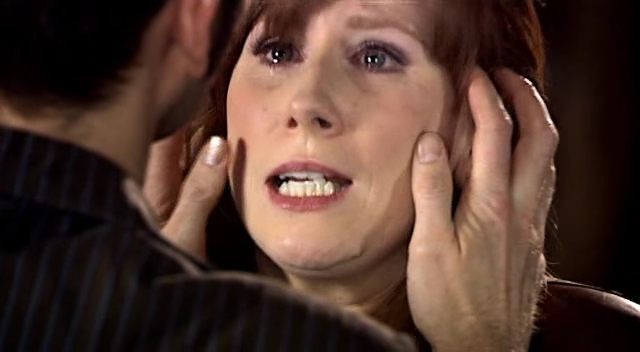
All of the most heartbreaking moments that people who grew up with the Davies era remember affecting them the most are all caused by the Daleks. 9’s goodbye to Rose, that’s because of the Daleks, 10 standing on the beach with a tearful Rose and being cut off before he can tell her he loves her back, that’s because of the Daleks. Donna tearfully begging the Doctor to let her stay as he places his hands on either side of her head and wipes her memory? Yep, that’s because of the Daleks!

The Daleks probably made more Whovians ball their eyes out during the 00’s than Michael Grade did during the late 80’s.

What was even more horrible about these tragedies the Daleks inflicted on the Doctor however was often the fact that they would force him to actually do them himself.

For instance they forced him to kill his own people in the Time War. They also forced him to wipe Donna’s memory in “Journey’s End” too. Also even in “Doomsday” it was the Doctor who actually opened the rip between realities and activated the device that pulled Rose into the other universe too.

Thus not only does the Doctor carry around an unbelievable amount of pain because of his dealings with the Daleks, but guilt too.

He has the knowledge of exactly how many billions of children he burned on Gallifrey and the images of Rose crying alone, trapped in another universe and of Donna begging to stay with him in his mind forever because of the Daleks.

The fact that they had been responsible for so many departing cast members in such heartbreaking ways for the viewers would also have no doubt helped to make the Daleks seem more terrifying to viewers.

Unlike other monsters the Daleks during Davies time would have actually seemed like they were capable of doing horrible things to the main characters.

There were only two main characters who did not depart because of the Daleks during Davies entire time. Martha Jones and the Tenth Doctor. Thus I’d imagine that whenever they appeared it would be frightening for the simple reason that you would know that a main character, possibly even the Doctor himself would leave under very tragic circumstances.

The fact that the Daleks had been the architects behind the Doctor and his friends, Jack, Donna and Rose’s suffering not only made them a greater threat, but also allowed Davies to show a darker side to the Doctors character at the same time.

It was during Davies era that the Doctor for the first time actually hated the Daleks. Indeed this marked the first time the Doctor had ever hated any of his many enemies. The Doctor had of course been willing to kill his enemies before including The Daleks, Davros, the Cybermen and even the Master, but he never hated any of them.

The Doctor only killed the Daleks before if he needed to.

In “The Evil of the Daleks” he only destroys them out of self preservation. In Genesis he memorably gives up an opportunity to destroy them as he believes it is the right thing to do in every respect. Morally he does not believe he has the right to exterminate a race from existence, and practically he thinks that some things might actually be better with the Daleks. Many worlds who may have destroyed one another in wars, including earth and Draconia instead become allies due to their mutual hatred of the Daleks.

By the time he reaches his Seventh incarnation however he now feels the Daleks must be destroyed. They are on the brink of gaining the same level of power as the time lords through the hand of Omega. Thus if they are not stopped they will decimate all of creation.

The Seventh Doctor therefore makes a very logical and again practical decision to destroy the Daleks. It is not because he hates them. He looks at it in a very cold, logical way and even wonders if he has done the right thing at the end.

“Doctor we did good didn’t we?”

“Perhaps time will tell, it always does.”

During Davies time however the dynamic completely changed between the Daleks and the Doctor.

The Ninth Doctor because of what happened in the Time War despised them. In “Dalek” he tries to murder the Metaltron when it is mutated, confused and helpless. Its hard to imagine any previous Doctor in this moment.

Here unlike in “Remembrance of the Daleks” the Doctor is not looking at things practically. He is motivated purely by hatred. In the season finale “Bad Wolf/The Parting of the Ways” the Ninth Doctor tells the Daleks that he is going to foil the Dalek invasion of earth, rescue Rose and then destroy them.

Unlike the 7th Doctor who destroyed them purely out of practicality, 9 makes it clear that he is going to destroy them after he has stopped them. Even if they surrender he is still going to wipe them from the face of the universe and we actually see the Daleks panic in response to this. In this moment the Doctors hatred is greater even than the Daleks.

Many have praised the ninth Doctor’s interactions with his greatest enemies. I would say the Ninth Doctors interactions with the Daleks were definitely the most interesting and dramatic after the Second Doctors.

Of course its worth noting that the Ninth Doctors first Dalek story “Dalek” was actually written by Robert Shearman. However a large part of what makes the Doctors interactions with the Daleks so tense and memorable is the time war back story which was invented by Russell T Davies.

The Doctor and the Daleks confrontations had certainly never been more tense than they had been during the Ninth Doctors era.

Davies also aside from making the Daleks the Doctors most personal enemies also made them his most powerful and dangerous.

The Daleks had never actually been the Doctors most powerful enemies. Indeed Terry Nation had often deliberately made them weak physically, whilst David Whitaker did make them all powerful war machines, Davies however made them practically gods.

I always felt the Daleks in Davies era were comparable to the Old Ones from “Buffy the Vampire Slayer” and the works of HP Lovecraft, though considering Davies’s love for Buffy I think it is the more likely influence.

The old ones in both Lovecraft’s work where they originated and in Buffy are ancient Demons who were once the masters of creation. They were more powerful and more evil than we could possibly imagine.

However fortunately for us they were banished from our reality years ago. In Lovecrafts work many of them were imprisoned in the earth, but the point is they were gone and the universe could breathe a sigh of relief.

However in both Buffy and Lovecrafts works there is the threat of what if they return? If they do then all hope is lost. Nothing can possibly stand against them and so we have to prevent that from happening above all else.

All we are ever shown is glimpses of the old ones power throughout Buffy’s run. We maybe seen one emerge from the hellmouth for a few minutes, see Ilyria on the spin off show Angel who possess immense power and strength that is virtually limitless.

The Daleks in the Davies era I think are very similar.

They too are ancient creatures who were once the most powerful and dangerous force in the universe. Much like the Old Ones they were more powerful and evil than we could imagine, but they too vanished from our reality in the time war.

Just like the Old Ones they passed into myth and legend. Even Captain Jack with all the incredible things he has seen and done is unable to believe the time war actually happened. Paterson Joseph’s character at the same time also finds it hard to believe that they could actually still exist.

However a few of them have survived and are now trying to rebuild their fallen empire and race and if they do then its all over. Nothing can stand against a full Dalek empire. The last time even the Time Lords were unable to defeat them and had to sacrifice themselves to stop the Daleks. Now however nothing could stop them and they would rip apart all of creation itself.

This is seen in “The Parting of the Ways” where the ninth Doctor at one point is seemingly prepared to sacrifice the earth to stop them pointing out that if he allows this fleet of Daleks to rebuild then the whole universe is in danger.

Like the old ones we are only given glimpses of the Daleks power throughout most of the Davies era.

In “Dalek” we only see one of them.

In “Bad Wolf/ The Parting of the Ways” we only see an invasion fleet. Granted its a fleet of half a million, but its still not representative of a full Dalek Empire. A full Dalek Empire consists of whole planets of Daleks and millions of fleets of billions of Daleks. This single fleet of half a million Dalek does not even begin to represent the full might of a Dalek empire.

Similarly in “Army of Ghosts/Doomsday” we only see 4 of them and even the army that is glimpsed at the end also cannot even begin to represent the full might of a Dalek empire.

This of course provided a totally new take on the Daleks. Before even at their most powerful the Daleks were merely intergalactic conquerors. In the Davies era however they were like long lost gods.

They had almost supernatural powers, including being able to bring themselves back to life through the touch of a time traveller, catapult planets through time and space like Tennis balls and reduce whole stars to nothing. They also fought in wars that were beyond our comprehension, wars that even people like Jack believed had to have been myths.

I often wondered if Davies turning the Daleks into long lost gods whom people believed were a thing from the past was perhaps a clever meta reference to the fact that in real life the Daleks had been away from our television screens for so long, and many saw them as being a thing from the past.

We finally do get to see what a full Dalek Empire can do in “The Stolen Earth/Journey’s End”. Now this was risky of Davies after the way he had built them up for the past four years, but I don’t think it disappointed.

To start with having the Daleks as the main villains of a story like “The Stolen Earth/Journey’s End” demonstrates how powerful they are. “The Stolen Earth/Journey’s End” is really like the “Crisis on Infinite Earth’s” of Doctor Who. Its the big crossover story that brings everyone together for a big battle.

The main cast of Torchwood, The Sarah Jane Adventures and Doctor Who are all here. For all of these types of stories you need to have a villain that is too powerful for one hero to defeat like the Anti Monitor. As great a villain as he is there is no way that the Joker whom Batman defeats on his own regularly could be the main villain of a story like this. Why would Batman need help to defeat a villain he beats on his own all the time?

As a result of this you will often need to invent a villain for this type of story rather than use any of the heroes involved’s enemies. Russell however was able to use the Daleks the most recurring enemies of one of the heroes involved because of how he built them up over his tenure.

The fact that he never showed us what a full Dalek empire could do meant that he could use them for this type of story as this story featured a full Dalek empire. This way not only was Russell able to use the Daleks in this story, but at the same time he was also able to show just by their inclusion how powerful a full Dalek empire was.

The Doctor is able to take on the Weeping Angels, The Cybermen, The Master, The Sontarans all by himself, Torchwood are able to take on Durac, Cybermen and all kinds of monsters by themselves, Sarah Jane and her gang can take on the Slitheen and the Sontarans by themselves. However a full Dalek empire is too big a threat for any of them to take on by themselves. They all need to unite to have any chance of stopping it. The Doctor can just about stop a rag tag group of Daleks by himself like the ones in “The Parting of the Ways”. However a full empire is too much for even he to take on by himself.

The Daleks also pose a greater threat than any other villain in either Doctor Who, Torchwood or The Sarah Jane Adventures in “Journey’s End”. They threaten to destroy every single universe. In comparison the Masters plan from “The Last of the Time Lords” seems like nothing!

Many fans have complained that the Daleks where too easy to defeat in “The Stolen Earth/Journey’s End”. I do agree to an extent.

Russell’s convenient kill all Daleks switch is quite frankly ridiculous. Why did the Daleks create a device that could kill all of them in the first place? And why did they stick it where they keep their most dangerous prisoners? And why did they construct it so that it is only operable by humanoid hands? The Daleks have only sink plungers remember.

Its a very lazy and stupid way to defeat the Daleks, and sadly does somewhat ruin “Journey’s End” .

Still at the same time it must be said it does take a huge amount to stop the Daleks in “Journey’s End” and the cost is immense.

It takes the combined might of three Doctors, 7 companions, UNIT, Mr Smith, Torchwood, K9 and Harriet Jones to stop them and even at that they still suffer heavy casualties.

The Doctor loses a regeneration, UNIT HQ is destroyed, Harriet Jones dies and Donna loses her memory. And that’s before we get into the millions of people who are killed by the Dalek in their invasion!

Even then I might add they only lose because 1 of the Daleks, Dalek Caan was a traitor who betrayed the rest of his kind and manipulated all of time itself against them!

The cost to stop the Daleks is always big in every Davies Dalek story in fact.

In “The Parting of the Ways” the ninth Doctor loses his life, virtually the entire population of earth which numbers close to 98 billion at that point are slaughtered as are the thousands of innocent people on board the game station and Captain Jack himself.

In “Doomsday”, Torchwood is destroyed, millions of innocent people are killed and Rose is left stranded in an alternate universe.

Even in low key Davies Dalek stories like “Dalek” and “Daleks in Manhatten/Evolution of the Daleks” still have a huge body count even when just dealing with a few Daleks or even just one.

You only have to look at how other characters react to the arrival of the Daleks in Davies stories to see how much more powerful they are compared to other villains.

In “Dalek” the Ninth Doctor who is normally a man without fear screams hysterically when he see’s one Dalek.

We have never seen him react that way before. He was cockey when facing an army of Autons or hordes of Slitheen unarmed, but the sight of one Dalek is enough to reduce him to a hysterical mess.

Similarly in “Doomsday” when Rose see’s just four Daleks emerge she is genuinely scared.

Prior to this she showed no fear when she believed it was the Cybermen, leader of the Cybermen in fact that was emerging. She was actually more focused on chatting to Mickey. However as soon as she see’s its just four Daleks she panics. I also liked how Jackie Tyler knew who the Daleks were because Rose had told her about them. Jackie didn’t know of the Cybermen, but clearly the Daleks had made a bigger impression on Rose.

Sarah Jane, Captain Jack, Martha Jones and Rose Tyler’s reactions to the Daleks arriving in “The Stolen Earth” meanwhile really shows you how much more dangerous they are more than anything. All of these characters have been through so much yet they all break down in tears upon hearing the word “Exterminate”.

Sarah Jane has faced Sontarans, Cybermen, Slitheen, Sutekh the Destroyer, Morbius and giant Robots.

Martha Jones has faced evil aliens that kill people and steal their bodies, the Weeping Angels and The Master. She has wandered the earth for a whole year battling evil monsters from the future.

Rose has fought Cybermen, Sycrocrax, stopped an entire Auton invasion by herself and even told the Devil to go fuck himself.

Captain Jack surely is someone who it is impossible to frighten. This is a man with a pet Pterosaur that eats Cybermen. He also has faced the Grim Reaper himself and has been killed in every conceivable way.

He has been tortured to death, stabbed through the heart, shot, starved to death, impaled, dropped 50 stories onto concrete, beaten to death, been killed over and over by The Master, one of the worst sadists in the entire universe, and been buried alive for thousands of years.

Imagine what he went through when he was buried alive. He would be trapped in a box and would die of suffocation again and again, and he would also die of starvation and dehydration at the same time. On top of that he would be covered in his own shit and piss in that box too.

Oh and on top of all that Jack can’t die, well he can die but he never stays dead. Even if you blow him up!

Yet even HE along with all of the others is shit scared when he hears the Daleks have shown up in “The Stolen Earth”.

No other villain could possibly stir up that much fear in our main heroes.

As if all of that wasn’t enough Russell also has the Daleks thrash the Doctors other major enemies too.

In Classic Who the Daleks got thrashed by other enemies. “The Space Museum” shows a Dalek sit among the Moroks hall of greatest triumphs, whilst both the Movellans and the Mechanoids thrashed them too.

In Davies era however nobody lays a fucking finger on the pepperpots.

4 of them kill hundreds of Cybermen, they wipe out the entire Nestene’s home planet off screen, they force the Master to flee to the end of the universe in fear of them and transform himself into a human being to escape them. Think about it the Master was so scared of the Daleks that he not only fled to the end of the universe a place no one had gone to before but he actually turned himself into a member of a race he hated and had been prepared to wipe out over a feud with the Doctor!

On top of that they also destroy the Valiant his main weapon effortlessly the following year.

They also wipe out the home planets of the Gelth, steal the worlds of the Pyrovales and the Adipose and Abzorbaloff’s people. Finally they also keep Davros and the holy Jagrafess as their servants.

Aside from being his most personal and powerful foes the Daleks also were the enemies who in some ways represented his dark side the most.

Both the Doctor and the Daleks during 9’s era in some ways can be seen to mirror one another. They are both survivors of a war where they lost everything. Not just their worlds, but everything they believed in.

The Doctor believed that he could be a good man, a man who makes people better. Unfortunately however when push came to shove he had to (seemingly) burn billions of innocents in order to stop the greatest evil he had ever faced.

He thus cannot believe that he is a good man any more. In a war between the Daleks and the Time Lords, a war with monsters like Davros, Rassilon and the Master the man who makes people better ended up having the most amount of innocent blood on his hands. Thus the Doctor we meet at the start of series 1 of the revival is a mere shell of his former self. He is angry, ruthless, even quite inept such as in “The Unquiet Dead”. Even the way he dresses is more stripped back. A sign he isn’t the same man he once was.

The Daleks meanwhile have lost everything too. They once believed that they were going to be the rulers of the universe, but now their race has died. There are only a few of them lived, forced to live in the shadows and even hyberdize with human beings, lesser creatures to survive. How can that be when they are supposed to be the Masters?

Thus as much as they hate one another the Daleks and the Doctor can even somewhat relate to one another. When the Ninth Doctor tells the Metaltron that everything you were and believed in is gone he is almost talking to himself.

The difference between them however is that the Doctor is eventually able to put this behind him and become his former self again, thanks to the influence of Rose.

Its in Dalek where we see this come full circle as Rose stands between the Doctor and the Dalek, trying to help both of them. Whilst she is able to get through to the Doctor, sadly she cannot get through to the Dalek.

Thus the Doctor from this point on becomes a better man. He becomes more merciful as seen in “Boom Town” and truly becomes the hero he once was as seen in the “The Empty Child/The Doctor Dances” where in contrast to “The Unquiet dead” where he caused the problem in “The Empty Child/The Doctor Dances” he saves absolutely everybody!

The Daleks however are unable to move on as all they ever had was their hatred to begin with and thus they degenerate further in caricatures of their former selves as seen in “The Parting of the Ways” where we see the half human Daleks.

Finally Davies also gave the Daleks much greater prominence in the show than ever before. The Daleks are not only the main villains for three of Russell’s 4 years as showrunner, but they are also responsible for most of the major events in all 4 series.

In series 1 they are responsible for the Time War story arc. The Nestenes and the Gelth invading the earth because their home planets have been destroyed, the Doctor being haunted by the memory of what happened, the Reapers showing up because the time lords are gone. The events of “Rose”, “The Unquiet Dead” and “Father’s Day” only happen because of the Daleks.

They are also responsible for the story arc revolving around the earth’s future being changed. They are also responsible for the Bad Wolf story arc too, as Rose only sends those words back in time as a warning to herself.

Finally it also through the final battle with them that we see how far the main characters lives have come too. We see how the Doctor is no longer prepared to murder innocents to stop the Daleks when he declares that he would rather be a coward than a killer any day. We also see how Jack has gone from being a coward to a hero who faces the Daleks down when all hope is lost. Finally we also see how Rose has become a hero in hero own right when she doesn’t give up and manages to stop the Daleks.

In series 2 it is the Daleks who create the rip between realities that allows the Doctor and Rose and Mickey to enter the Cybermen’s reality and the Cybermen to later enter ours.

In series 3 even though they are not the main villains they are still responsible for the main story arc. The Master was after all resurrected from death by the time lords to fight against the Daleks and he fled to the end of the universe to escape them. Thus no Daleks, no Master in “Utopia”.

Finally in series 4 they are once again the main villains and everything happens because of them.

Ten and Donna meeting, Rose being able to enter our reality, the planets disappearing and races like the Pyrovale’s invading earth because the Daleks have stolen their world and the prophecy surrounding the Doctor Donna too etc.

Finally in the Specials the Daleks continue to influence the show as it is because of them that Rassilon and the rest of the Time Lords become corrupted.

The Daleks even influence Torchwood the spin off as without them Jack would never have been an immortal and without them destroying Torchwood 1, Ianto Jones would never have gone to work for Torchwood 3.

Whilst the Daleks of the 80’s could not possibly be seen as the Doctor’s archenemies, Russell’s Daleks fulfilled every requirement.

They were his most personal enemies, his most powerful, the villains who represented his dark side the most, and the villains who had the most influence in his era.

Russell’s Daleks were the ultimate Doctor Who monster and the ultimate archenemy.

However at the same time what was rather interesting about Davies’s Daleks was the way they were so pathetic despite their power. His Daleks were creatures who like I said had lost everything.

They were on the brink of death, living in the sewers, desperate to survive and even at times being forced to merge with lesser creatures, going against everything they ever believed in in the process. It was such a wonderful irony that even with their power they still couldn’t survive.

Davies Daleks like many of his villains were afraid of death. The theme of death and being afraid of death is strong throughout the Davies era. Many of his villains such as Lady Cassandra, Rassilon and John Lumic are people who are terrified of dying and do all they can to avoid it not caring who they harm in the process, just as long as they get to extend their life a bit longer.

The Daleks can be seen as the epitome of this in the Davies era. They are an entire race whose time has clearly come, but fight it, even when they are forced to give up everything they have ever believed in and are forced to live skulking in the shadows they still cling to life above all else.

Overall I would rank Davies as the third best writer of the Daleks on television.

He was really the first writer to really do anything new with them since the 60’s and whilst I still prefer Terry Nation and David Whitakers Daleks overall I have to give Russell credit for making the most badass Daleks of them all.

Best Dalek Moment/ The Daleks Announce Themselves/ The Stolen Earth

This is possibly my favourite Dalek moment of all time after the Daleks turning on Davros in Genesis. As I said before seeing these characters who have faced the worst the universe has to offer and have been through so much torment literally break down at the thought of facing the Daleks truly establishes them as the ultimate Who villain better than anything else.

Worst Dalek Moment/ Dalek Anne-Droid Fight/ The Parting of the Ways

What a shame such a stupid moment belongs in an otherwise cracking Dalek story. Still this is a low point for Skaro’s finest, fighting with and losing to Anne Robinson, though it is good when the last one blows her head off.

Quotes

On bringing the Daleks back.

I had about four or five of these toys when I was a kid. I still collect them now – it’s my weakness. I have one from every era, I love them. When I took over the show, I was absolutely determined to restore them to their former glory. People said they’d had their day and we should come up with new monsters, but I knew they would work – and I was right!

David Whitakers Daleks

David Whitaker was one of the most influential writers in Doctor Who’s long and varied history. He was the shows first script editor, then called story editor, and was in fact partially responsible for the creation of the series itself.

Whitaker would also go on to write many stories both during and after his time as script editor on the show. Among those he wrote included “The Edge of Destruction” which introduced the idea of the TARDIS being alive. This would become an important feature and plot point in many subsequent stories, including Neil Gaiman’s “The Doctors Wife” and the first season finale of the New Who “The Parting of the Ways”.

The idea of the TARDIS being alive also helped to shape the dynamic of the show itself in some ways. It helped add a somewhat more fantastical aspect to the Doctors character that his ship was in many ways almost as much a character itself. The TARDIS is really like the Doctors horse or trusty steed. Its not like the USS Enterprise that can be destroyed and another can take its place, such as in the film series. The TARDIS can never truly be replaced as it is unique.

This was just one of many important elements that Whitaker brought to the show, yet sadly he continues to be somewhat overlooked. Still among hardcore fans at least he is revered. In 2003 he was voted the third greatest Doctor Who writer of all time. One place above Terry Nation himself!

However among general fandom he is sadly a somewhat obscure figure which is a real shame as in some ways he is as important a figure as Verity Lambert herself. I must admit I was annoyed that he wasn’t mentioned in the otherwise excellent “An Adventure in Space and Time”. I understand that they couldn’t have included everybody, but they could have at least name dropped someone as important as Whitaker and for that matter Raymond Cusick the designer of the Daleks.

Whilst Whitaker made many contributions to both the shows success and its lore, arguably his greatest where the ones he made to the Daleks.

Whitaker loved the Daleks. He even once mentioned that he considered them to be on the level of Jules Verne. I think that what made him such a great Dalek writer was the fact that he had such enthusiasm for them, much like Russell T Davies and of course Nicholas Briggs.

I think in order to be a really great writer for a character you need to have a real enthusiasm for them. Eric Saward for instance disliked the Daleks and thus whilst his stories for them were good, unlike Whitaker he didn’t really do anything with the Daleks themselves and simply either pushed them to the background or wrote them as grunts.

Whitaker contributed to the Daleks success from the very beginning. He was the one who actually commissioned Terry Nation to write the first Dalek story and he alongside Verity Lambert championed the story against Sydney Newman, the creator of Doctor Who, who initially didn’t want to do it.

Whitaker also made important rewrites on the first and second Dalek serials that he served as script editor on too. For instance he was the one who actually wrote the famous “One day I shall come back yes I shall come back” speech that the first Doctor delivers to Susan before leaving her.

In addition to this he also wrote a large number of spin off material involving the Daleks. The famous tv Century 21 comics featuring only the Daleks and not the Doctor were all written by Whitaker. They were credited to Nation as the magazine wanted to use Nation who was a big name at that point to sell it, however Whitaker was the ghost writer on the comics.

Whitaker also wrote the first ever Doctor Who stage play “The Curse of the Daleks” alongside Nation, though again the bulk of it was written by Whitaker. Like the 21st Century comics this did not feature the Doctor.

Whitaker also wrote the novelisation of the first Dalek story titled “Doctor Who in an exciting Adventure with the Daleks”. He also even contributed to the script of the second Cushing Dalek film “Daleks Invasion Earth 2150AD”

However it would not be until the Second Doctors era that he would finally get a chance to write for Skaro’s finest on tv in “The Power of the Daleks” a story that is sadly completely missing from the archives except for a few clips, but is still often regarded as one of the all time greatest ever Doctor Who stories.

Its no exaggeration to say that Whitaker completely and utterly reinvented the Daleks in just two stories “The Power of the Daleks and “The Evil of the Daleks”.

The Daleks in these two stories are nothing like the Daleks that Nation wrote. Indeed I’d say that they were in some ways the complete opposite in almost every respect from Nations Daleks.

With this in mind its not hard to see why Nation disliked Whitakers take on the Daleks so much as they were so different to what he had intended for them to be. Whitakers Daleks in some ways were more effective and in some ways less effective than Nations.

Whilst I overall do prefer Nation’s take on the monsters  I do think that it was good that Whitaker brought something new to their characters. That’s the only way that a character can remain fresh is if they are reinvented from time to time.

However having said that obviously you can’t change a character too much as then what is the point? If the character is completely different to the point where they are unrecognisable then you might as well invent a new character. Whitaker still kept up the Daleks defining trait, their xenophobia as well as their ruthlessness, allowing them to still be believable as being the same villains.

Nation as we saw in the last article enjoyed making the Daleks weak physically. His Daleks were the perfect allegory for men like Herman Goerring or even today Nick Griffin, pathetic, weak little men who ironically despised others because they viewed them as weak. Whitaker however was really the first to make the Daleks virtually unstoppable.

Where as Nations Daleks needed help from their Robomen to rule a Dalek ravaged earth, and were incapable of launching an attack on Earth by force and instead had to use chemical warfare. Whitakers Daleks in comparison were so dangerous that the Second Doctor stated that one of them would be powerful enough to destroy an entire earth colony by itself !

This is a huge shift in the way the Daleks are portrayed. They go from being weak, frail creatures who are at their most terrifying when in larger numbers to being a villain who now works best when there are only a few or even one of them. “The Power of the Daleks” only features two working Daleks throughout most of it, but they are every bit as terrifying as Nations army of Daleks in “The Daleks Masterplan”.

Aside from making them more powerful Whitaker also made the Daleks more manipulative and sly than Nation ever did. Nation generally tended to focus on their inhumanity more than anything else, but it was Whitaker who really focused on their cunning. That’s not to say that Nations Daleks couldn’t be crafty. They could in stories such as “the Daleks Masterplan”, but it wasn’t to the same extent as Whitaker.

Whitakers Daleks were always manipulating people. They were able to trick the colonists of Vulcan into thinking they were docile, harmless even helpful creatures. In “The Curse of the Daleks” meanwhile we also see them manipulate the main villain of the piece who believes that he has them under his control. The Daleks allow him to think that they are his loyal servants until they are able to harness their own power source. Finally “The Evil of the Daleks” is practically nothing but a game of manipulation between the Doctor and the Daleks from start to finish.

Whitakers more manipulative Daleks were the perfect match for Troughton’s more manipulative Doctor. There are a number of fascinating parallels that can be drawn between the Second Doctor and his mortal enemies.

Both of them to start with do not look menacing. The design of the Daleks whilst unique obviously, is not menacing. Its small, cumbersome and even quite cute. However Whitaker takes advantage of that, by having the Daleks use this to their advantage. They use the fact that they do not look threatening like say the Cybermen to lure people such as the colonists of Vulcan into a false sense of security. Only the Doctor who knows what they are really like doesn’t underestimate them, and thus none of their usual tricks that fool other people work on the Doctor.

At the same time the Second Doctor also looks harmless too. He wears clothes that are too big for him, his hair is scruffy and unwashed, he panics and screams at the first sign of trouble. Of all the Doctors he seems the most ineffective and bumbling on the surface, but underneath he is arguably one of the most cunning, and uses his bumbling facade to throw his enemies off. Most of the Second Doctors enemies greatly underestimate him and think him a fool. The Daleks however who again know him as well as he knows them, know how dangerous he truly is and thus none of the Doctors usual tricks that fool his other enemies such as the Cybermen work on the Daleks.

This not only creates a rather interesting similarity between the Doctor and the Daleks, but also allows the Daleks to stand out among the Doctors many enemies at that point as the most dangerous. When he goes up against them he knows he can’t use his usual tactics, he will have to go that extra mile.

We see this more clearly in “The Evil of the Daleks” which as I said is essentially just the Daleks and the Doctor playing games with one another, whilst using everybody else, including even the Doctors companion Jamie as pieces on a chess board against one another.

We also saw the second Doctor get more genuinely scared as opposed to the act he normally puts on in Evil when many of his tricks fail to work. Personally I found the Second Doctors interactions with the Daleks to be the most interesting of any Doctors.

Aside from bringing a more manipulative streak to the Daleks, Whitaker also made them more human as well. Nation had made the monsters completely alien as we explored in the last article. Whitaker however brought more human qualities to them. For instance in the tv Century 21 comics he gave a Dalek a name “Zeg”. Zeg also had an individual personality too. He wanted to take control of the Dalek empire away from the Emperor. This marked the first time a Dalek was shown to have any individual desires of its own, prior to this they had all been working towards a single goal with no individuality whatsoever.

Whitaker also had the Daleks possess a greater level of understanding of human beings as well. Nation always portrayed them as being totally unable to understand humanity in any way shape or form because they were so different. That was often how he showed how alien they truly were. Whitakers Daleks however were once again the complete opposite. They knew everything about us, every strength and every weakness of humanity they could exploit for their own ends. The Daleks in Nations time had been able to manipulate Mavic Chen, but that was only because he thought like them, was ruthless, callous etc. Whitakers Daleks however were able to manipulate anyone. They played on Bragen in “Power of the Daleks” lust for power, but they also played on Lesterson a good compassionate man’s desire to help those around him. In “The Evil of the Daleks” they also play on Waterfields love for his daughter. They need both Waterfield and Maxtible help. They understand that for a good man like Waterfield who would never help them willingly the only way they can gain his help is to threaten his daughter. Maxtible on the other hand who is greedy and corrupt they know they can bribe with promises of alchemy.

Nations Daleks could never have manipulated someone like Lesterson. They would not have understood his compassion or desire to help others. They also would not have understood or have been able to exploit Waterfield’s love for his daughter. Nations Daleks in “The Dalek Invasion of Earth” didn’t even know what children were. They referred to them as our descendants. Contrast that with the Daleks in “The Power of the Daleks” who state “we understand the human mind”. They are a far cry away from Nations Daleks who can’t even comprehend pity.

Finally Whitaker also often did stories that saw the Daleks actually become infected with humanity. There was a strip in the TV Century 21 comic that saw a Dalek become mutated and develop feelings of compassion and even affection. This Dalek that is dubbed “The One in a Million Dalek” proceeds to decorate itself in flowers which it finds beautiful, before being exterminated by its fellow Daleks for being an abomination. Whitaker would revisit this idea in “The Evil of the Daleks” with the humanized Daleks “Alpha, Beta and Omega”.

Whitakers attempts to add humanity to the Daleks did ruin Nations attempts to make them completely alien, which had been a large part of not only what had made the Daleks scary, but also unique. However at the same time it also allowed the opportunity to tell new types of stories with them. It allowed them to be menacing in a new way. Here they were an enemy who could play on our weaknesses like greed, cowardice, etc, but also our strengths too like our desire to help one another and even our love for our children, all for their own sinister plans. Finally by bringing humanity to the Daleks Whitaker also allowed showed us the Daleks turning on one another. The humanised Daleks who weren’t pure Daleks. We had seen the Daleks slaughter and kill other life forms for being different, but to show them now turn on members of their own kind for not being pure Daleks was a true master stroke.

Despite only writing two Dalek stories on television I think that Whitaker’s Daleks have actually been more influential than any of Nation’s on subsequent Dalek stories and writers, particularly those by Big Finish and in the New Series.

That’s not to say that Nation’s influence has vanished from the Daleks. He invented their hatred for other life forms which has become their defining characteristic, also there are many Dalek stories that are in the style of Terry Nation too. “Rememberance of the Daleks” is very much a Terry Nation style Dalek story.

The Daleks in it are utterly inhuman, they are also not completely indestructable and generally tend to travel in large numbers. There are also parallels with the Nazi’s in this story, with the Daleks even working with a Nazi collaborator. Added to that the story is very fast paced and full of lots of action like Nations stories.

“The Stolen Earth/Journey’s End” is also very much a Nation story. Again we have parallels with the Nazi’s to the extent of the Daleks speaking German! The Daleks are also presented as totally inhuman creatures and are shown as an army, plus again it is also very fast paced and full of action.

A story like Dalek however is very much a David Whitaker style Dalek story. It revolves around the damage that one Dalek can do, it features a Dalek manipulating people, its much more slower paced and it also revolves around the idea of a Dalek becoming infected with humanity. All of the Daleks we have seen in the new series who have become infected with humanity or have seen the light, The Metaltron, Dalek Sec, Dalek Caan and Rusty can all be traced back to Whitakers “One in a Million Dalek”.

Indeed many whole stories from the revival borrow huge elements from Whitaker’s two stories.

“Dalek” is very Whitakerish. It has one Dalek that is low on power that everyone underestimates except for the Doctor who tries to warn everyone how dangerous it truly is. There is even a scene in both stories where we see the 9th and the 2nd Doctor try to warn the ignorant humans that one Dalek is capable of destroying an entire planet. “Dalek” also deals with the idea of a Dalek gaining human emotions too like “The Evil of the Daleks”

“Bad Wolf/ The Parting of the Way’s” see’s the Daleks led by an emperor the leader of the Daleks that Whitaker created for them in the tv Century 21 comics and “The Evil of the Daleks”.

“Army of Ghosts/Doomsday features four Daleks with names an idea first dreamt up by David Whitaker, Dalek Zeg.

“Daleks in Manhatten/ Evolution of the Daleks” is almost a remake of “The Evil of the Daleks”. Both stories are Dalek stories set in the past where the Daleks who are now desperate to survive try and integrate human qualities into themselves in order to become stronger. However both plans are abandoned as they fear that doing so will make them less Dalek and not pure, so instead they attempt to inject Dalek qualities into human beings and even turn several human beings into Daleks. Both stories also apparently see the Daleks be completely destroyed by their plans as their servants defy them and exterminate them.

“The Stolen Earth/ Journey’s End” also though primarily a Nation style Dalek story does also have certain Whitakeresque elements in it too. Dalek Caan follows on from Whitakers One in a Million Dalek and the three humanized Daleks formula. A good Dalek that turns on its fellow Daleks because of how evil they are.

“Victory of the Daleks” is basically a remake of “The Power of the Daleks”. Both stories revolve around Daleks who pretend to be servants of human beings whilst the Doctor tries to warn everybody about how evil they really are.

“Asylum of the Daleks” also features a Dalek that turns against the rest of its kind. Though Oswin is slightly different to the One in a Million Dalek in that she was a human turned into a Dalek who rediscovers her humanity.

“Into the Dalek” meanwhile again features another one in a million Dalek in the shape of Rusty who turns on his kind and even becomes an ally of the Doctor.

Its also worth noting that Whitaker was even the first to come up with the idea of the Time War. Seriously he was. In the original draft for Power of the Daleks it was revealed that the Doctors people had been destroyed in a war with the Daleks and that he was the last surviving member of his kind. Ultimately this idea was rejected from Whitaker’s final script much to his annoyance, but Russell T Davies would later resurrect the idea for the new series in the story “Dalek” which as I have pointed out already bears a number of similarities to Whitaker’s two Dalek stories already.

Finally Whitaker was also the first writer to try and draw a parallel between the Doctor and the Daleks. The new series does this all of the time in stories like “Dalek” and most recently “Into the Dalek”. Whitaker was the first to really do this in both “The Power of the Daleks” and “The Evil of the Daleks” by casting both the Doctor and the Daleks as more manipulative characters who use everyone else around them for their own plans. He showed us a darker side of the Doctor this way as he showed us how the Doctor was prepared to risk the lives of even his companions in order to commit genocide against the Daleks.

Whilst I do think some of the writers of the new series namely Russell T Davies and Steven Moffat came up with their own take on the Daleks, I still think they all take a lot from Whitakers two Dalek stories which considering of the two of them only episode 2 of “The Evil of the Daleks” still exists, is pretty incredible.

The New series Daleks are definitely by and large more David Whitaker’s Daleks than Terry Nations Daleks. Sadly however Whitaker cannot appreciate the depth of his influence on the current generation of Who writers as he passed away from Cancer at the age of just 51 in 1980. Just before his death he was all set to novelise his second Dalek story “The Evil of the Daleks”.

Whitaker never got a chance to write for the Daleks again after Evil. Though he did write many more stories right up until the Third Doctors era, including one for the Cybermen “The Wheel in Space” I don’t think he ever quite matched his two Dalek masterpieces. With “The Power of the Daleks” and “The Evil of the Daleks” Whitaker achieved something truly remarkable. He managed to completely reinvent an iconic character and consequently have a greater influence in terms of how they would be portrayed than anyone else for the next 50 years.

I would still rank Nation as my favourite Dalek writer however. I think a lot of people tend to write the Daleks more like Whitaker because his take on the creatures is a lot more easy to write. To start with his Daleks are more human and thus more relatable. Its quite hard to right a villain that is completely alien like Nations Daleks. The fact that Whitaker’s Daleks can imitate human behaviour and even have names and individual personalities obviously makes them more easy to relate to. Finally I think due to how powerful they are Whitaker’s Daleks are the obvious choice to go for when reintroducing the characters to modern audiences. Nations Daleks I actually find to be the most unnerving because of how alien they are, but Whitaker’s who are more powerful are going to be a more kind of obvious scary, Nation’s are more subtle.

Still whilst I prefer Nation’s Daleks I would still rank David Whitaker as one of the greatest Dalek writers, second greatest in fact after Nation and I will always appreciate him for being able to completely reinvent them and not just emulate Nation’s style. I would also rank “The Power of the Daleks” as the second greatest Dalek story ever made.

Best Dalek Moment/ “I Am Your Servant/ The Power of the Daleks

One of the most chilling moments in Doctor Who history. This scene perfectly demonstrates how perfectly matched the Daleks were against the Second Doctor as we see the Daleks manage to manipulate everyone here by pretending to be docile whilst the Doctor in a panic desperately tries to warn everyone, only for the Dalek to screech over him “I AM YOUR SERVANT”. It shows how the two are able to trick everyone else but not each other as both instantly despite the Daleks benevolent act and the Doctors regenerated form, recognize one another and how dangerous the other is.  Its also the perfect Whitaker Dalek moment as it demonstrates just how sly and machiavellian they are too.

Worst Dalek Moment/ “Dizzy Daleks”/ The Evil of the Daleks

This isn’t as bad as Nation’s worst Dalek moment. Its not that bad to be honest, but its the worst moment from Whitakers Dalek stories. Seeing some humanized Daleks spin round going “dizzy Daleks, dizzy Daleks” is not quite as menacing as “I am your servant”.

Quotes

On the problems involved with getting the first Dalek story made and what he thought of it.

Ironically, Terry Nation didn’t want to write for us, considering it rather demeaning that he’d even been asked. However, in the end, something – I think the collapse of another job – persuaded him to go ahead and do something for the show. That turned out to be ‘The Daleks’, and with it  came two things, first a row and then audiences of an incredible number. The row came when it was thought that the Daleks would drag the show down to being puerile rubbish. One of our prime intentions was to keep an educational slant to it, and Daleks were felt not to be in the right mould at all. Actually, that Dalek story was educational in a subtle way – it showed the dangers of war, pacifism and racial hatred. It contained many admirable and idealistic truths in it, and it was also a jolly good adventure story.”

On the success of the Daleks

We were allowed to go ahead with ‘The Daleks’ simply because none of the other scripts had been finished. When it was shown, not very long after being recorded, we were, and I don’t mean this to sound smug, proved quite right. Terry Nation then came up with another story for us and he has been writing on and off for the programme ever since – rather like me! One interesting thing was that we weren’t actually intending to bring the Daleks back. I felt very strongly that we should try constantly for new ideas and treat new unexplored ground. As it turned out, their popularity ensured, in fact rather blackmailed us, into commissioning a sequel.”

His opinion of the Daleks

The Daleks were a smashing invention, and I took to them at once. I would say they’re worthy of Jules Verne.”

On “The Evil of the Daleks” and it being the last intended Dalek story.

The Evil of the Daleks had a lot to it, and it included a theme I’m very fond of – the lure of alchemy. It was as good opportunity to write an atmosphere story, and I had some pleasing characters to work with. It still suffered from re-writes, however, and although it was intended to be the final Dalek story, as Terry wanted to launch them in America, I didn’t really think they’d be gone for good.

Join me tomorrow when I will be looking at Russell T Davies’s take on the Daleks.

Terry Nation’s Daleks


Terry Nation is without doubt one of the most influential and important figures in not just the history of Doctor Who, but also in televisual science fiction and indeed British television itself. He not only created the Daleks, but he also wrote for many other iconic series such as The Avengers, The Saint and The Persuaders and created two iconic cult series The Survivors and Blake’s 7. Over the years his work has influenced such high profile figures as Stephen Fry, Joseph Michael Straczinski and even Dennis Potter!

Despite this however among Whovians at least he remains a somewhat divisive figure. Whilst many still revere him, (there was even recently an attempt to have a blue plaque placed outside his former house.) There are others who regard him as a hack who leeched off of the work of other people such as Raymond Cusick who actually came up with the iconic design of the Daleks not Nation. It is certainly true that Raymond Cusick was for decades criminally overlooked for his crucial role in the series success. Had it not been for Cusick then the Daleks, and by extension Doctor Who itself may not have become the massive successes that they were. Many argue that Cusick is the true creator of the Daleks and that all Nation really came up with was the name Dalek.

Whilst I do agree obviously that Cusick’s role should never be overlooked again, I don’t think it is right to entirely dismiss Nations contributions either. I think that Nation and Cusick should probably be referred to as the Co-creators of the Daleks.

The Daleks could not have been what they were without either man’s contributions. The Daleks would not exist at all, had it not been for Nation writing that first Dalek script, but in addition to this Nation established their characters and entire mythology as well.

Terry Nation wrote more Dalek stories than anyone else on television. Seven and a half over the course of seventeen years. Whilst it is true that he did have a tendency to reuse certain ideas and story lines, such as most notably in Planet of the Daleks, which was essentially a remake of the first Dalek story. He nevertheless still managed to reinvent the Daleks again and again, and keep them fresh. He wrote for them in a truly unique way which I personally found to be much more effective than subsequent writers.

Terry Nations Daleks were truly alien and inhuman monsters, not just the way they looked, but acted as well.

Most aliens in science fiction not only look human, but they act it too.

Take for instance the Klingons in the Star Trek franchise. They look like us and they also have their own art, literature, code of honour, religion, creation myths, opera’s even their own booze. They have a full culture we can relate to. It is a more barbaric culture yes, but it is still a society that is basically exactly the same as ours except that it is more brutal and warlike. The same applies for the Romulans, the Ferenghi, the Predators and within Doctor Who itself the Sontarans and the Ice Warriors who both also have their own code of honour and even the Time Lords. Their societies may be portrayed as corrupt and decadent, but they are all still relatable to ours. Indeed many of the problems the society of the time lords go through are comparable to the problems that we have faced throughout our history, just simply on a grander scale.

Other alien races meanwhile are simply either animals such as the famous Xenomorph, acting on instinct to kill and feed and protect their race. Or they are machine like creatures operating on pure logic, such as the Cybermen or the Borg. We can compare the majority of alien races in some way or another to something that we are familiar with whether that is an animal or a machine or even ourselves.

Terry Nation’s Daleks however do not behave in any way we can understand or relate too. They do not have a culture like the Klingons. There is no Dalek art, literature, poetry, philosophy, creation myths, religions or even laws. They are all faceless drones with no individual personalities of their own working towards a single cause. We never see a Nation Dalek that disagrees with the rest of its kind and repents its evil actions, but at the same time we never see a Nation Dalek that is even more fanatical than the rest of its kind. There is never a Nation Dalek that has its own personal agenda or lust for power and plans to overthrow the Dalek leaders. They all behave in exactly the same way from the lowliest drone to the Supreme Dalek.

Yet despite this however you could not compare them to the Cybermen as they are not simply emotionless machine’s operating on logic either. They are living breathing creatures who are actually driven by their emotions. They have an irrational fear and hatred of other life forms, and that is what drives them to kill and conquer. Their voices unlike the Cybermen’s are full of strong emotions such as anger, hatred and even fear.

They are also obviously not simply animals acting on instinct either. They are highly intelligent emotional creatures, yet they do not behave in any way that we can really understand.

This coupled with their completely inhuman appearance really makes them the only genuinely alien race in virtually all of science fiction.

Terry Nation often enjoyed highlighting just how alien the Daleks were in his stories. Sometimes it was in little ways such as when the Daleks refer to our children as the descendants in the Dalek Invasion of Earth, showing us how the creatures cannot even begin to understand what children are. Or in The Mutants when they refer to Susan’s laugh as a “noise”.

However on other occasions it plays an important role in the story such as in Genesis of the Daleks where we see the monsters lack a concept of pity. Once again we see how the Daleks are not simply like the Sontarans or the Klingons, who know what pity is, but consider it a weakness, or even the Cybermen who have removed it, but still know what it is.

The Daleks cannot comprehend pity at all even with their advanced intelligence. Their brains are simply not wired that way. Trying to get a Nation Dalek to understand pity is like trying to get a cat to understand astrophysics. That final scene in Genesis where even Davros, a man guilty of wiping out his own people begs the monsters to show mercy to his loyal Kaled scientists, and they fail to understand what he means perfectly shows not only how alien they are, but how malevolent too.

Even the most twisted members of other races are capable of showing some compassion. The Ice Warrior commander Skaldak in The Cold War spares humanity, The Master sacrifices himself to save the Doctor in the The End of Time, even Davros manages to show mercy to those who have remained loyal to him. The Daleks however simply can’t because they literally don’t know the meaning of the word.

However at the same time whilst Terry Nation enjoyed making the Daleks as alien as possible, he also quite cleverly used them as a metaphor for the very worst of humanity.

Nation based the Daleks very much on the Nazi’s. He often wasn’t subtle in the comparisons he drew between the Daleks and the Third Reich with the Daleks even performing the Nazi salute in both The Mutants and The Dalek Invasion of Earth. Of course this wasn’t a bad thing. If anything it actually made them more effective. Viewers in 1964 so soon after the war could easily see that the images of Daleks gliding through familiar London landmarks in The Dalek Invasion were meant to evoke the widespread fear during the war of a Nazi occupation of Britain.

The fact that the monsters were a gruesome reminder of a real life horror made them all the more terrifying as villains. Indeed this often gave his Dalek adventures a somewhat greater edge and even depth to them than many other Doctor Who stories. Examples of parallels between Nations Dalek stories and the Second World War can be found primarily in The Mutants, The Dalek Invasion of Earth and The Genesis of the Daleks.

In The Mutants Nation creates a similar situation to the years leading up to World War Two. The Thals are in the same position as Britain was in before the outbreak of war, in that they are facing a powerful and dangerous enemy, but they do not wish to act due to the memory of a previous conflict. In Britain’s case the First World War, in the Thals their war against the Daleks that destroyed Skaro.

Both Britain and the Thals try a peaceful solution instead and try and appease their enemy, as they both feel that another large scale conflict is simply not an option.

Sadly however when dealing with an enemy like the Nazi’s or the Daleks the only option is to fight them. The Daleks and the Nazi’s cannot be reasoned with because they both hate their enemies simply for who they are. They fail to recognise other people’s right to exist and thus you cannot appease them, and try or try make concessions. You have to stand up to them. However still despite this no one wants too in both cases due to the memories of a previous conflict that was genuinely pointless and unjustified.

Gradually however the Thals come to learn that they need to fight against the Daleks just as Britain eventually learned after the policy of appeasement failed completely and utterly, that Hitler needed to be stopped. In this respect the Doctor and his companions who try and convince the Thals to fight the Daleks from the beginning, and eventually lead them to victory, can be seen as a metaphor for Winston Churchill’s role in the war.

Both recognise that this new enemy needs to be stopped from the beginning and has to convince everyone around them who cannot see the justification for another war to fight back before it is too late.
The first Dalek story does not glorify war at all. We see many innocent people killed pointlessly not even in the conflict against the Daleks, but just simply getting to the city, and we are not meant to celebrate the death of the Daleks either.

The leader of the Thals even comments bitterly after the Daleks apparent extinction. “If only there had been some other way”.

Ultimately the story shows us that sometimes war can be justified, that sometimes there are enemies who need to be stopped, namely those who would despise others simply for who they are, and it uses a similar situation to the Second World War with the Daleks standing in for the Nazi’s to get the point across.

The Dalek Invasion of Earth meanwhile serves as more of a metaphor for what life was like under Nazi occupation with the story not only playing on the fears of a German invasion of Britain during the war, but also serving as an allergy for countries that were actually invaded such as Holland and France.

We see how people who are forced to live under such a society react in different ways with the Dalek resistance fighters representing “La Resistance” and the women who hands Barbara and Jenny over to the Daleks representing Quisling and the other willing Nazi collaborators.

Genesis of the Daleks meanwhile shows us how if given enough power one man such as Adolf Hitler can corrupt and ultimately destroy an entire society. In this case it is Davros who succeeds much like Hitler not so much due to his own cunning, but also due to his enemies’ failure to act quickly enough to stop him. The Kaled government and even the Kaled scientists in the bunker all underestimate just how far Davros is willing to go and they all pay a price for it.

Whilst Nation’s Daleks were primarily a metaphor for the Nazis, they could also be seen to represent other examples of man’s inhumanity to man as well.

Their disregard for the Thals right to exist in The Mutants is comparable just as much to General Chivington’s attitude towards the Native Americans as it is for Nazi’s attitude towards the Jews.

One disturbingly close parallel between the Daleks and Chivington occurred in 1864 when Chivington was confronted at the Denver public Opera House by members of Congress, after he had just carried out the Sand Creek Massacre, where over two hundred people, men, women, children and infants were slaughtered.

Chivington was asked by the members of Congress in front of a public audience if it was better to either try and civilise or simply exterminate the Native Americans and the Congressmen were greeted instantly to cries of “exterminate them” by both Chivington and even by the members of the public.

There suddenly arose such a shout as is never heard unless upon some battlefield a shout almost loud enough to raise the roof of the Opera House ‘EXTERMINATE THEM! EXTERMINATE THEM! EXTERMINATE THEM!’”.

Now I am not saying that the Daleks were directly based upon Chivington and the Sand Creek massacre. Maybe they were though I have never read anything to suggest that and I think that Nation did intend for them to primarily to be based on the Nazis.

Still the way that Nation wrote them they could just as easily be seen as representing Chivington’s disgusting beliefs too, or indeed any example of race hatred throughout human history. As alien as they were, Nations Daleks in many ways represented the darker side of humanity overall.

The fact that we could actually draw parallels between the actions of Nations Daleks and real men from history such as General Chivington or Herman Goerring which made them far more terrifying than the Doctors other enemies.

Nation I feel also used the Daleks to comment on man’s destructive effect on nature too. The Daleks tampering with nature is a strong theme that runs throughout many of Nations Dalek stories, and indeed the Daleks themselves are a product of their humanoid ancestors disregard for the environment.

In their first story the Daleks plan to not only destroy the Thals with a radiation bomb, but to create a world where no Thals could possibly exist afterwards. By literally polluting the air they will make sure that the thals can never grow any food and their water supplies will be poisoned.

This is somewhat reminiscent of the much earlier attempts by the British in the 1950’s and the later attempts by the Americans during the Vietnam War (after the first Dalek story had been written, but it is comparable nonetheless) to use Agent Orange to destroy their enemies crops and bushes.

Much like the Daleks, the British and the American forces wished to poison their enemies’ environment to make sure they could not live there afterwards, even if they had survived their initial attacks.

The Daleks reflected the attitude of many people throughout the entire cold war who felt that they had the right to unleash devastating new weapons that sinned against nature itself such as Curtis LeMay who once said of Vietnam “we’re going to bomb them back to the stone age”.

The dead planet of the Daleks in The Mutants can be seen to represent what our world could have become had the cold war led to a Third World War. A barren, irradiated wasteland whose people, the few that had survived that is, had degenerated into primitives and mutations.

Bare in mind that the first Dalek story was also written not long after the Cuban Missile crisis when possibility of a third world war seemed very real.

Whilst the first Dalek story does draw strong parallels with the Second World War, it can also be seen to draw on fears surrounding the cold war and the threat of a nuclear holocaust that were present at the time Nation wrote it just as much.

The Second Dalek story The Dalek Invasion of Earth meanwhile continues the idea of the Daleks tampering with nature by having the monsters attempt to remove the magnetic core of the earth and “tamper with the forces of creation” itself.

In The Planet of the Daleks we see the Daleks create a plague so dangerous that it will destroy even them if it is unleashed before they have a chance to immunise themselves, whilst in Death to the Daleks we see how the Daleks attempt to control a natural resource, the parrinium the only known cure to a space plague.

Nations Daleks always feel they have the right to control, tamper with or even destroy natural resources.

When they say in their first appearance “We do not need to change to suit the environment we will change the environment to suit us” we can see how in their arrogance they feel that their planet and indeed all planets are theirs to do whatever they want with; regardless of how devastating it would be to other life forms or nature itself.

Nations Daleks were not only a gruesome reminder of what had come before, but they also represented what we could become, if we continued to persecute others for being different, and have such a cavalier attitude to poisoning the environment. A stagnated, dead society devoid of any individuality or humanity living in a cold, dead world we destroyed in our arrogance.
Terry Nations Dalek stories were often very dark overall. Even more so than other writers. Nation’s Dalek stories didn’t just simply have a high body count, they also weren’t afraid to touch on issues like racism, genocide and the threat of an atomic war.

Nation was indeed arguably one of the darkest writers in the history of the series. He often enjoyed much like Robert Holmes in pushing the boundaries of what was acceptable.

Mission to the Unknown saw all of the main characters die gruesome deaths, The Daleks Masterplan saw two of the Doctors companions die violently (though Sara died in an episode written by Dennis Spooner) and in Keys of Marinus, one of only two non Dalek stories he wrote, a villain named Vasor actually attempts to rape the Doctors companion Barbara.

Even today never mind in 1964 when the story aired, such a scene where one of the Doctors companions is sexually assaulted would most certainly provoke extreme outrage.

Think of how many complaints there were about that scene in Dinosaurs on a Spaceship when Solomon the Trader stated that he was going to enjoy “breaking” Nefertiti’s spirit.

Even outside of Doctor Who Nations work pushed the boundaries. Blake’s 7 was famous for its controversial content such as being really the first science fiction and fantasy series, long before the works of Joss Whedon or George R Martin, to regularly kill off its main characters. The first episode of Blake’s 7 also sees the main character Roj Blake framed by his enemies for molesting children!

Nation often revelled in the controversy that some of his stories caused once commenting in an interview on Whickers World that he loved the fact that parents would be sending the BBC letters about the Daleks complaining about how could they put these horrible things on television, whilst children would be sending them letters at the same time saying please don’t stop.

With this in mind it is not surprising that Nations Dalek stories had a much darker edge to them than most other Doctor Who adventures. There was no subject from body horror, to race hatred, to genocide, to rape, to pedophilia that Nation was afraid to tackle throughout his long career.

Whilst Nations Daleks did have their roots in history and even real life events they also drew from literary sources as well, particularly the works of HG Wells. In many ways Nations Daleks are an amalgam of the Morlocks from The Time Machine and the Martians from War of the Worlds.

Much like the Morlocks in their first story which Nation had intended to be set in the future the Daleks are weak, frail creatures who are more technologically advanced than their peaceful humanoid neighbours, the Thals/Eloi whom they persecute with both the Thals and the Eloi refusing to fight back albeit for different reasons. However like the Martians from Wells War of the Worlds they are also octopus like mutants housed in robot like armour who come from a dead planet and seek to conquer the earth.

Of course this is not to say Nation’s Daleks are derivative of Well’s work at all. Like all writers he drew from many sources both fictional and real to create something new.

Arguably the biggest similarity between the Morlocks and the Martians and Nations Daleks was how weak they were.

All three monsters relied on their brains and technology and had virtually no physical power of their own. Unlike many later writers Nation did not write the Daleks as being physically unstoppable.

Nation actually always portrayed them as being frail and extremely vulnerable. In their first story the monsters can’t even leave their city, and they are extremely slow moving and can be killed just by being knocked over. In The Dalek Invasion of Earth they are shown to not even be powerful enough to rule over a devastated earth without the aid of their human servants the robomen. They also do not conquer the earth through force either.

If it were the Daleks during the Russell T Davies era, a mere one of them would have been enough to conquer the earth, but Nations Daleks instead have to use more sneaky, underhand methods. They have to launch plague missiles to kill off most of humanity before they can invade, as there is no way they can take the earth through force alone. In The Daleks Masterplan we see a Dalek get killed by Egyptians wielding rocks and spears. In Death to the Daleks we see how vulnerable they are without weapons with one Dalek being unable to hold off a group of primitive Exillons on its own.

This does not make Nations Daleks any less frightening however, as whilst Nation often made them weak physically he made them terrifying in other ways such as through their inhumanity, ruthlessness and cunning.

Nation also often got round the fact that the Daleks were so weak by having lots of them. He never went for the Dalek approach of only having one or a few Daleks being a threat. Instead he would portray them more as a line of endless storm troopers. If you killed one of them, then there would always be another one nearby.

The idea of the Daleks being incredibly weak was also quite a nice irony as well considering how they believed themselves to be the Master race.

The Daleks themselves were in actual fact, truly pathetic, fragile, vulnerable creatures who often needed the aid of supposed lesser beings such as the Robomen, Varga’s and Spirodons to conquer planets, or even just to do the simplest things in Nations stories.

They certainly were not anyone’s idea of the perfect race physically either. They were repulsive, slimy little mutants hidden inside cumbersome, ridiculous looking robots.

In this respect the Daleks once again serve as a good metaphor for weak, pathetic, repulsive, useless little men like Klaus Barbie, Herman Goerring, and even today Nick Griffin who ironically despise others as they view them as inferior.

Davros can also be seen as an example of this too. He is a weak, cowardly, weasly person who can’t survive on his own without people to help him, yet he believes that only the strong deserve to survive. Nation used the design of the Daleks to his advantage in this way as he used the fact their design was not particularly threatening looking to further reinforce the great irony of these weak, ridiculous looking creatures viewing other races as inferior.

The fact that Nations Daleks were so vulnerable also served as quite a good explanation as to why they hated other life forms as they were scared of them. They are creatures who in their first appearance can be killed by being pulled over a rug so it makes sense that they would be afraid of even the Thals.

This served as their motivation for many years until Terry Nation reinvented them in Genesis of the Daleks. In that story Nation showed us how they had been created simply to hate by Davros.

Whilst Genesis did provide some continuity problems with the first Dalek story it actually at the same time provided an explanation for the Daleks behaviour. It explained why we had never seen a Dalek that had behaved differently, as they were all conditioned to behave in exactly the same way.

It also showed us how nothing like the Daleks could evolve or happen naturally. They could only be created to be the way they are. In a way it almost makes you feel sorry for them.

They started out as humanoid creatures who had the ability to tell the difference between right and wrong, and who could actually interact with the world around them, but now because of Davros, they are all monsters who actually have no choice in what they do and spend their lives locked in a cold metal cage.

In a later story Destiny of the Daleks we see how the Daleks take a particular pleasure in persecuting humanoids, with Romana speculating it is because they were once humanoids themselves.

This adds yet another reason dimension to their characters that they hate us because we are a reminder of what they once were. We are a reminder to them that they were once “lesser creatures”, yet at the same time we are also perhaps a reminder of what they have lost. The ability to think for themselves, to interact with the world around them, even just to enjoy their lives and feel something other than hatred, and thus they hate us for that as they are perhaps, deep down, somewhat jealous of the fact that we still get to experience all of these things that Davros took away from them.

Nation was always finding new ways to reinvent the Daleks. He initially portrayed them as creatures who hated the rest of the universe because they were seemingly scared of it, and then in Genesis reinvented them as monsters who had been created to feel nothing but hatred, and then later portrayed them as being perhaps somewhat jealous of us due to the fact that they had once been like us.

He also always managed to do something new with the Daleks in virtually every story he wrote.

In their first story he shows us the Daleks on their home planet, in their second he shows us their invasion of the earth and brings them into familiar everyday surroundings, which in turn sets the template for all subsequent invasion earth stories that bring monsters into everyday surroundings such as the Yeti in the London Underground, the Cybermen in front of St Paul’s Cathedral, Daleks flying outside Canary Wharf and a Racnoss above the Thames.

The Chase meanwhile creates the Doctor/Dalek feud. Up until that point the Daleks were merely monsters the Doctor ran into, but the Chase establishes that they know who he is and even take the fight to him. It also establishes their ability to travel through time as well.

In The Daleks Masterplan we see how the monsters are able to manipulate people for their own purposes such as Mavic Chen and don’t just always simply invade. They can be subtle tacticians too.

Planet of the Daleks is probably Nations weakest work and is really the only story where he does not bring anything new to them. As most critics point out it is simply a rehash of their first appearance, however in his following three Dalek stories he would still manage to do something new with them.

In Death to the Daleks he showed us how the Daleks cope when they are vulnerable.

In Genesis he showed us where the monster had come from and even answered some questions about their behaviour, whilst in Destiny he showed us how ironically even the Daleks feel that there are some areas where they can improve, such as their reliance on logic.

Though he has often been accused of recycling his own ideas I think it is fair to say that Planet of the Daleks aside Nation always sought to do something new with the monsters, and managed to not only change their characters somewhat over the years, but also bring them into new environments and situations in every one of his stories.

Of course in the years since his passing in 1996 the Daleks characters have continued to change to the point where the monsters nowadays in some ways unrecognisable from the ones Nation created way back in 1963 in many ways.

Modern Daleks are virtually completely indestructible, a far cry from Nations Daleks who were beaten up with sticks and stones, and they are also somewhat more human. In the new series we have seen Daleks with their own parliament, their own concept of beauty, their own myths and legends, such as those surrounding the Doctor, whom they refer to as “the oncoming storm”, their own cults, and even their own religion (with the Emperor of the Daleks calling himself the “God of Daleks” and the destruction of earth his heaven.)

We have even seen Daleks gain actual proper human emotions and repent their evil actions and turn against other members of their kind such as Dalek Sec and Dalek Caan.

No writer has portrayed the monsters as being truly alien like Nation did. Of course this is not to say that other writers, both before and after Nation’s passing have not brought a lot to the Daleks, or that Nations influence on and characterisation of Skaro’s finest has completely vanished.

Whilst the Daleks have changed greatly over the years one characteristic that has remained constant and that has really linked all of the different interpretations together is their hatred of other life forms, which is a characteristic that Nation gave them.

Nation also created virtually their entire mythology too, their home planet of Skaro, their creation, their creator Davros, their ability to time travel, their feud with the Doctor, even their feud with the Time Lords has its roots in Genesis of the Daleks, which marks the first time the Time Lords consider the Daleks a potential threat to them enough to break all the laws of time and erase them from history if need be, something which they have never been prepared to do to their other enemies. Thus Terry Nations influence is still very visible on the Daleks even after all these years.

Whilst I have enjoyed other writers such as David Whitaker, Nicholas Briggs, Russell T Davies and Steven Moffat’s interpretations of the Daleks, Terry Nations is still the most effective for me. I think he was right when he said that he understood his creations better than anybody else.

He understood that what made the Daleks not only frightening, but truly unique was their inhumanity. They were the only truly alien race in all of science fiction. They weren’t just alien in the sense that they had funny names or strange customs or weird table manners like most aliens do. They didn’t have any customs, table manners or names because they didn’t have anything that we could relate too. I also found the themes of race hatred to be far more powerful in Nations Dalek stories than in other writers.

Terry Nation really did push the boundaries and the likes of The Mutants and Genesis of the Daleks are among the darkest and most ground breaking Doctor Who stories of all time. Whilst I do definitely enjoy and appreciate other writers versions of the Daleks, I still don’t think anyone has ever captured their menace quite as well as Terry Nation did. I also feel that Nation to this day has still written the greatest Dalek story of all time, Genesis of the Daleks and thus he is without doubt my favourite Dalek writer.

Best Dalek Moment/ The Daleks Turn on Davros/ Genesis of the Daleks

This is not only Terry’s best Dalek moment, but the best Dalek moment in the entire history of the show for me. This moment demonstrates not only how alien, but also how truly malevolent they are too. Here we see that Davros has removed all concepts of pity and remorse from them as he believed such emotions were weaknesses.

Only now does he realise his mistake. All creatures, even the most despicable and wretched can and have to experience pity of some kind. Even Davros himself ironically discovers that he has compassion to those who have remained loyal to him. The Daleks don’t however. They can’t even for practical reasons spare scientists who could aid them they are so lacking in mercy.

Thus they are more evil than even Davros. Nothing like the Daleks, a creature so lacking in even the smallest compassion has ever existed before, and when Davros realises what a true Monster he has unleashed, and how all of his sacrifices have been for nothing; it is a classic Frankenstein moment.

Worst Dalek Moment/ Daleks Get Beat Up By Fun Fair Robots/ The Chase
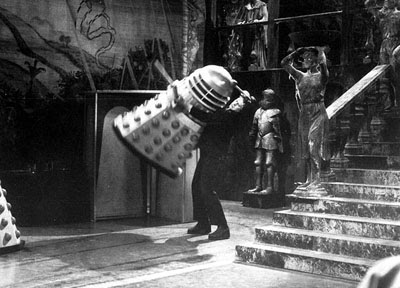
Terry’s worst Dalek moment from one of his worst Dalek stories. I do find The Chase to be a fun romp, but still it sadly undermines the monsters menace quite a bit, and whilst there are many poor moments from the story, such as the Dalek forgetting his words, the Dalek crashing over the balcony of the Mary Celeste etc, the worst is definitely the Daleks getting beaten up by fun fair robots.

Its hard to describe how stupid this part of the story is. The idea of Dalek weaponry not working on attractions designed to scare kids is ridiculous.

Also the idea that these attractions can then rip a Dalek in half is even more ridiculous! One wonders why we didn’t ever use these robots in the many Dalek invasions of earth?

The Daleks of course reach an all time low when they run away from these robots chanting “embark, embark, embark, embark”. It reminds me of “run away, run away” from Monty Python and the Holy Grail.

Quotes

On the popularity of the Daleks in the 1960’s.

After the Daleks, I was for a short time the most famous writer on television. The press interviewed me, there was mail arriving in great van loads. There was stuff coming to my house that said ‘Dalek Man – London’, and I was getting lots of them. Almost all the kids wanted a Dalek, and nobody was quick enough. The BBC, not being the great commercial operator, wasn’t ready, so there was no merchandising, there were no plastic Daleks, there were no buttons, there were no anything. My God, was that to change! Within the year, there were Dalek everythings.”

On Raymond Cusick’s contribution to the Daleks

Raymond Cusick made a tremendous contribution, and I would love to be glib enough to put it into percentage terms, but you can’t do that. You start with something that’s a writer’s dream, that he’s put down in words, and amended, and added to in conversations. Something starts there. Cusick didn’t get anything, to my understanding. I think they may have given him a hundred pound bonus, but he was a salaried employee, and I think he knew the nature of his work, and it was what he did every week. The copyrights resided with the BBC and myself, and there were lovely legal words to cover these things, so that before they could merchandise anything, they had to have my agreement. I was very lucky. The salt cellar part is the legend: that gave Raymond Cusick the idea for the shape. He was restricted by budget, obviously – it wasn’t a big budget show we were doing. But yes, he made a tremendous contribution. Whatever the Daleks are or were, his contribution was vast.

On The Dalek Invasion of Earth

“You’ll recall that we killed the Daleks, so we had to use the logic that this was trillions of years into the future, and we could now go back in history and find out whatever they did. We had seen them in that city, and they could only travel in that city, so the next generation of Daleks had to have something attached to them. I thought if the menace could be brought to modern-day Earth, it would really make the Daleks supreme in the minds of the public; actually bringing them in so we could see them crossing London Bridge, we could see them coming out of the Thames, that was the idea.

You don’t kill off Carole Ann Ford! Didn’t she marry, or meet someone? That was ‘happily ever after’ and off we go again.”

On Dalekmania vs Beatlemania

They were so hot at that time, you couldn’t avoid The Beatles. I remember with great pride that the commercial channel was running the Beatles when they were really at their peak, at the same time as a ‘Doctor Who’ episode with the Daleks, and ‘Doctor Who’ got the ratings. I was pretty pleased with that.”
On David Whitakers interpretation of the Daleks.

I didn’t like ‘Power of the Daleks’, and I responded very badly to them. The Daleks were something that I understood better than anybody else. It appeared that they were simple robots, and all you’d have them do was say ‘Exterminate’ and you’d have it made. They were very much more complex in the way they should be presented. I didn’t like David’s episodes, where he had them being very sweet, and very polite; that seemed totally alien to me. This is not to say that they were not good episodes; this is just my personal opinion.

Join me tomorrow when I will be looking at David Whitakers take on the Daleks and how it differed greatly to Nations.