
(This article is from a friend of mine named Laurence Buxton. I have decided to showcase some of his writing here. Let me know what you think, and enjoy.)
DOCTOR WHO. SEASON 18 REVIEW. By Laurence Buxton 2019.
Season Credits : –
Produced by John Nathan-Turner
Executive Produced by Barry Letts
Scripts edited by Christopher Hamilton Bidmead
THE LEISURE HIVE
Written by David Fisher. Directed by Lovett Bickford
Plot
The Doctor and Romana cut short a less-than-successful holiday on Brighton beach and decide to head to the famous Leisure Hive on the post-apocalyptic planet Argolis. They soon find themselves caught in a political powderkeg, where the natives are at risk of being manipulated to sell the Hive by a breakaway group of their mortal enemies the Foamasi. Meanwhile a militant young Argolin, Pangol, is looking to use the power of the Hive’s Generator, tweaked by the Earth scientist Hardin, to form an army of doppelgangers to destroy the Foamasi. The Doctor must not only convince the suspicious Argolins he is not behind a sudden murder in the Hive, but find a way to reverse his accidental rapid ageing and to prevent all-out war breaking out between the Argolin and the Foamasi…
‘The Time Lord’s looking his age all of a sudden – is the party over for Doctor Who?’
Review
Following the popular, if shortened and rather frivolous season 17 ( after shooting of the troubled Shada production was finally abandoned ) few could have expected the massive changes that Doctor Who, under the stewardship of JNT and Christopher Bidmead, would incur. With the departure of producer Graham Williams and script editor Douglas Adams the undergraduate humour that had begun to slip in during s16 was firmly vewtoed, and so when the series reappeared there would be very little, apart from the continuing presence ( for now ) of Tom Baker and Lalla Ward on board the TARDIS, to link it to what had gone before.
Not since season 7, with the introduction of Jon Pertwee, colour TV and UNIT, had there been quite as many fundamental changes to the on-screen realisation of Dr Who. Gone was the time tunnel sequence that had been a staple of Tom Baker’s time on the show; gone too was the ghostly howl of the theme tune, to be replaced by a ‘travelling through the stars’ opening segment and a more haunting, phased and up-tempo ( often referred to as the ‘disco’ ) arrangement by Peter Howell. Both seemed to be aimed at dragging the series into the 1980s, and it only took a brief look at the sets and special effects in the trailers to realise that the standards of both had done the same.
Even more changes are clearly signified by the opening scene, ones which give a chilling notice of intent for a gloom-laden future for the season, and for the Doctor personally, especially when compared to the previous year’s. The knockabout first moments of season 17 (Destiny Of The Daleks) on board the TARDIS had seen a coughing K9 being teased by the Doctor about having ‘laryngitis’, whilst Romana casually tried on a succession of new ‘bodies’ and ‘styles of dress’ – the latter including Baker’s – with the Doctor sniffily passing judgment on each. In The Leisure Hive, the opening titles to part 1 are followed by a plaintive and wistful synthesiser score accompanying a very lengthy pan across a notably out-of-season, windswept Brighton beach – all flapping deckchairs and abandoned beach tents. The camera finally alights on the Doctor, alone, wearing a vampire-like variation of his famous outfit, and slumped as if dead with his hat over his face. Even the apparent attempts to inject humour into this startlingly forlorn scene with the arrival of Romana and K9 sit disconcertingly with the viewer (the Doctor’s apparent narcolepsy, K9’s ill-advisedly going into the sea to ‘fetch’ a ball for Romana, and exploding) and with their referencing of decay and death seem to bode ill for both the titular hero and his trusty metal dog in series 18. More of which in future reviews…
The Leisure Hive, a story rumoured to make wry comment on the declining status of the British tourist industry, is nothing if not convincingly brought to the screen, with a gloss and sheen that was then new to the production, with evocative shots of the planet’s surface. The directing and camerawork from Bickford is certainly distinctive, and with the use of editing the Foamasi come across as an effective menace, when depicted as shadows, claws etc. This effectively increases the tension levels through the opening episodes, where a breakaway group of the Foamasi (originally envisaged as a kind of alien Mafia) are breaking their way into The Hive. They are also, unfortunately, rather too portly when viewed properly to convince as being able to disguise themselves as humans (as with Julian Glover’s head being the ‘disguise’ for the Jagaroth in series 17’s City Of Death). Hence the close-ups and single-camera work used here by Bickford, who unfortunately ran over budget and was not asked to return to the program.
There are also a certain amount of pacing problems with The Leisure Hive, notably in the first half, where events such as the landing of Mena’s spaceship, and the aforementioned pan along the beach are perhaps allowed to run on for rather too long and test the viewer’s attention span before the story, let alone the season, has really got going. Another oversight is the moment where Hardin’s shifty financier, Stimson, is fleeing from a Foamasi and leaves his glasses on the floor which are promptly stepped on and crushed by the alien – whilst a suitable conveyor of the ill fate which is about to befall him. However the likelihood of him either not noticing or at least trying to retrieve them stretches credibility, and a more convincingly edited sequence would at least have shown why he did not try to get them back. Apart from what is shown from the later shots of the Foamasi, however, the costuming and casting in The
Leisure Hive are generally strong, and the political scene on Argolis is well-realised through the many conversations by the major players in the boardroom. The theme of characters such as Morix and Mena displaying their mortality ( through the ‘buds’ dropping off their heads and visibly dying as this happens ) links in well with the grim themes of entropy and decay not only in the Argolin world but season 18 generally, themes that set the season a league away from what had gone before in light-hearted stories like The Horns Of Nimon and The Creature From The Pit.
Other aspects of the production are more hard to fault. Peter Howell does the incidental music for The Leisure Hive, and he does a good job at initiating a very different, austere synth soundtrack for the season, a clear step away from what had previously been heard on the show. Howell also went on to score the likes of Meglos and though obviously varying from story to story, the haunting style of this background music adds much to stories such as State of Decay, Warrior’s Gate and particularly Paddy Kingsland-scored Logopolis. There is a balancing during the suspenseful and serious scenes of high-pitched drone and lower, clanking ominous sounds. The opening pan along Brighton beach is perhaps the most distinguished moment, however, the aforementioned mournful melodies finally lightening with the ironic burst of “Oh I Do Like To Be Before The Seaside” upon the glimpse of the Doctor. Nonetheless the underpinning of the action with pensive, minor-key synthesized motifs will form another navel-gazing element of a downbeat season.
It is noticeable that this more serious atmosphere is partly induced by the changes in the dialogue, which are certainly noticeable in this story – as well as the removal of Baker’s physical pratfalls of series 17 there are noticeably fewer wisecracks made between the Doctor and Romana, and the concentration is now on not only political but scientific wording : discussions hinge here on the likes of tachyon recreation generators, anti-baryon shields, and so on. This would gain the show criticism by some long-term reviewers for being rather distant and clinical, and for fans of David Tennant’s more recent portrayal of the Doctor there are no vague ‘timey-wimey’ style explanations here.
Not as accessible to a casual viewer as in the past, perhaps, but there are at least strong and more serious performances from most of the guest cast. David Haig, well-known now for playing comic supporting roles alongside Hugh Grant in the likes of Four Weddings And A Funeral and Two Weeks’ Notice, shines as the increasingly militant and deranged Pangol, convincingly developing the character from apparently good-humoured tour guide to hate-filled fanatic, and making his ultimate defeat suitably poetic. Adrienne Corri also puts in good work as the dignified and wise Mena, and Laurence Payne, who would go on to appear as the ambitious scientist Dastari in the Colin Baker story The Two Doctors , plays the short-lived Chairman Of The Board, Morix, who desperately wants to finish the negotiations over the Hive before his imminent demise. Nigel Lambert also has plenty to do as Hardin, and forms a trusting bond with Baker’s Doctor. There are also great cliffhangers to part 1 ( where the Doctor is apparently dismembered by the Generator ) and part 2 ( where the Doctor emerges from the machine prematurely aged ).
Following on from the notorious ‘commentaries’ which accompany the DVD releases, much has been made of the tensions between Tom Baker and other cast members this season, which, coupled with the apparent after-effects of an illness that he caught in Australia, bring a world-weariness to his performances that had been totally lacking in previous years. Coupled with the need for him to play an aged version of his character, complete with long beard and sad eyes, Baker suddenly seems far more subdued, less comic ( even the ‘arrest the scarf’ comment he makes on being accused of Stimson’s murder is glossed over ) and even when not aged by the machine his portrayal here comes across much more consciously autumnal – when K9 ‘dies’ from going in the water at the beginning he continues to snooze, remains seated during his conversation with Romana and falls asleep again before she has finished. The more mature, less garish and more stylised black and burgundy version of his ‘costume’, which Baker allegedly did not approve of, arguably adds to this sense of decline, as well as his occasionally gaunt appearance, broody demeanour and slightly greyer hair. On the issue of his superbly-realised ‘aged’ appearance after entering the Generator special mention should go to make-up artist Dorka Nieradzik, and Baker’s increasingly drained, wistful and desperate performance has garnished great praise, for all the rumours of bad behaviour on the set.
Then of course there’s poor old K9, with his original voicer John Leeson back in the fold. With his indisputable logic and lethal lasers, the ‘metal dog’ had been such a useful ally to the Doctor and Romana in the past, particularly in season 17, but here he’s pretty much sidelined in scene one after his dip in the Channel – a deliberate ploy from the new production team that would become a regularity until the character was written out later in the season. The character had been seen as too easy a way for the heroes to escape from potentially difficult situations, hence lessening the danger and heightening the humour, and so spends much of s18 being mistreated, repaired or generally being out of action. If there were such a thing as the ‘Royal Society For The Prevention Of Cruelty To Droids’, then they would have had a field day with the majority of stories in s18.
The Leisure Hive represents a dour new direction for Who under JNT and, more temporarily, Bidmead. Technobabble takes over from titters, longeurs from laughs, and the fact that the show struggled for viewing figures up against the more light-hearted sci-fi of Buck Rogers is perhaps not so surprising in hindsight. In fairness however the serial, whilst containing one or two costuming and plotting issues, and whilst rarely remembered as either a fun romp likeCity Of Death or a gothic masterpiece like Talons Of Weng-Chiang, did at least allow the show to develop
greatly away from the sometimes farcical tone of the previous show. It also establishes the themes that would, in some form or another, encompass the entire season.
MEGLOS
Written by John Flanagan and Andrew McCulloch. Directed by Terence Dudley
Plot
An old friend of the Doctor’s, Zastor, requests that he visit his planet of Tigella (one of two planets in the Prion star system, the other being Zolfa-Thura) to help investigate why the Dodecahedron (the source of their power) is fluctuating. The problem is compounded by the fact that their society is split into two tribes – the Savants, who have used its power scientifically, and the Deons, who believe that the Dodecahedron has been passed down from the god Ti. However, the TARDIS is trapped within a time loop by the last remaining Zolfa-Thuran, a cactus-like Meglos who has enlisted the help of some Gaztak mercenaries, led by the grumpy General Grugger and the impulsive Brotadac, and forces an Earthling to merge with him to enable him to take the Doctor’s identity. The Doctor needs to free himself and Romana from the time loop, stop Lexa and the rest of the Deons from launching a coup, prevent his own execution at Lexa’s hands and stop Meglos and the gaztaks making off with the dodecahedron.
‘A talking cactus, a devilish Doctor doppelganger – is Douglas Adams back on board?’
Review
After the serious introduction to the new season with the dramatically different The Leisure Hive, Meglos appears on paper to be a surprisingly quick return to the more whimsical, not to say fantastical style of storytelling of s16 and particularly s17. A talking cactus with aspirations to steal an immensely-powerful device and disguising itself as a diabolical double of the Doctor, whilst enlisting the help of a semi-comic selection of blundering space pirates. On the face of it, a return to the light-hearted entertainment of the show’s then recent past.
However Meglos touches on themes which had always been central to Doctor Who, in particular the battle between science and religion – here represented by the scientific Savants, led by Deedrix and the fanatical religious figures of the Deons, led by Lexa. This is slightly at odds with what could have been an unusually knockabout and daft adventure in the gloomy season 18. Inevitably the Deons are shown to be stubborn and struggle to listen to reason, though like the Savants ultimately their intentions are noble, and whereas in the past a race of scientists has not always managed to co-exist with others – note the strained ‘union’ between the Sevateem and the Tesh in the season 14 story, “The Face Of Evil” – at least there is a genuine chance of co-operation after the heroic death of Lexa and the destruction of the Dodecahedron.
Typical to the season, however, there are also themes of society being in decay and needing a revolution or change, and the attempted sacrifice of the Doctor by the increasingly powerful Lexa links back to rituals in stories such as The Power Of Kroll, where not only is such barbarism is shown as primitive, xenophobic and closed-minded, but the Dexans’ increasing dominance actually allows the pirates to make off with the Dodecahedron. Once again the Doctor arrives at the correct time, as unbeknown to the Tigellans Meglos is launching a plan that will take advantage of the Time Lords’ friendship with Zastor, and curiously it is Meglos’ abuse of the Doctor’s privileged position that, having threatened his life, allows him to bring down the threat to the fractured society and help it develop.
In fairness the suspicion of the Doctor is on this occasion understandable, due to the very convincing impersonation by the human-melded Meglos, even though it is never really explained why the villains needed to go to all the trouble of obtaining an apparently random human earthling was needed for this rather than a local Tigellan. It is also not convincingly explained how Meglos performs many of his actions in this serial, from the shrinking of the dodecahedron to the piloting of the spaceship, to the sealing the doors shut to prevent the Gaztaks from looting the ship, to the notorious ‘Chronic Hysteresis’. not to mention how the character is able to give the appreciative Brotadac the Doctor’s coat for good keeping.
On the subject of the titular villain, Tom Baker surpasses himself in the role of his own adversary, contrasting nicely even with his now more subdued – and occasionally grouchy, note the opening scene in the TARDIS – Doctor. Having already proven his ability to play an ‘evil’ version of the Doctor by briefly doubling as his robot imposter in “The Android Invasion”, Baker is asked here to play both the Doctor and the main villain for most of the story, and in doing so provides it with its ‘draw’. Baker steals the show every time he is on-screen as the villain, whether roaring “I am Meglos!” at Karris, shouting “Patience!” at the excitable but dim-witted Brotadac or coldly stating, “We mustn’t disappoint the Tigellans” to his co-conspirators, upon first appearing to them and the viewers in the Doctor’s guise. The actor’s excellence keep the strange premise grounded, and provides the unusual but excellent cliffhanger to episode 1.
Baker is great too at subtly enhancing the Doctor’s softer, warmer qualities when he pretends to be the disguised Meglos in return. The spiky green make-up for the actor as Meglos fights against the Earthling trying to exert his independence from him is excellent, and as on the Leisure Hive the production values are strong, including the scenes toward the stories’ climax where the Doctor and Meglos are locked away together as there is not the usual superimposing problem of having the same actor on screen twice. Indeed the two characters are immediately personally distinct in every way, which again stands as a compliment to Baker’s ability, even it renders the obvious subterfuge on the viewer less convincing than expected – there’s rarely a moment of doubt as to which ’version’ of the Doctor is which. Still, whatever criticisms Baker had of the changes made to Doctor Who for his last season, the first two stories in particular give him a great chance to play outside the normal constraints of the Time Lord’s character.
Unsurprisingly then it’s the lead actor’s show, but there are other strong performances. Lalla Ward is given plenty to do as Romana – note her curious reaction in the opening scene in the TARDIS when Baker states “First things first – but not necessarily in that order”, and it’s good to see K9 get a serious run-out after his ‘cameo’ in the opening scene of The Leisure Hive, though the metal dog is no sooner repaired than he runs out of power and is demeaningly kicked by Grugger. Stand-out among the guest cast is the surprise return of former Who star Jacqueline Hill (a rare case of an actor/actress who had portrayed a former companion, in her case Barbara Wright, returning in a guest role), giving a three-dimensional performance and instilling some genuine debating skills into the character rather than portraying her as just a two-dimensional ranting religious zealot – she even heroically lays down her life for Romana. Crawford Logan and Christopher Owen are also committed as Deedrix and the ‘possessed’ Earthling respectively, although Bill Fraser’s role as the grumpy, blustering Grugger is something he had by now been rather typecast in, after similar roles in comic films alongside the likes of Frankie Howerd. Though intended as mostly comic relief, Frederick Treves is mostly as annoying to the audience as the coat-obsessed Brotadac as he is to his fellow schemers, whilst Edward Underdown’s Zastor sadly fails to convince as any kind of leader even before his attempted deposing by Lexa.
Again the production values are more convincing than in then recent years : Meglos’ spaceship is clinical but convincingly high-tech, and the contrast between the white of the Savants and the red attire with black headgear of the Deons is simple, but striking. Perhaps for budgetary reasons the dodecahedron is shielded from the audiences’ view whilst still in its larger form, however, and its underwhelming ‘detonation’ at the end, to the chagrin of the squabbling villains, is a rather throwaway ending to the serial. There is also a fairly unconvincing sequence at the end of episode 2, where Romana is chased and apprehended by the Gaztaks, led by a shrill and rather unthreatening Brotadac, and once again the production team’s attempts to convincingly recreate the surface of a vegetative world look over ambitious, although it is still far from the worst ever seen on the show.
Peter Howell handles the incidental music for the story, and for the most part does very well at supplying apt atmospheric touches to different occasions and situations – the eerie rattle musical cue for Meglos immediately grabs the audience’s attention whenever he appears, which combined with Baker’s unblinking and stern-faced portrayal is the highlight of the serial. There is also the use of stately music in the early Debating Chamber sequences establishes the society well, and the increasingly fast-tempo use of ‘chanting’ vocoders in the sequence where Lexa is attempting to sacrifice the Doctor builds to a tense climax as the rope burns away.
There are also welcome touches of humour peppered throughout the tale, surprisingly for this more austere season, although fan reaction to these is often exaggerated due to the notable absence of comedy in the other stories. Furthermore, unlike the latter stages of the Williams era some of them actually seem to have been in the script originally, and those that do appear more improvised and natural are a little more tightly-edited and not allowed to get out of hand. That said, there are more unguarded moments that appear to have been allowed through – the previously mentioned one from Lalla Ward in the opening TARDIS scene, where she clearly winces, and one from a giggling Baker in the initial scene of the ‘time loop’. Other jokes, where Zastor chides Deedrix for being argumentative or during the Chronic Hysteris – which was itself widely criticised as being part of padding to increase the story from 3 to 4 parts – where K9 addresses the Doctor as Mistress, are dealt with in a more deadpan fashion that would have been the case in the past. The previously mentioned long-running joke about Brotadac’s obsession with Meglos’ discarded coat which he ends up wearing also works as a metaphor of changed identity, along with Meglos’ adoption of the Fourth Doctor’s persona, the fight for control of the Earthling and the spooky moment where the Doctor ends up facing his doppelganger. That comes immediately after the belly-laugh moment where the Doctor witnesses Meglos being winded and apprehended, opining “Ooh nasty – that could have been me!” before exactly the same fate happens to him seconds later. “Haven’t I seen you somewhere before?” states Baker upon facing his double, a sequence that briefly harks back to the ready wit and fun of the previous season.
But whilst not nearly as bleak as other season 18 stories such as The Leisure Hive, Warriors Gate or particularly Logopolis, Meglos also continues the former story’s theme of society stagnating, and the impasse between the Savants and the Deons in the opening debate being mirrored by the TARDIS crew being trapped by the Chronic Hysteris. The famous, endlessly-looping short sequence of comic events (the Doctor tripping over, Romana’s casual exasperation), which the crew escape by deliberately performing it out of turn, is regularly remarked on as a comment on the show’s former failings under the Williams era. It’s possible to imagine JNT and Bidmead saying Romana’s repeatedly circling opening groan of “Oh blast – here we go again!” to the previous season’s similar frolics, but here the sombre incidental music, and the way that Baker and Ward’s previously lightheartedness changes to real concern at the possibility of being stuck in it forever, makes the threat more unsettling than comic. This feeling is reinforced when a serious-faced and malevolent Baker subsequently appears as the transformed Meglos has been criticised for having a lightweight conclusion, and the comments are valid. Overall, though, is still a very enjoyable adventure in the classic Doctor Who mould, with generally strong acting and with its less downbeat mood it breaks up the more weighty stories that make up season 18, and one featuring a very impressive dual role from the still impressive Tom Baker. The next three stories, making up the E-Space trilogy, would see a return to a more thematically-rich style of storytelling.
E-SPACE TRILOGY
FULL CIRCLE
Written by Andrew Smith. Directed by Peter Grimwade
Plot
The Doctor tries to take the reluctant Romana back to Gallifrey, but pass through a Charged Vacuum Emboitment. Despite the scanner showing that they are on their home planet, they have actually landed on Alzerius, containing people whose origins are from another planet, Terradon. There is a schism between the crew who wish to take off in the Starliner (led by Three Deciders) to return to Terradon and a band of outcasts who reject the oligarchy of the Deciders. When the Mistfall descends, strange Marshmen start to emerge from the swamps, and spider-like creatures start to hatch from eggs that have come from the Riverfruit that make up part of the colonists’ diet, and the outcasts take refuge on board the Starliner which puts the crew at further risk. As well as trying to prevent Romana from devolving when she is bitten by a spider the Time Lord tries to discover what the connection is between the the spiders, the Marshmen and the crew, and just how long they have been preparing to leave Alzerius…
‘The Doctor and Romana immediately regret entering E-Space – and on top of Adric there are Marshmen for them to deal with, too…‘
Review.
It’s off into E-Space we go with the Doctor, for a trilogy of very different adventures : an evolutionary tale, a Hammer horror homage and an experimental mind-bender. Full Circle, the first of the trio, harks back in some ways to the ‘sympathetic monsters’ and moral dilemmas of early Pertwee-era Who, despite the higher production values and extra sheen. Furthermore it adds an extra twist to the genre as well as another element of variety to an already varied season, with the revelation that the Marshmen, and the Marshspiders before them, are ultimately the same race as the crew – and the circle of life will continue unabated unless drastic change is made.
Full Circle is the first story by the then 18-year old Andrew Smith, and it has to be adjudged a success, never gaining cheap criticism over the years in the manner of either the ‘derivative’ vampire tale State Of Decay or the ‘overly-complicated’ or ‘baffling’ Warriors’ Gate, with Smith’s scripts proving remarkably multi-layered and mature for the author’s age. The story also succeeds in introducing the unlikely ( and unpopular ) future companion of Adric in a subplot, where the adolescent fruitlessly endeavours to prove himself to his brother Varsh and his friends in much the way that the Starliners’ crew try to prove to themselves that they are not trapped on Alzerius. This determination to gain respect would be a characteristic that, whatever one thinks of the character and Matthew Waterhouse’s performance, would define the character through to his surprise exit in the Davison years.
The atmosphere is definitely murkier than the more ‘straight-ahead story’ of the preceding Meglos. The idea of Mistfall clearly fills the locals with a sense of dread, and the spooky music during part 1, including electronic drums and pan-pipe style synths as well as the usual minor-key motifs, enhances the menace of the bubbling swamps. Moreover the Doctor himself is fairly slow to get to the scene, too late to save Decider Draith who is chillingly dragged into the swamp whilst accosting Adric. The idea of being locked away on the sterile Starliner for up to ten years is shown as being almost as much of a punishment as being left outside during the Mistfall, and the irony that the crew have never learnt to fly the fully active Starliner seemingly condemns them to their needless fate, the same as befell the previous 40 000 or so generations.
There are strong central performances to enhance the clever concept, too. Baker shows charming little flashes of humour: when he meets the Marsh Child “How odd – I usually get on terribly well with children!” or flashing the now-rare grin when the Deciders introduce themselves to him, “And I’m the Doctor!”, quiet inquisitiveness in the opening two episodes, his usual unpredictable reactions to events, one amusing telling-off of Adric upon a crowd of Alzerians emerging from the TARDIS, “What is this, Noah’s ark!?” and finally roaring his dismissal of the Deciders’ flimsy moral self-defence after the Marshchild’s death, “Not an alibi – Deciders!” make this another strong outing for his portrayal of the Time Lord. But it’s Lalla Ward who gets the plaudits this time, coming into her own away from Baker’s Doctor. Here we see Ward able to play a more assertive yet nuanced version of Romana – witness her cheerful admonishment of Adric for asking her to touch his wounded knee – acting despondently upon hearing that she is wanted back on Gallifrey, during the quietly intimate scene with Baker in her quarters on the TARDIS, or the scene where, with the help of Adric, she disarms Varsh and points the knife at him before calmly handing it back. But the piece de resistance is the moment where she gets possessed by the spider – just as Baker got to play against the preconceptions of the audience in previous adventures, here it is Ward’s turn, and she rises to the occasion.
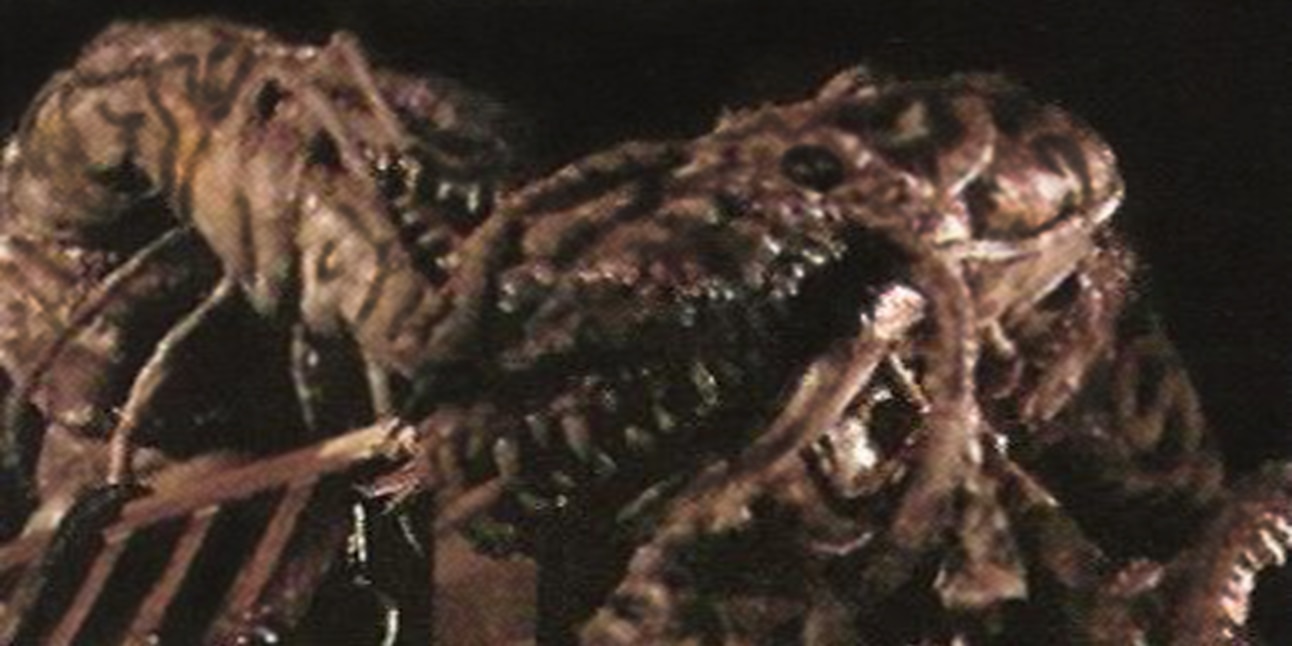
One of the accusations always levelled at the classic series of Doctor Who is that it contains wobbly sets and rubbery monsters, but here the season again defies this – if only to a point. The Marshmen arising from the swamp represent a dramatic (if unfortunately curtailed) climax to part 1, and the Marshchild comes across as a genuinely innocent and sympathetic character whom the audience immediately feels sorry for. As a contrast, however, the scuttling spiders are far less realistic, and Romana’s initial dismissal of them seems a more appropriate reaction than her subsequent terror. However the interiors of the Starliner are minimalist but effective, and the Inquisition chamber beautifully balances the black and grey décor with the gold of the Deciders, whilst the make-up for Romana’s ‘possession’ is also a winner.
One aspect of the production that becomes apparent from here on in, and would become an even more noticeable problem during Davison’s tenure as the Doctor, however, is the ‘costuming’ of some of the regulars. Whilst Romana here appears in a strikingly different red gold and white apparel as opposed to her ‘sailor’ outfit of the first two transmitted tales, the Doctor’s attire, though stylish, distinctive and more urbane than his previous ‘random collection’ of clothes, is by now seeming to be as much a ‘uniform’ as clothes of choice. Whilst Davison’s Doctor’s inflexible cricket garb and Colin Baker’s notorious multi-coloured coat when playing the role are worse intruders in this sense than the 4th Doctor’s’ burgundy outfit, JNT’s stating that this was for merchandising reasons only half-convinces, and has given rise to speculation that this was also an attempt to ensure that Baker played the Doctor as a dramatic part and not simply as an extension of the more comic side of his real-life personality. In any case, considering how many times the Doctor lands on a planet or spacecraft and is instantly threatened or ‘tried’ for a crime by suspicious individuals, coupled with the amount of clothing that we have seen on several occasions within the TARDIS, it makes little sense that he would now ensure that he or his companions would look even more out of place than usual, and therefore place themselves in immediate danger and hinder his investigations. In the near future, Adric’s off-yellow and grey ‘pyjama’ outfit becomes a particularly hideous example of this once he stows away on board the TARDIS, in this adventure.
On the subject of Adric, Matthew Waterhouse gets a great deal of bad press for his performance here as Adric, and his general attempts in the future at trying to display the character’s often contradictory qualities of intelligence and well-meaning kindness whilst being naïve and desperate to impress. Actually his performance in Full Circle is not too bad, displaying a pragmatic side (when he advises that Romana look outside the door rather than look for technological ways of surveying the surface of the planet), brief moments of burgeoning sexuality (the aforementioned scene with Romana), bravery (when he helps Romana fight off the River people), and ironically reacting more calmly and naturally to the Doctor than in later adventures. He still finds himself on the receiving end of a fair few Baker broadsides throughout the adventure, however, as does Romana, and commentaries on the E-Space trilogy box-set have proved rather candid on the deteriorating communications on-set at the time – such as Baker allegedly not looking at his co-stars during takes if riled. Perhaps more pertinently during his time on the show, the character’s occasional sulks or ill-considered wilfulness, such as one which indirectly leads to Decider Draith’s death, hindered his would-be allies and greatly alienated viewers, right up to the character’s final story.
Of the rest of the cast, Richard Willis impressed many as the more headstrong Varsh, by some way the best of the actors playing the Outlers and unfortunately casting a shadow over the appointment of Adric as companion, and the death of his brother saving his life would be rather glossed over for much of the mathematician’s time on board the TARDIS. George Baker is probably the best of the Deciders, although Leonard Maguire impresses as the ill-fated Draith. The musical accompaniment, like many this season, is of a high standard, particularly the Church organ-style music during the ‘Decider’ scenes on board the Starliner.
The subject of resistance to change, or an (in)ability to adapt is a key theme to Full Circle. The Marshmen are observed by Romana as adapting to their new environment quickly when she admonishes Varsh and the others; in contrast are the inhabitants of the Starliner, who in some cases show a struggle to develop without the Doctor’s assistance – take the scene where the three Deciders each expect the others to come up with a solution to the Marshmen invasion. There is a neat moment where the Doctor remarks to Adric that “we’ve come full circle”, which his new companion remarks is what the scientists have observed – which can be compared with the Chronic Hysteris sequence in Meglos . Ultimately the two remaining Deciders are forced to make a decision on whether the Starliner stays and their race continues to go full circle or leaves, and evolves, and the fact that they depart Alzerius – albeit with a little prodding from the Doctor – provides the positive resolution to the story. Apathy is defeated, though the theme of stagnation and disinterest would again surface during the E-Space trilogy (Warriors’ Gate).
Full Circle is another strong story, well-directed by debutant Peter Grimwade and with plenty of opportunity for both Baker’s Doctor and Ward’s Romana to shine in a well-written script that disproves the addage that first-time or ‘fan’ writers cannot come up with the goods. The addition of Adric’s ‘boy genius’ to the TARDIS crew would allegedly cause ructions on-set, but the theme of change prevalent in the tale is particularly apt here – with the arrival of Adric, the process of change had begun of the crew themselves. By the end of the season the Doctor, Romana and K9 would all, like the crew of the Starliner, be gone…
E-SPACE TRILOGY
STATE OF DECAY. Written By Terrance Dicks. Directed by Peter Moffatt
Plot
Still trapped in E-Space The Doctor, Romana, K9 and the stowed-away Adric arrive on an unnamed planet. They are surprised to find that it is almost feudal, and note that the villagers are in fear of the ‘Three Who Rule’: elusive beings who dwell in a nearby Tower, and with the help of their guards, the Habris, seem to be behind the annual disappearance of a number of the younger villagers. Threatened by the Lords’ guards and the mysterious ‘Wasting’, the adventurers look to investigate the reason why the corpses of the missing villagers are drained of blood, whether the Three Who Rule and the Tower itself are linked to a spaceship which once landed there, and whether a long-standing enemy of the Time Lords could be behind the current state of decay…
‘It isn’t just the young stowaway on the TARDIS who’s’ proving a pain in the neck…’
Review.
“It’ll be dark soon” notes Romana towards the end of the first episode, and this observation highlights not only the ethos of the gloomy march to oblivion of season 18 of Doctor Who but more specifically the phobia of creatures that fear the sunlight. And the fact that State Of Decay is the title is something of an irony, as not only is the story about a society that has become something of a regression but the story itself is something of a throwback, being as it is a rewrite of an adventure initially intended to take place in the Gothic days of s15.
During the earlier days of the Tom Baker era classic monsters from film and literature had been the subject of homage successfully. His very first story (Robot ) was a tip of the hat to King Kong, and another of his earlier adventures (The Brain Of Morbius) was clearly inspired by Mary Shelley’s Frankenstein. So why not take the vampire legend and put that unique Doctor Who spin on it too?
Of course Gothic Horror such as The Brain Of Morbius had been successfully done during the Hinchcliffe era, and even when not featuring any kind of horror genre-related villain, it had been a defining feel of early Tom Baker stories such as series 12, 13 and 14. Indeed, an early form of the serial had been submitted by Terrance Dicks back in 1977 during the Hinchcliffe era called The Witch Lords, and was intended to open series 15, but due to a clash with a BBC adaptation of Bram Stoker’s Count Dracula the claustrophobic, lighthouse-based story Horror Of Fang Rock (which was perhaps even more horror-inspired) was commissioned instead. With hindsight, then, one can see such a story fitting in well to that period of Tom Baker’s tenure.
The title and theme of State Of Decay slot more appropriately into this entropy-obsessed season, however, and encapsulate the general theme of societies in decay, decline and regression. The Doctor’s conversation with Camilla and Zargo in the second episode highlights this, as does his subsequent chat with Romana where he deduces that the vampires are the original crew of Hydrax, and that the ‘throne room’ was once the spaceship’s control booth. The planet is clearly in a state of devolution, obvious from the scene where the Doctor talks of ‘consonantal shift’ explaining the changing of the Three That Rule’s names over a great period of time and the fact that the control room is now a throne room, and from the moment the villagers produce communicators and other hi-tech devices yet, as in Full Circle, are unable to explain what ‘the Wasting’ actually is. Once again, such self-destructive traditions and fears are questioned by the Doctor upon his arrival, and by doing so he prevents a society from stagnating – ironically causing the literal ‘wasting away’ of the Three That rule when he slays the Great Vampire.
Another theme that rears its head is the easiness of waiting for things to improve rather than taking risks to ensure that they do. The scene where Tarak, Kalmar and the others argue in the dwelling highlights a theme that was particularly noticeable in the previous story, Full Circle, where the crew of the Starliner showed an unwillingness to learn how to launch a perfectly functional Starship, actually sabotaging it to avoid doing so. Kalmar admits he is prepared to put off any revolution for several generations if necessary, and apart from Tarak the others agree that it is ‘too soon’. The acquisition of knowledge is seen as the greatest power in a society like theirs, as Camilla remarks to Zargo, and this is backed up by Tarak’s remarks to the others about the importance of the Doctor. It is no coincidence that Aukon comes across as the most knowledgeable of the vampires and is also effectively their leader.
The planet is realised onscreen as largely a plush and convincing environment, and the ‘covering up’ of high-tech equipment among apparently mediaeval settings is convincingly done, enhanced by the sometimes occasionally archaic incidental music, whilst accentuating the spooky threat of the vampires. The use of location filming during the first episode gives the chance for a surprisingly relaxed-looking Doctor and Romana to stroll through genuine flora at dusk, and the moment where the bats (aka ‘The Wasting’) bite the Doctor and fly over them could be straight out of a classic Hammer film. The superimposing of a bat over Aukon during episode 1 shows a stylised touch which previous Who had rarely attempted, and is a memorable image which removes the need for stilted information dumps. Clothing-wise the more stylised, two-tone black and burgundy Baker fits in perfectly here, of course, despite seeming a little more chipper than at certain other times this season. There is an ominous moment the moment we first see the Doctor in the TARDIS, however, where Romana is concerned at his pained expression, which seemingly doesn’t bode well long-term for this incarnation of the Time Lord. Baker’s Doctor had always been famous for almost cheerfully enduring physical pain in early stories like Arc In Space, or dealing with being menaced by monsters in tales like Nightmare Of Eden in farcical fashion – not any more.
Adric has a rather strange adventure here, however, showing ‘Artful Dodger’-style cheekiness (which was originally how the character was envisaged), but his inward and easily malleable nature makes him less than sympathetic. Within moments of being caught entering the villagers’ dwelling he is helping himself to their food and their son’s coat, though with hindsight it’s a shame that he didn’t continue to wear this more natural looking garment during his time on the show instead of his horrendous yellow ‘pyjama’ outfit. Furthermore the Alzerian later displays turncoat-style behaviour in apparently acquiescing to become like the Lords, and gives an unconvincing explanation to Romana about fooling them into a false sense of security. Whether due to Waterhouse’s performance or a conflicting script, Adric’s behaviour during this adventure never convincingly comes across as anything other than self-serving, even though he does eventually attempt to slay Zargo towards the end of the tale as the Time Lord and Lady are threatened. This portrayal of the character contrasts with the more plausible attempts he made to help the Doctor and Romana in his debut story Full Circle. K9 finally gets to have a less battering adventure of his own here, a rare event this season, and delivers a cutting summary of Adric in the TARDIS upon discovering the stowaway – “Immature humanoid – non-hostile.”
Characterisation is generally inconsistent in this story, sadly. Ivo, head of the village, shows equally unfathomable motives throughout, going from acceptance of any uprising to betraying it. This is unfortunate when the humans are clearly shown to be the oppressed and disadvantaged peoples of the planet, ruthlessly preyed on by the Lords. More appealing by far is Arthur Hewlett as Kalmar, with his quiet subversion evoking memories of Timothy Bateson as Binro the Heretic in the Key To Time adventure The Ribos Operation, and Thane Bettany as Tarak, who in contrast to his peers shows the charisma and the bravery to defy both the Three Who Rule and the once loyal villagers who now serve under Habris and his guards. On the subject of the Lords, Emrys James is imposing and entertaining as the dominant Aukon, though his dominant performance does reduce Rachel Davies’ Camilla and William Lindsay’s Zargo to the role of hissing, bickering sidekicks whenever he is present.
There are other quite noticeable flaws. The on-screen realisation of the Great Vampire is a disappointment almost on the scale of the Skarasen in Terror Of The Zygons, and the rocket going straight up and then straight back down to pierce its heart, is poetic but truly corny. The use of blood as ‘fuel’ over such a long period of the time raises the simple question of why has it not evaporated or gone bad, being organic, not to mention the fact that the planet’s population now seems extremely meagre for them to continue plundering. Considering how the peasants’ society has regressed over time it is surprisingly easy for the Doctor to get them up-to-speed with the high-tech equipment, and it is equally surprising they have not destroyed or thrown it out once it became useless to them. It is also difficult to work out what the ‘perks’ of becoming a guard are, as the Three That Rule still threaten to feed them to the great one upon the slightest failing, and show no concern when informed that they are dying.
State Of Decay is not perfect and with its use of hypnotism, mind-reading and other vampire cliches, seems a little out of place in a season heavy on science, but it remains a stylish story even today, for sure, and though criticised for being something of a derivative horror story given the Doctor Who treatment, it is nonetheless watchable and reinforces the themes of the season as directly as any of the stories without being too heavy-going. Those who criticised the story for perhaps lacking much under the surface or for being too simple would soon see the flip-side of the coin…
E-SPACE TRILOGY
WARRIOR’S GATE
Written by Stephen Gallagher. Directed by Paul Joyce ( assisted by Graham Harper )
Plot
At the point where N-Space and E-Space meet, a time-sensitive Tharil named Biroc escapes from a slaver cargo vessel holding others of his kind, and hijacks the TARDIS which, like the slave vessel, has become trapped there, near a gateway. He warns them that the slavers are following him and that they cannot be trusted. The Commander of the slaver ship, Rorvik, is determined to recapture Biroc who has been navigating them, and is becoming increasingly irritated at both the entrapment of his ship and the rest of his crew’s apparent disinterest in escaping. The Doctor will need all of his wits to investigate a mysterious gateway and an abandoned banquet hall nearby, utilise a number of mirrors which provide passage for time-sensitive aliens, avoid the threat of the malfunctioning Gundan robotic knights, rescue the captured Romana from Rorvik who believes her to be time-sensitive too and intends her to replace Biroc, and prevent both the slave ship from diminishing the Gateway into nothingness and its captain from misjudging the power of the mirrors and destroying everyone…
‘Who knew E-Space could get so complicated’?
Review.
One of the fascinations of Doctor Who, particularly in its’ ‘classic’ days, was the sheer range of its types of storytelling, and s18 had already encompassed this – a sly satire on the culture and holiday business ( The Leisure Hive ); a fantastical ‘villain with delusions of grandeur’ tale ( Meglos ); a pacifistic and environmentally-aware precautionary tale of evolution ( Full Circle ) and a homage to the horror genre ( State Of Decay ). With the 5th story to be released chronologically, however, season 18 went one stage further, with a bizarre tale of time-travelling reformed aliens, cruel and listless humans, mysterious mirrors and mystical castles, which showed influences from sources as diverse as Jean Cocteau, Stanley Kubrick, C S Lewis and Mervyn Peake.
Warrior’s Gate , though utterly distinct from either, ranks with The Mind Robber during the Patrick Troughton era and Ghost Light during the McCoy era as one of the most experimental serials in the show’s history, featuring concepts that would baffle any first-time viewer. Furthermore, faced with the need to convincingly wrap up the E-Space trilogy (which had had little bearing on the previous adventure other than the Vampires had fled there to hide from the Time Lords), return the Doctor to N-Space and plot the departures of both Romana and the now long-suffering K9, it would need to include a convincing reason why they would choose this moment to depart. Not only did the writer succeed in doing this, and expanding on the themes of season 18 as a whole, but they managed to create a world like no other in the Doctor Who canon – the Tharils, the mirrors, the gateway, the abandoned hall, the shrinking dimensions and the time winds are all strikingly original, to an almost daunting degree when all are presented at once.
Once again the Doctor finds himself faced by a pseudo-tyrant, in the form of the blustering and impatient human Commander Rorvik, “We’re back in nowhere” mutter the crew near the beginning of the story, and this sums up the quandary they find themselves in, and Rorvik’s desperation to escape. In typical series 18 fashion it is not so much the prospect of death but that of being trapped or regressing which seems to breed even greater apathy and fear of action in both the time-sensitive Tharils (represented most strongly by the noble yet enigmatic Biroc), who are clearly being mistreated and even killed, and their new masters the privateer crew. The theme of devolution is present in the Tharils once being masters but now being slaves, and that of apathy is evident not only in their failure to rebel until the Doctor and Romana arrive, but also in the crew who show little urgency to escape E-Space, although their inertia is not wholly condemned by the fact that as the Doctor says to Biroc, “sometimes it’s best to do nothing, if it’s the right sort of nothing.”
In many ways it should be possible to have sympathy for the crew for the literal and metaphorical limbo they find themselves in, despite the casual cruelties they inflict on their former masters. “Nowhere to go and no way of getting there” remarks Rorvik sourly to the crew at one point, and they say nothing. In many ways the void the crew are in, trapped between N Space and E Space, reflects their state of mind. This sense of aimlessness then ensures that they remain trapped, their lack of personal progression being displayed in their concern with maximising their bonuses rather than escaping the void. Following on from the theme shown in the likes of Meglos of individuals failing to evolve and going round in circles (the Chronic Hysteresis), and the same thing happening to societies in The Leisure Hive, Full Circle and State Of Decay, Warriors’ Gate takes the extra idea of the oppressors becoming the oppressed – with the Tharils having been defeated by their then ‘inferiors’ rising up and defeating them with the aid of the Gundans. The decay of the Tharil civilisation after that revolution ties in with the idea presented in State Of Decay, where the fortunes of the oppressed are actually declining the longer they allow the current state of affairs to continue.
“It’s always darkest before the storm” says the Doctor, linking to Romana’s comment about night being about to fall in the previous story, and though the murky huts, darkened ‘tower’ and gloomy wood of the previous story are stylistically completely opposite to the well-lit spaceship, white void and fantastical castle behind the Gateway, there is a similar underlying bleakness about this story. The Doctor himself seems to have developed something of a death wish, where he nearly pushes a button that would have destroyed the TARDIS in the first episode and recognises that chance is in itself not an explanation for what he could have done. When he faces apparent decapitation by the Gundans he seems, at times, strangely resigned to his fate, albeit cheerful when he is not ultimately killed. In fact this story could be seen as the ultimate encapsulation of the Doctor succeeding by being ‘passive’ – such as his aforementioned comment to Biroc, his tolerance of Biroc and acceptance of a logic which is alien to him and finally his opposing of Rorvik’s rashness in trying to escape E-Space, even though it is something the Doctor himself wishes to do.
Lalla Ward, generally considered to have steadily improved as an actress since her initial Doctor Who appearance as Princess Astra in The Armageddon Factor, puts in one of her finest performances, and so whilst her departure at the end to stay with Rorvik in E-Space has been signposted – both by her comment in Full Circle to the Doctor and her earlier remark to Adric that she and the Doctor may soon be going their separate ways – it is a curiously rushed scene when she and K9 depart, with the Doctor’s comment, “You were the noblest Romana of them all” standing in sharp contrast to the increasing discord that Baker and Ward’s relationship was going through at the time. As for poor K9, after his more dignified treatment in State Of Decay he’s back to being abused with a vengeance here: overheating, running out of power, getting kicked and thrown away all in the same story. To literally add insult to injury he is even belittled by Adric! It’s difficult not to see this constant belittling of the character as being alienating to the children who were intended to be his fanbase, and for the character’s sake it is good to see his suffering end as the Doctor orders him to stay with Romana and the Tharils.
Surprisingly in such a ‘puzzle within a puzzle’ story, characters such as Aldo and Royce provide effective and accessible humour, and the two succeed in grounding what could have been a grim and incomprehensible story with some down-to-earth observations and their general laissez-faire attitude, and their cowardice only goes further to ensure that they will not escape from the gateway. Kenneth Cope puts in as reliable a performance as ever as the more level-headed, no-nonsense Packard, the perfect foil to Clifford Rose’s irascible Rorvik. Even Rorvik himself is not a stereotypical villain, however, as his frustration is understandable when surrounded by the apathy and counter-productive attitude of the crew, and the fact that he causes his crew’s death by the hot-headed action in trying to blast away is an irony in a season where inaction is often seen as the worst thing to do. As he himself remarks caustically to the Doctor “I’m finally getting something done!” It is a bleak conclusion to a tale where all the humans
are apparently killed in the inevitable blastback, regardless of whether they agree with Rorvik’s rash but understandable action.
Warrior’s Gate is undeniably complex. Whilst well-made with remarkable effects and brimming with intriguing ideas its mixture of mind-bending science, surreal fantasy, satirical comment and comments on self-destruction, slavery and cycles of oppression make it unlikely to top a fan’s favourite poll, and it is certainly a story that requires more than one viewing due to its density. It is also not only the end of the E-Space trilogy but the end of another era for the Fourth Doctor with the departure of long-standing companion Romana and the even longer-standing K9, and with Adric now the sole companion on board the TARDIS the Doctor prepares to return to N-Space – where an old enemy awaits…
THE KEEPER OF TRAKEN. Written by Johnny Byrne. Directed by John Black
Plot
The Doctor and Adric return to N-Space and are visited on the TARDIS by the aged and infirm Keeper Of Traken, who states that he has perceived a great evil within his potential successor Tremas and his family – wife Kassia and daughter Nyssa. Although Traken is a planet where decency is paramount, the arrival of an evil life form, calcified on arrival by the essential ‘goodness’ of the planet and now known as the Melkur, leads to the mysterious deaths of a number of citizens which are blamed on the Doctor and Adric. The Melkur has also taken control of Kassia by means of a collar, and is manipulating her in order to become Keeper himself and gain access to the source. Who is the Melkur, and why do they wish for control of the source?
‘Anthony Ainley makes his Doctor Who debut – and there’s barely a cackle in sight…’
Review
With Tom Baker’s time on board the TARDIS now drawing towards an end (it was during the filming of this serial that it was announced on the BBC that the Liverpool-born legend would be leaving the show), Season 18 continues its remarkable range of different adventures with the almost Biblically-themed Keeper Of Traken. And for the role of the snake in the garden of Eden, there can be only one long-standing adversary of the Doctor to fit the bill – the Master.
The tale of Traken is ultimately especially grim, of course, as the Master – the real force behind the evil, calcified Melkur – manipulates the people of the ‘utopia’ of Traken to not only ascend to the throne but to steal the body of the wise and open-minded Tremas, who seemed to represent a better, more astute future for Traken, and ultimately to lead to its destruction in the following episode. The corruption and destruction of the planet by the satanic Master (note the number of references to not looking into the Melkur’s or the possessed Kassia’s eyes) would of course go on to form part of a similar plot of the David Tennant story, “Utopia”, carried over into the following two episodes which concluded season 3 of the new series. Here, however, his ultimate aim is to obtain a new, healthy body, the audience being deliberately misled to think that his aim is universal domination and Jacobean-style revenge on the Doctor – though with the now more malevolent than ever Master, neither of those motives are far away either.
The season’s themes of entropy and decline cast a shadow over Traken from the beginning of the story, in the image of the dying Keeper in the TARDIS, the initially unexplained death of the old man in the grove, the notion of the Melkur immediately being pinpointed as an all-pervading evil corrupting the ‘absolute goodness’ of Traken; the still hideously-wizened figure of the Master, skulking in the Melkur and reaching out to seize the body of Tremas (an anagram of Master) in the very final scene, and the ominous fact that the clock’s hands on the Master’s newly-disguised TARDIS in that scene are at five to midnight, boding ill for the final story in the series. Curiously there is also the theme of rebirth and change after a low period, as evidenced by both Traken and the Master’s restorations by the end of the story – a theme which becomes evidenced again in Logopolis through the Doctor’s own fate.
Whilst the behind-the-scenes documentaries have often pointed the finger at Tom Baker being less than satisfied in s18, he seems calm here, and at times quite warm towards Waterhouse. In the opening scene he discusses the wonders of N-Space to Adric and even puts his arm around the young Alzerian, and shows the full array of the 4th Doctor’s emotions – humour, bafflement, empathy, grace, brief indignation, a tendency to ramble and absent-mindedness, along with a greater awareness of his incarnation’s limited timespan. “I know that feeling” states the Doctor when the aged Keeper makes a remark about feeling his age. Although Baker is clearly looking older he puts in a lively performance here, getting his famous humour into his performance when captured. “I wonder what we’ve done this time”, he whispers to Adric, and ponders aloud to his captors if they are the welcoming committee and knocks two of his opponent’s heads together with the obvious but effective quip, “two heads are better than one”. Yet he also enhances the threat of Melkur where he admonishes Tremas for wanting to keep his honour intact rather than give him the master plans so he can help save Traken.
Intriguingly the other more recent theme that had come up in Season 18 : that of changing one’s course of action rather than simply keeping the status quo not always being for the better (in Warrior’s Gate) is again referenced here, with the consul’s willing adoption of Kassia as the new Keeper proving as ill-thought out as Rorvik’s suicidal decision to try and blast free of the Gateway in the previous story. Unfortunately the combination of the apparently ‘nice to each other’ Traken peoples being generally extremely suspicious of outsiders and willing to pass death sentences on even each other quickly may try the patience of those who are supposed to sympathise, whereas in Warriors Gate, of course, the ship’s crew were led by the stories’ main villain, Rorvik. One also has to wonder why the Traken people are so convinced of the Doctor and Adric’s ‘ultimate evil’ when unlike the Melkur they have not calcified upon arriving in the grove.
Anthony Ainley, who became so maligned for his occasionally OTT performances as the Master during the Davison era, has been uniformly praised for his rounded portrayal of Tremas in The Keeper Of Traken. His compassion, knowledge of science and shrewd good judgement helps him form an immediate empathy with the Doctor, and his decency is reflected in the warmth of his daughter Nyssa (played by Sarah Sutton) whose pure-heartedness contrasts greatly with the weak-willed desperation of Kassia, who has fallen under the thrall of the Melkur. Nyssa, who would soon become a surprise long-term companion on the TARDIS, has greater character development here and in Logopolis than in many of her subsequent stories with Davison’s Doctor, due to the more obviously personal effect that the Master/Melkur’s machinations have on her. Roland Oliver’s performance as the pragmatic Proctor Neman, looking at monetary gain for himself until his shock execution, is also impressive, though it is another indictment of Traken’s supposedly virtuous society that such a corrupt character has become so prominent. John Woodnutt is as entertaining here as the self-assured and seemingly politically-astute Seron he was in dual role of Forgay/Broton in Terror Of The Zygons , and even adds a touch more fruitiness to the role this time around, and proves his good intentions as he begs Kassia to reject the evil within her.
Even Adric’s many detractors confirm that Waterhouse is on good form here, too – forming an effective double-act with future co-companion Nyssa which mirrors the Doctor-Tremas partnership. Sheila Ruskin’s Kassia is more hit-and-miss, however. She is overly histrionic in the scene where following the Keeper’s death she denounces the Doctor and Adric as the culprits for the recent evils on Traken, even considering the Shakespearian tragedy that the character is central to – her love for her husband and wish for him not to suffer and playing into the Master’s hands. Geoffrey Beevers makes up for this, however, as the silkily-evil and Iago-like Master/Melkur, although as a downside the untreated voice of the Master lacks the echoing resonance of the Melkur’s, and is less effective as a result.
To complement the well-thought out society of Traken there is an appropriately-stagey (but well-realised) combination of Elizabethan-style sets from Tony Burroughs, with the right array of lighting to denote the time of day when outside, and though the grove does not look like anything other a set in itself, it is attractive and imaginatively designed, with the off-white form of the Melkur proving a strong, contrasting image. Roger Limb’s soundtrack, though not perhaps the best of the season, is steady and stately without being too intrusive, and the costumes etc, in a range of subdued reds, blues and greys, provide a society into which the Doctor’s flowing burgundy garb fits in well, though the same can hardly be said of Adric’s attire.
The Keeper Of Traken is one of the more consistently-highly rated stories from season 18, a dark scientific fairy tale with tragic overtones but without the tone of utter gloominess that pervades the following Logopolis. Though looking a little wearied Baker is back to his energetic, more spirited and humorous self, but the arising of the Master, the time on his TARDIS’ clock-face and the mentions of “time running out” during the story are an ominous portent for what is about to happen…
LOGOPOLIS. Written by Christopher Hamilton Bidmead. Directed by Peter Grimwade
Plot
The Doctor, alerted to oncoming danger by the ringing of the Cloister Bell in the TARDIS, decides to head to Earth to measure an original police box as part of a scheme to fix his chameleon circuit with the help of the peoples of Logopolis. However the Master has materialised his TARDIS on board the Doctor’s, and due to his psychotic tendencies the deaths of a number of Logopolitans, whose chanting of a series of complex numbers keeps the entire universe in check, interrupts the process and threatens the whole of creation with entropy. Robbed of several of its workers Logopolis decays dramatically, followed by the Traken Union, and the Doctor, Adric, Nyssa and accidental new companion Tegan Jovanka join forces with the Master to prevent universal annihilation. Can the Doctor’s old nemesis be trusted even now, however, and who is the strange ghost-like figure that keeps appearing?
‘A ghostly grim-reaper and a black-clad blackheart – is time almost up for the Doctor?’
Review
The curtain finally comes down on the Fourth incarnation of the Doctor after seven hugely successful years, in what is unquestionably one of the gloomiest stories in the canon of the series. As season 18 is not exactly a barrel of laughs even at the best of times, Baker’s forlorn face, the ultimate encapsulation of the entropy theme and the utterly desolate feel all make Logopolis seem a fitting season finale, if not necessarily a wholly-satisfying end to a once so jocular incarnation of the character.
It is Tom Baker’s performance that naturally takes centre-stage here, and Matthew Waterhouse’s constant questioning and repeating his phrases in the TARDIS during the earlier scenes has to be endured as a minor distraction. As in The Keeper Of Traken there is an initially warmer rapport between the two now Romana and K9 are no longer on the scene yet Baker looks tired, drawn and fearful throughout, in a manner never seen before even in this more sombre season, and before long he is snapping his impatience with Pertwee-like fierceness. Ironically one of the rare moments he smiles (apart from the brief flash of those familiar teeth as he suggests a tour to Earth to measure a police box) is as he lies ‘dying’ at the bottom of the Pharos research Tower. Thus even in death he achieves victory – even as the Master has achieved one of his aims (the destruction of the Doctor) the Doctor succeeds heroically in foiling the Master’s opportunistic attempt to seize control of the Universe. It also allows Baker to depart in a manner appropriate to his often larger-than-life legendary portrayal, after a season where the theme of decay seems to have had a quietening effect on his character too.
The idea of entropy comes to a head here, both explicitly – Baker directly addresses this in his first scene in the grove, noting the decay of the TARDIS, as does Adric to Nyssa, and entropy is openly discussed as Logopolis visibly decays, coupled with the more subtle but noticeable ‘decay’ of Tegan’s car – looking battered and getting a flat without the means to replace the tyre (the spare is flat too) – drawing parallels with the now inadequate nature of the TARDIS. Of course the universe’s peril from the Master’s ultimate plan seems to indicate the decay and destruction of everything, and the shrinking of the TARDIS in part 3, with the Doctor still inside, also foreshadows the ‘shrinking’ of the universe, as does the miniaturisation of the Master’s victims with his Tissue Compression Eliminator. This ties in with the downsizing of the Gateway in Warriors Gate, along with the shrinking power of the respective sources inMeglos and The Keeper Of Traken, and the forthcoming ‘death’ of the Doctor is cleverly referenced during the ‘mini-TARDIS’ scene as, trapped inside, he sees his companions looking down at him, desperately calling his name.
Logopolis has a wary standing amongst long-term fans, however, many of whom criticise certain plot holes, notably when the Doctor is in the TARDIS and debates ‘flushing out’ the Master in his own TARDIS, and the ending of the story at the Pharos Research tower, where the Doctor and the Master are supposed to be working together to prevent the utter destruction of what is left of the universe. Adric’s bafflement at block transfer computation, and at why the Doctor needs to go to Earth to find a police box in the first place, is understandable, too. The decision by the Doctor to flood the TARDIS has also been particularly condemned in such a science-heavy season as being deeply improbable, although it does fit in with the title character’s apparent death-wish, previously seen in Warriors’ Gate. The fetching of Nyssa from Traken is another such issue, as is the fact that the police immediately deduce that Vanessa and the policeman are dead, even though the only ‘evidence’ of this are two tiny doll-like figures – and one has to wonder who called the authorities in the first place. Finally there are the logistics of the Master’s deranged plan to hold the universe to ransom from on board the research tower, which bearing in mind that the authorities are still a factor is flawed in the extreme – one suggestion put forward by reviewers is that the Master might have been playing a cruel practical joke on the Doctor, which is made to look unlikely by his subsequent concern and panic when the Doctor goes outside to disconnect the cable.
Anthony Ainley’s performance here is a curious one, too, the actor following up his superb portrayal of the kindly, reasonable and honourable Tremas with a Master who, though bearing a general resemblance to that of Delgado’s, is altogether more psychotic and malevolent, and whose schemes are far less rationally-based. This is not Delgado’s ruthless yet oddly gentlemanly crook, nor is it the wizened, wraith-like figure of Pratt/Beevers, desperately clinging to the remnants of life and gleefully inching closer to rejuvenation. This is a character who as well as taking that extra silver of pleasure from the suffering of others, that Pratt and Beevers displayed, seems to have an almost impulsive, ever-cackling evil, one which if left unchecked would not only threaten his own life but the decay of the entire universe. If that weren’t enough, the Master then cannot help but threaten to continue the destruction of all life unless they subject to his will, and his giggling near-collapse at the delight of holding such power suggests total psychosis and a more unfocused megalomania than ever seen before from the character. The Doctor’s subsequent astonishment at this unhinged behaviour (famously exclaiming “You’re utterly mad!” when his nemesis makes his latest plan clear) is rather contradicted by his earlier comment to Adric. “He’s a Time Lord. In many ways we have the same mind.”
Davison’s initial trio of companions are all together by now, with the loud-mouthed Tegan becoming an occasionally reluctant and complaining presence on board the TARDIS. Janet Fielding’s portrayal of the character is notably at odds with the good grace of previous passengers, and the first scene where she screeches at Tom Baker for an explanation (and his pained expression as she does so) is a moment of surprise humour in a doom-laden tale. Despite the fact the character went on to become, like Adric, one of the more criticised companions in the show’s history, and despite the fact that her dialogue with Aunt Vanessa is rather clumsily geared at making sure the audience know she is a flight attendant – her emotional reactions to events – whether berating the crew of the TARDIS, talking openly to the Monitor about the joyless lives of the Logolopitans or learning of the death of Aunt Vanessa – provide some genuine, believability and humanity to a miserable and sterile story, though her costume is no better than Adric’s. Matthew Waterhouse’s performance, however, is sadly not as strong here as in the previous story, hectoring Baker’s Doctor repeatedly in the opening stages and his OTT greetings of Nyssa seem forced – almost suggesting a potential attraction from the former towards the latter, though any potential relationship which could have humanised the characters never did come to pass. On a positive note, John Fraser provides gravitas as the welcoming, dignified and ultimately terrified Monitor, conveying the scale of doom in part 3 as entropy overwhelms Logopolis.
The sets are again of a high standard. The Master’s TARDIS is a clever variation on the traditional model, with a devilish red tinge to the outer panels, and the cold, sterile sets for Logopolis, described by the Master as “a cold, high place overlooking the universe”, are well-lit and suitable for an austere story such as this. Paddy Kingsland creates an ethereal, haunting score, notably during the scenes where the Doctor first sees the Watcher across the road and later on the bridge overlooking the Thames, and this sets the mood for the gloomy adventure ahead along with the dignified incidental music when the Doctor first arrives on Logopolis. The chicken-guitar funk music where the Doctor, the Master and the companions are attempting to get into the Pharos tower is a little less successful, however, rather breaking the consistent mood of the story even bearing in mind that something more up-tempo was needed for the chase scene.
Finally, after the Doctor’s ‘life flashing before the eyes’ moment clinging for dear life to the tower, and seeing his old enemies – the Master, a Dalek, the Pirate Captain from The Pirate Planet, a Cyberman, Davros, a Sontaran, a Zygon and the Black Guardian – comes the regeneration scene on the ground beneath. There is a similar ‘run-through’ of his companions – Sarah-Jane, Harry, Brigadier, Leela, K9, and the two Romanas – looking down at him and calling his name as well as the present and correct trio, and an effective use of special effects (unlike the moment where the Doctor is supposed to be hanging from the tower, and the badly choreographed reactions of the companions who ‘watch’ him fall) where the Watcher, now revealed to be a transitional stage between the 4th and 5th incarnations of the Doctor, merges with him in a flash of green and then white light. “It’s the end – but the moment has been prepared for” gasps Baker, with a triumphant expression at odds with the Master’s apparent ‘slaying’ of him, before the fresh-faced Peter Davison sits up wordlessly in his place. The theme of change referenced here in the constant ‘regeneration’ of the Master’s TARDIS (and the Doctor’s attempt to do the same to his ), and the clearing of the decks (the jettisoning of Romana’s room) is complete, with the once-inconceivable changing of the lead actor.
Logopolis, then, gives Baker a memorable (if not always for the right reasons) send off. It is a sombre, doom-laden final goodbye for an actor in the part of the Doctor, who will probably always be remembered as its most popular. It does well in bringing the themes of entropy and decay which had seeped through all the stories of season 18 to the forefront and to a conclusion, and with the regeneration of the Master to compliment that of the Doctor (whose own instability would not be cured until the end of Davison’s first transmitted story Castrovalva), hinted at the show’s future, where the two’s fates would be as interlinked as they were in Pertwee’s day. Whether one approves of all the changes Nathan-Turner had made during the season, there was little doubt that the show which concluded with Davison now in the role of the Doctor had completely evolved to enter the 1980s.
THE END








 burrunjorsramblesandbabbles