My Favourite Dinosaur Novels

“Implacable November weather.  As much mud in the streets as if the waters had but newly retired from the face of the Earth, and would it not be wonderful to meet Megalosaurus, forty feet long or so waddling like an elephantine lizard up Holborn Hill.”

From Charles Dickens classic novel Bleak House. This was the first ever mention of a Dinosaur in any work of fiction. The name Dinosaur itself had only been coined ten years earlier by Richard Owen, but the beasts were fast catching the public’s imagination. This reference, like much in Dickens novels reflected what was going on at the time.

The very earliest Dinosaur novels that followed after such as The Lost World, Journey to the Centre of the Earth and The Land That Time Forgot would lay down the foundations for nearly every subsequent Dinosaur story across all mediums.

Since the heyday of Sir Arthur Conan Doyle and Edgar Rice Burroughs there have been many more exciting and ground breaking Dinosaur novels, such as Jurassic Park which helped to bring new and exciting theories about Dinosaurs to the public’s attention and changed how we viewed them.

I think that many of the greatest Dinosaur novels can help to show that Dinosaur fiction isn’t just something for children. Sadly many people tend to view having an interest in Dinosaurs as being childish, like in the American sitcom Friends for instance. The character of Ross Geller is frequently ridiculed by both the writers and the other characters for his love of Dinosaurs.

Stories like Journey to the Centre of the Earth, Jurassic Park and The Lost World meanwhile were written by among the most accomplished writers of all time. From Sir Arthur Conan Doyle to Jules Verne. Clearly these great literary minds didn’t see Dinosaurs as a childish subject.

The greatest Dinosaur novels are more than just fun adventure stories. They tackle subjects such as exploring the unknown, man’s destructive effect on the environment and tampering with nature as we will soon see.

This list will not be presented in any order of preference, as ultimately I found that I couldn’t pick my all time favourite.

Journey to the Centre of the Earth (1864)

The first novel to focus on prehistoric creatures. I wasn’t sure about whether or not to include this as technically there are no true Dinosaurs in it. The marine reptiles who attack our heroes are not actually Dinosaurs. Still I feel I have to include it in this list for a number of reasons.

To start with whilst creatures like Plesiosaurs may not technically be Dinosaurs, they are still often viewed as such in popular culture. Furthermore this was the first book to actually feature prehistoric creatures of any kind. Particularly those who lived at the same time as the Dinosaurs.

Also most importantly, Journey to the Centre of the Earth is essentially the template for close to every single Dinosaur story for the next 150 years.

It is the first story to revolve around a remote area on earth where prehistoric reptiles still roam. Whilst there are a few pieces of Dinosaur fiction that don’t follow this formula. Primeval, Jurassic Park, One Million Years BC etc. The majority do follow the basic premise of there being some little remote area on earth, a valley, a plateau, an island, an underground cave, where Dinosaurs, prehistoric mammals, Pterosaurs, Plesiosaurs, maybe even a tribe of proto humans and ape men or giant apes, still exist into modern day.

Sir Arthur Conan Doyle’s The Lost World and Edgar Rice Burroughs The Land That Time Forgot both follow this idea, except they moved the land of Dinosaurs to above the ground. Later films such as Gwangi and King Kong also stick to Verne’s formula beat for beat too.

Even the original Godzilla starts with this same premise, as Godzilla is shown to have come from a remote island where Dinosaurs still roam before he was mutated by an atomic blast.

There are even many other stories that revolve around the idea of Dinosaurs living in a land that exists within the Earth’s core. Edgar Rice Burroughs Pellucidar series which began with At the Earth’s Core as well as the Russian novel Plutonia are both among the most famous examples of the hollow earth subgenre.

Most Dinosaur stories are really just variations of Verne’s idea, though that’s not to do down these other works, as the variations ultimately allow them to stand out as classics in their own right.

It should be acknowledged at the same time that Journey to the Centre of the Earth was not the first Hollow Earth story either. Nothing is completely original, as just about every story has been done. All any writer can really do most of the time is just add a new variation to an old idea.

Still ultimately at the end of the day this novel is the forebear of most Dinosaur fiction, so in spite of the fact that there are no true Dinosaurs in it. (Only marine Reptiles and prehistoric mammals.) I still have to include it here.

The novel itself aside from its literary significance still holds up as a great adventure. Some critics have responded negatively to the fact that compared to Verne’s other novels, the science in it is rather dated. It has also been criticised for its very slow pace. .

Still personally I found it an enjoyable read right the way through. The scientific goofs don’t bother me as at the end of the day it is still science fiction. Plus whilst I know a bit about Dinosaurs, the same as any nerdy guy, I’m a complete scientific illiterate anyway.

Also I found the build up to their adventure at the center of the earth interesting as the three main characters, Otto Lidenbrock, his nephew Axel and their guide Hans are all very engaging.

Lidenbrock is a total hot head and the classic insufferable genius type of character like Sherlock Holmes (who he predates by about 20 years) taken to the utmost extreme. He actually locks his own nephew and maid in the house, and starves them until he can find a way to crack an ancient code! Despite this he is given a few moments that show deep down he does care for his nephew, in spite of his borderline psychotic behaviour towards him.

Axel meanwhile is a complete coward and utterly useless. In fact his bumbling almost kills the team and briefly strands them in the valley.

Hans meanwhile functions more as the straight man of the group and helps to balance out the two more extreme personalities of his companions.

The lost world of the story is intriguing as we don’t really know much about it. In later lost world stories we often get a complete image of the valley/island/plateau the main characters travel too. In King Kong and The Lost World we see the natives customs and even little bits of their history too. Peter Jackson did a whole fictional documentary about the history of Skull Island.

Here however it feels like we are only given little glimpses. On the one hand unlike Burroughs later Pellucidar series, Verne isn’t given a chance to really create his own unique little world in quite the same way, but on the other it does allow Verne to build up a more effective atmosphere.

When the main characters discover the remains of a large ape man they decided to avoid encountering one at all costs, which actually helps to make the creature more sinister.

For all we know it may have been a peaceful, even somewhat advanced creature that felt a kinship with the human explorers. Or it may have been a savage monster that would have ripped them limb from limb. The reader is allowed to build up an image of what the true beast could be like, and it becomes much more tense the knowledge that this large, mysterious creature could be lurking around any corner. For all we know it could be stalking the main characters.

Sadly Journey to the Centre of the Earth is not quite as remembered as some of Verne’s other works, but its impact on the genre is immeasurable. It has spawned a few adaptations over the years including 2 live action films, one in 1959 starring James Mason and another in 2008 starring Brendan Fraser.

Neither are particularly faithful to the novel, though both are still good movies nonetheless. The 2008 film does actually have genuine Dinosaurs in it too.

Overall a classic of the genre and the template for most Dinosaur stories.

Sir Arthur Conan Doyle’s The Lost World (1912)

From the creator of Sherlock Holmes, this was the first true Dinosaur novel.

The Lost World see’s Professor George Challenger lead a team consisting of Lord Summerlee, Lord John Roxton and Edward Malone to a plateau high above the Amazon rainforest where a variety of prehistoric creatures, as well as a tribe of human beings and vicious Ape men (who are at war with each other) roam. Challenger and his team help the natives wipe out the Ape men and later escape the Plateau with a Pterodactly egg. The egg later hatches in London, giving Challenger the proof he needs of his exploits.

Whilst Journey to the Centre of the Earth may have created the Lost World trope, this adventure perfected it. Far more aspects of this story pop up in future Dinosaur stories than from Verne’s novel. The tribe of humans, the giant two legged meat eating Dinosaur that stalks our heroes throughout the novel, and a creature from the lost world of Dinosaurs being brought back to a big modern city like London or New York. These tropes would all later re-appear in classic Dinosaur stories like King Kong, Gwangi and the Jurassic Park films.

Doyle’s Lost World is much more fleshed out than Verne’s. There are advantages and disadvantages to this. On the one hand there is less of an atmosphere and mystery about Doyle’s plateau, but on the other hand we do get more exciting Dinosaur sequences as a result, such as the Allosaurus’s attack on the natives village. The fact that we see the plateau in great detail also allows Doyle to explore a wider variety of ideas, such as how human beings would live alongside prehistoric beasts, how they would manage to tame them in some cases, yet also be completely humbled by the large meat eaters in others.

The natives are also given a very sympathetic and 3 dimensional portrayal unlike in some later adaptations of the novel, such as the Irwin Allen version in 1960 or other films with a similar premise such as King Kong. Whilst much of Conan Doyle’s work was of its time, it is true that he was a very progressive writer in a number of ways too.

He created one of the most memorable female characters in all of fiction in the shape of Irene Adler, who manages to be the only person to beat Sherlock Holmes. Another short Sherlock Holmes story by Doyle “The Adventure of Charles Augustus Milverton” features another female character who wins Holmes respect and actually kills the main villain of the story.

The Lost World similarly can be seen to perhaps be ahead of its time, in that the main characters are shown to have the utmost respect for the natives and their customs. The natives are also depicted as highly civilized and advanced.

A problem with the Lost World is that there perhaps are too few Dinosaur species in it. Allosaurus is the only meat eating Dinosaur to appear in the novel

In all fairness to Doyle however there weren’t that many Dinosaur species known when he wrote this book. Even Tyrannosaurus Rex though it had been discovered by this point, it’s fossils were not that well known.

Still Doyle manages to use his single meat eater in a variety of different ways. When our heroes first encounter the Allosaurus, the reader is given just a fleeting glimpse of how immense and dangerous the beast is, as the explorers are tormented by the sounds of the Iguanodons screaming in the dark.

This just helps to make Malone’s encounter with the Dinosaur in the jungle more effective, as Malone has to deal with a monster that slaughtered an entire herd of giants by himself. Doyle doesn’t just simply have the beast attack however. He builds up the terror gradually as Malone slowly realises he is being followed through the woods by the Allosaur.

Finally when the two Allosaurus’s attack the natives village Doyle show the reader how the Allosaurus truly is the king of the Lost World. The latter part of the book builds the natives who keep Iguanodon’s as pets, hunt Icthyosaurs, and wiped out the Ape men, as seemingly the dominant life on the plateau, yet they are ultimately just powerless against the Allosaurs as anyone else.

The attack on the village was always my favourite sequence from the novel, and surprisingly it is left out of almost all adaptations (except for the 2001 telemovie version, made by Impossible Pictures, the team behind Primeval and Walking with Dinosaurs.)

Another problem with The Lost World is that Edward Malone, the main protagonist is a bit bland. Lord John Roxton meanwhile is also at times a bit annoying the way he is shown to be perfect at everything.

Challenger and Summerlee make an interesting team however. They are almost like two squabbling brothers trying to constantly get one over on the other. It’s also nice seeing them eventually grow to develop respect and even something of a friendship over the course of their time on the Plateau. Though they never become close, the best they become is vitriolic friends.

Professor Challenger was actually Conan Doyle’s favourite creation, even more so than the great detective himself. Challenger is a brilliant character all around. He is cut from the same cloth as Sherlock Holmes in the sense that he too is a maverick genius who plays by his own rules, yet he is almost the complete opposite in every other respect. He is loud, short tempered, violent, boisterous, even physically he is an absolute tank of a man with a massive beard. There is one funny sequence where the leader of the ape men feels a certain kinship with Challenger because he resembles him so much.

Whilst Challenger may not have as complex a personality as Holmes, he still has a huge presence which does somewhat make up for Malone’s blandness.

The Lost World has been adapted more than any other Dinosaur novel across both film and television. Sir Arthur Conan Doyle himself even appeared in the first ever adaptation in 1925.

No adaptations have remained completely faithful to Doyle’s novel. A female explorer is always added for a bit of variety and also often to supply Malone with a love interest. This began with the very first adaptation in 1925. Roxton also tends to vary between being a hero, an anti hero and even in some cases an outright villain. Tyrannosaurus Rex also often takes Allosaurus’s place as the king of the Lost World too, whilst the natives are often presented in a much more unsympathetic light, though many versions have added a sympathetic native girl at least who helps to save the explorers. The native girl may even become a love interest of Malone or Roxton. The friendly female native first appeared in the 1960 Irwin Allen version and has been a staple ever since.
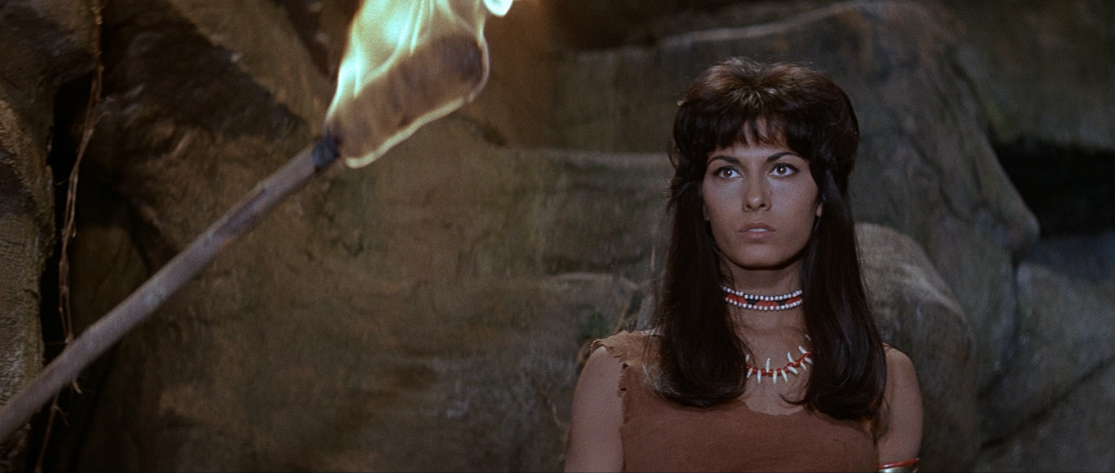
To be fair this character does have something of a small precedent in the book itself. Just before they leave the Plateau all 4 of the explorers are offered up wives by the natives, but they politely turn them down. Their proposed wives play no real role in the story however, but the idea of the explorers finding romance as it were on the Plateau is not entirely a deviation from Doyle’s story.

The most faithful adaptation of Doyle’s novel is arguably the 2001 tv miniseries produced by Tim Haines, the man behind Walking with Dinosaurs. This version stays close for the most part to the original novel and even has Allosaurus as the main Dinosaur. It also refreshingly portrays the natives as a civilised and advanced society rather than a group of vicious savages.

However once again there is a female explorer and whilst the natives are portrayed sympathetically, they do still turn on the explorers after Challengers actions accidentally cause the two Allosaurus to attack the village. The natives however seem to forgive Roxton who in a further deviation is left behind and marries the friendly native girl of this version.

The Lost World is to Dinosaur fiction what Dracula is to Vampire fiction. Its the quintessential Dinosaur adventure and one of the most influential pieces of prose ever written.

Sir Arthur Conan Doyle would be surprised to see the two women as well as the T-Rex’s on his plateau. 

Caspak Trilogy (1924)

The Caspak trilogy consists of The Land That Time Forgot, The People That Time Forgot, and Out of Time’s Abyss. All 3 have regularly been collected together in one volume, though they are also still released separately too. For the sake of this list however I have decided to list them as one story. I feel they work better as the one adventure.

The Caspak trilogy represents a somewhat grittier, darker take on the Lost World idea than either The Lost World or Journey to the Centre of the Earth.

The main characters do not choose to visit Caspak for the sake of scientific curioisty. Instead they become trapped there after their mission is sabotaged by a traitor. Furthermore the explorers do not all willingly work together either. They are made up of British, American and German soldiers from the First World War, who are forced together to survive, but who ultimately betray one another.

None of the explorers in The Lost World or Journey to the Centre of the Earth were killed either. They all made it back and were given happy endings to boot, where as in Burroughs trilogy, many of the main characters meet violent ends at the hands of the Dinosaurs and monsters they come across.

The darker more pessimistic tone of Land That Time Forgot can be seen to reflect the time this story was written when compared to the earlier classics. This adventure written not long after the first world war, and not long before the great depression reflects a more unsure, darker time as opposed to The Lost World.

In terms of the Dinosaurs there is a much larger bestiary of creatures, with Tyrannosaurus and Allosaurus making an appearance. Edgar Rice Burroughs was fascinated by Dinosaurs. Arthur Conan Doyle and Jules Verne merely had an interest in them, but Burroughs loved them so much he would write many books about the beasts. The second entry in the series however tends to focus more on the natives of the island. The second and third books also create a new kind of creature, a vicious winged humanoid known as the Wieroo, which is feared by many of the natives even more so than the Dinosaurs!

The Wieroo marks the beginning of a trend in future Lost World stories of introducing new, fictional beasts, which Burroughs would continue to a greater extent in his Pellucador series.

Burroughs also goes into much greater detail about his Lost World than even Conan Doyle did and he provides a full and proper explanation as to why it exists. Here evolution is determined by the location of the island and individual mutation. It’s a complicated process which Burroughs describes as such in Out of Time’s Abyss.

“All came up from the beginning. The egg from which they first developed into tadpole form was deposited, with millions of others, in one of the warm pools…. Down the warm stream from the pool floated the countless billions of eggs and tadpoles, developing as they drifted slowly toward the sea. Some became tadpoles in the pool, some in the sluggish stream and some not until they reached the great inland sea. In the next stage they became fishes or reptiles, An-Tak was not positive which, and in this form, always developing, they swam far to the south, where, amid the rank and teeming jungles, some of them evolved into amphibians. Always there were those whose development stopped at the first stage, others whose development ceased when they became reptiles.    Few indeed were those that eventually developed into baboons and then apes, which was considered by Caspakians the real beginning of evolution.   From the ape the individual, if it survived, slowly developed into the lowest order of man — the Alu — and then by degrees to Bo-lu, Sto-lu, Band-lu, Kro-lu and finally Galu. And in each stage countless millions of other eggs were deposited in the warm pools of the various races and floated down to the great sea to go through a similar process of evolution outside the womb as develops our own young within;

Burrough’s also even gives his Lost World a name Caspak, though it is known as Caprona by the explorers with Caspak being the name its natives give to it.

The Caspak trilogy is also notable for its strong female characters. Whilst much of the novel is still of its time in terms of attitudes to race and gender, Lys La Rue from Land That Time Forgot and the native girl Ajor from People That Time Forgot are both portrayed as strong, brave, resourceful and regularly save the main male characters lives.

Lysa is actually in some ways portrayed as being more competent than Bowen J Tyler. It is Lysa who not only figures out the identity of the real saboteur, but also singlehandedly saves the British crew from the Germans after they are captured in the opening part of the novel. She is also shown to survive the horrors of the island by herself for several days after she becomes separated from Bowen.

Burroughs generally tended to write more dynamic and interesting female characters than many of the contemporaries. By modern standards his female characters may be somewhat lacking, but still much like Doyle he tended be ahead of the curve in more ways than one.

Whilst the Caspak trilogy may not be Burrough’s best work, they are still exciting and engaging stories in their own right and a must have for any fan of Dinosaur fiction.

The three books were later adapted as two films for Amicus studios in the 70s, The Land that Time Forgot, People that Time Forgot starring Doug McClure.

Pellucidar novel series (1914-1944)

Whilst this is technically a series, ultimately much like the Caspak trilogy, I feel that the Pellucidar novels work better as a one long story. That’s not to say that the individual stories aren’t great in their own right, but still I find that when you read one it isn’t enough. You have to read another and another, so I am listing all the books together in this list.

Burrough’s has always been one of my favourite authors because I think he really had a talent for creating whole worlds that would spread out across many books like no other.

Most writers would usually only create one big fictional universe like J R R Tolkien and Middle Earth, but Burrough’s has many with Tarzan, John Carter, Pellucidar, Caspak and the Amtor (Venus) series. Though the Tarzan and Pellucidar series were actually linked via a crossover story, Tarzan at the Earth’s Core.

The Pellucidar series revolves around yet another land at the center of the earth where Dinosaurs and other prehistoric creatures still roam to this day, but it combines magical, fantastical elements with science fiction concepts.

Its much wilder than previous Lost World stories and features ideas like sentient Pterosaurs called Mahars, that are able to take control of people via mind control and kill their victims by forcing them to drown themselves. Best of all is a flying Stegosaurus that is able to glide through the air using the plates on its back in Tarzan at the Earth’s core.

Pellucidar takes the Lost World formula to a whole new level by filling it full of many fictional species of creatures. Previous Lost World stories had featured fictional creatures from the giant Ape man in Journey to The Centre of The Earth, to the Ape Men in The Lost World, to the Wiemoo in the Caspak trilogy. However all of these monsters were different in that they all had at least some basis in science. Pellucidar takes it to a whole new level by having actual supernatural creatures inhabit the Lost World.

From this point on most Lost World stories will often invent their own monsters as well as having regular Dinosaurs such as Skull Island with King Kong, the Savage Land in Marvel Comics with its various Dinosaur and ape men and even later versions of Sir Arthur Conan Doyle’s Lost World, such as the version in the 1990’s tv series that has everything from Dinosaur men, to Aliens from outer space, to Vampires!

The Pellucidar series had a massive influence on many subsequent works of fiction including H.P. Lovecraft’s At the Mountain of Madness. I’d also argue that it had an influence on subsequent adaptations of other Lost World stories too. The friendly native girl that often pops up in the later versions of The Lost World really has more in common with Dian the Beautiful from this series.

The full series consists of

At the Earth’s Core (1914)

Pellucidar (1915)

Tanar of Pellucidar (1929)

Tarzan at the Earth’s Core (1929)

Back to the Stone Age (1937)

Land of Terror (1944)

Savage Pellucidar (1963)

Surprisingly there have only been two adaptations of stories from the series. One film version of At the Earth’s Core in the mid 70’s starring Peter Cushing and Caroline Munro, and another television adaptation of Tarzan at the Earth’s Core which served as the pilot for a Tarzan tv series.

Raptor Red (1995)
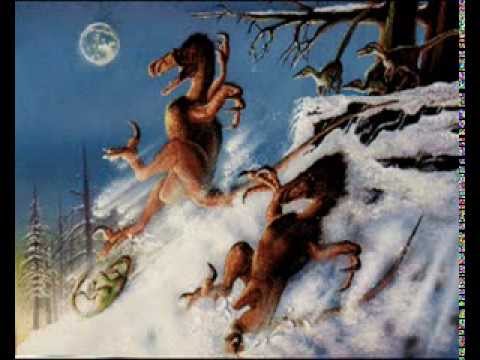
This novel was written by paleontologist Bob Bakker. It tells the story of a Utahraptor named Red and her attempts to survive after her pack’s death.

Its obviously written from a third person perspective. Think of it as being like Walking with Dinosaurs though it actually came a few years earlier.

The story despite being written by one of the worlds leading experts on Dinosaurs does take a few creative liberties with what the Dinosaurs could actually do.

Utahraptor for instance whilst being a formidable predator most likely would not have been able to kill a sauropod like it does in this novel.

Its quite an interesting change to focus on a predatory Dinosaur. Normally stories that feature only Dinosaur characters tend to focus on the herbivores like say The Land Before Time. The novel does quite a good job of getting us to sympathise with and root for what was one of the most dangerous predators ever to live on the planet!

I don’t know if I’d rate it quite as a classic but it is an enjoyable read nonetheless. Its fun reading about Dinosaurs frolicking in their natural habitat and running around without any damn humans getting in the way.

Jurassic Park (1990)

There are many reasons Jurassic Park stands out as the most acclaimed Dinosaur novel after The Lost World itself.

Obviously it has benefited in terms of fame from the fantastic film adaptation directed by Steven Spielberg in 1993, but still I think the novel can hold its own even without the film.

It’s not just another variation of the Lost World theme. That’s the problem with Dinosaurs is that as interesting as they are, there are only a few ways you can bring them back into the modern world.

Jules Verne and Sir Arthur Conan Doyle basically established the method to bring them back by having them survive in a little remote area, and after that you can tell it was hard for writers to think up new ways that weren’t just variations of that. Even Godzilla though a very different type of Dinosaur story still used that method to bring the titular Dinosaur into modern day.

Jurassic Park which had the Dinosaurs brought back by cloning broke the mould and in doing so was able to explore a new theme. Jurassic Park explores the idea of man tampering with nature, rather than exploring the unknown like The Lost World.

The Dinosaurs are almost like a prehistoric Frankenstein Monster turning on the people who created them. Whilst the ideas in the novel of Dinosaurs being brought back through cloning might seem far fetched, it might not be complete science fiction.

Jack Horner a leading Paleontologist (who worked on the Jurassic Park films) has in fact embarked on a project to clone a Dinosaur from a Chicken!

See here

Paleontologist Jack Horner is hard at work trying to turn a Chicken into a Dinosaur.

Crichton’s novels may still turn out to be somewhat prophetic!

Of course it should be said that Jurassic Park was not actually the first novel to explore the idea of Dinosaurs being brought back by cloning.

Carnosaur by Australian author John Bronson revolves around Dinosaurs being created in the modern day through cloning, and it predated Jurassic Park by about 6 years. Now I have not had a chance to read Carnosaur yet so I am afraid I could not include it on this list, though it sounds brilliant.

Having looked at its synopsis it appears to be more of a comic book type of story about a mad professor who plans to have his Dinosaurs repopulate the earth. Not that I am holding that against it, but still I think this is where Jurassic Park establishes its own identity in that it sees people try and capitalise on the new scientific discovery instead.

Still its interesting seeing how nothing is original. Even something as ground breaking as Jurassic Park has a precedent.

It would be funny to think that at some point in 1990 this might have happened to Michael Crichton after he sold his novel to his publisher, and was talking about this great new idea he had of Dinosaurs being brought back by cloning to his friend at the local store; only for the person behind the counter who was a fan of Carnosaur to give him a dressing down like this. It could also have happened to Edgar Rice Burroughs when he talked about his new idea about Dinosaurs living at the center of the earth called At the Earth’s Core, and a fan of Journey to the Center of the Earth told him off.

Maybe Skinner shouldn’t have given up on Billy and the Cloneasaurus after all?

Another great thing about the way this novel portrays its Dinosaurs is that it actually tries to make them seem like real animals. Jurassic Park helped to bring what at that time were many ideas and theories about Dinosaurs that weren’t widely known to the public’s attention, such as the idea that some Dinosaurs may have been warm blooded and that birds evolved from small meat eating Dinosaurs.

The Dinosaurs in this novel are fast, quick and as realistic as they can possibly be.  There are still a few gaffes however. Most famous of all is that Velociraptor is depicted as a 6 foot tall killer capable of disembowling a human being with its sickle like claw. In reality Velociraptor was the size of a turkey. The reason for this was because at that time Velociraptor was considered a member of the Deinonychus family, a much larger group of meat eating Dinosaurs, but this has since been disproven.

Still the book did more than simply use Dinosaurs for thrills and escapism. It tried to teach its reader about them.

Finally the Velociraptors also helped to make a break from the usual Tyrannosaurus/Allosaurus giant meat eater. The T-Rex still got a look in, but the Raptors gave us Dinosaur enemies who could fight you indoors, sneak up on you, even in some circumstances outwit you. The way they killed you was also more gruesome too. With a T-Rex and an Allosaurus its at least over in just one quick bite. With the Raptors its a horrific, painful, drawn out affair as they slice your guts open and eat you alive!

The novel does have some key differences with the film though I won’t reveal what they are so as not to spoil it for people who might only be familiar with the film. It’s a classic piece of entertainment in its own right every bit as much as the film and I can’t recommend it enough.

The Lost World (1995)
The only sequel that Crichton ever wrote to one of his books. This is not as strong as the original. Really I’d say that there is as big a gulf in terms of quality between the first and second books as there is between the first and second films.

However don’t think that means I dislike the book. I happen to still love the second film too by the way. The Lost World doesn’t really add to the point of the first film. It’s plot is really just a collection of Dinosaur attacks.

That’s not to say it isn’t still a page turner of course. The Dinosaur attacks are very exciting and creative such as the Carnotaurs that have camouflage abilities or the Tyrannosaurus Rex’s smashing the trailer over the edge of a cliff ( a scene that was later used in the film), but again whilst its a good read it doesn’t really feel like it has much else to say from the first book.

It bares very little similarity to the film. In fact the only scene from the book that is in the film is the T-Rex vs trailer scene. It could be argued that Spielberg’s film borrows as much from Conan Doyle’s Lost World as it features the idea of a Dinosaur being brought back to civilisation from Doyle’s novel. Really Spielberg’s film is like a hybrid of the two Lost Worlds.

When I first read the book it was like reading a completely new story. I’d say that the book is at places more of a character piece focusing on how Ian and Sarah survive on the island than the film. Definitely worth a look, but not quite the classic the first Jurassic Park is.

Thanks for reading.

Allosaurus in Popular Culture

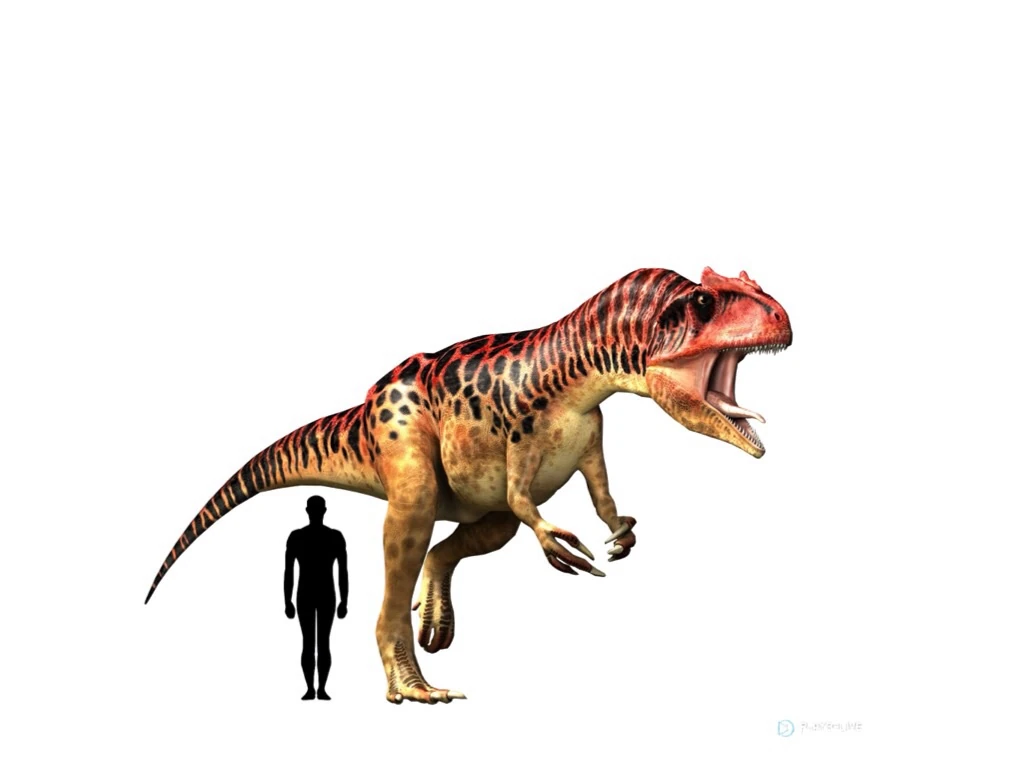
Allosaurus is probably the most represented giant meat eating Dinosaur in popular culture after Tyrannosaurus Rex.

At one point I’d say that it was the second most famous Dinosaur of all time, but in more recent years it has been replaced by other Dinosaurs such as Velociraptor and Triceratops.

Still it does have a fairly large body of work behind it and in this article I am going to explore its role in popular culture.

Sir Arthur Conan Doyle’s The Lost World

Allosaurus appeared in this novel as the main predatory Dinosaur.

It appears in three sequences. First it murders several Iquanodon’s in the middle of the night and briefly attacks the main characters before Lord Roxton chases it away with a torch.

It later chases Edward Malone when he is exploring on his own into a pit after which it abandons him. Malone theorizes that the great Saurians were practically brainless and that’s why it loses interest as soon as it can’t see him and heads off.

Finally two Allosaurus’s attack the Natives village when they steal two of their eggs. They kill dozens of them, destroy their houses and buildings until the natives manage to kill them with a barrage of poison arrows.

This sequence was always my favourite in the novel as it showed the reader just how vulnerable the humans were on the plateau.

Two Allosaurus’s very nearly destroyed the entire village. Up until that point in the novel it appeared as though the humans were at the top of the food chain on the plateau the way they hunted the Iquanodon’s, the Icthyosaurs and wiped out their rivals the Ape men, but this scene shows you how mankind are in Malone’s words only there on tolerance. A pack of Allosaurus could exterminate all trace of them in about 10 minutes if they wanted too.

The giant predator of the novel is never actually identified as an Allosaurus. Challenger only speculates that it is an Allosaurus, though Summerlise also says that it could be a Megalosaurus.

The two men admit that it could be any one of the great meat eaters and so I suppose its up to the reader to decide which one it is.

Still its often considered to be an Allosaurus most of the time so what the hell I’ll list it here anyway.

The Lost World (1925)

The first ever film adaptation of Conan Doyle’s novel (which he himself appeared in) featured Allosaurus as the main predatory dinosaur.

A Tyrannosaurus Rex appears too and is portrayed as the most powerful creature on the Plateau as it effortlessly kills a large Ceratopsian Dinosaur that mere minutes ago had gored an Allosaurus to death with its horns.

Still Allosaurus has more screen time. Only one scene is taken from the novel where it attacks the camp fire. One humorous moment see’s Roxton toss the torch into the Allosaurus’s mouth which makes it look like its smoking a cigar.

Probably the most famous moment in the film is when an Allosaurus pushes a Brontosaurus over the edge of a cliff.

The special effects in this film were supplied by Willis O’Brien who would later go on to provide the effects for King Kong in 1933.

Allosaurus was O’Brien’s favourite Dinosaur which is probably why he gave it a bigger role than Tyrannosaurus. Tyrannosaurus had only been discovered about 25 years before this film was released and as it was thought to be the largest meat eating dinosaur of all time it had completely overshadowed Allosaurus. So it was only natural that Tyrannosaurus would appear in the film.

Still O’Brien’s loyalty  to Allosaurus meant that he still got the bigger part.

The Beast From Hollow Mountain

This 50’s movie about Cowboy’s fighting Dinosaurs was made by Willis O’Brien. It originally began as a project called the Valley of the Gwangi, that would have seen an Allosaurus discovered in a valley alongside other prehistoric beasts be brought back to a Circus where it escapes and murders several lions, before being killed by being knocked over the edge of a cliff.

The project finally materialized as Beast From Hollow Mountain and bore very little resemblance to O’Brien’s original script other than them both revolving around Dinosaurs fighting cowboys.

No explanation is given as to how the Allosaurus is alive in modern day. It just shows up and starts eating people and cattle.

The film is still brilliant nonetheless. Its often regarded as one of O’Brien’s weaker films, but I don’t know why.

Its an interesting and original idea of merging the Western and giant monster movie genre’s. The beast itself is also an impressive monster. I like the way its fast. Normally the big Dinosaur villains in movies are obviously slow so its quite frightening and surprising when the Beast darts after the main characters. This is also actually more accurate too as Allosaurus could run at 35 miles per hour which is faster than any land animal alive today except for Ostriches, Horses and Cheetah’s. Thus it would easily be able to outrun a human being despite its massive size.

Its death sequence is also spectacular as we see the monster struggle and writhe as it sinks into the swamp. Like all truly classic monster movie deaths such as Kong and Godzilla’s deaths its quite moving in a way as the beast looks so helpless when it sinks.

The Animal World

Allosaurus appears in this film that was basically the 1950’s version of Walking with Dinosaurs. It attempted to tell the story of all life on earth and though it did try to be as accurate as possible, by today’s standards it is dated. It features many theories that are now often used as a by word for showing how little we understood Dinosaurs in the past such as the idea of Sauropods living in the water or Dinosaurs not caring for their young.

Still I find that its quite an interesting little time capsule much like the statues in Crystal palace of Iguanodon that help us to see how much our understanding of Dinosaurs has changed throughout the years. The dinosaur sequences themselves are also very well animated and too.

In all fairness there are aspects of Walking with Dinosaurs itself that are dated by today’s standards such as the idea of non feathered Raptors.

The Allosaurus is described in this movie as the precursor to the Tyrannosaurus Rex (though the two were not actually related, T-Rex in fact is much more closely related to modern day birds than it is to Allosaurus) and archenemy of the Brontosaurus. Brontosaurus doesn’t actually exist as what they thought was a Brontosaurus was in fact another specimen of Apatosaurus so this is another example of how the film is dated. By the time this film was made it was already known that Brontosaurus did not exist. Its name had simply become much more well known. To be fair it is a much, much better name.

Allosaurus only actually appears fleetingly where it menaces a Brontosaurus. The meat eater with the most screen time in the film is in fact Ceratosaurus.

The effects for this movie were supplied by Willis O’Briend and Ray Harryhausen, Obrien’s protege and friend.

One Million Years BC

Allosaurus appeared in this 60’s remake of One Million BC. This is a classic example of the remake being better than the original in pretty much every way. The sets, direction, the music, the acting and above all else the special effects supplied by Ray Harryhausen.

Allosaurus appears in a sequence where it attacks a tribe of cavemen. There are a lot of really creative and thrilling moments in this scene such as when the Allosaurus fishes the cave men who are swimming in the lake out, or when it corners a young girl trapped in a tree which is somewhat reminiscent of the scene in King Kong when the Brontosaurus corners a sailor up a tree.

Its probably a little homage as Kong was the film that directly inspired Harryhausen more than any other and there are little bits and pieces of it scattered throughout all of his work.

By far and away the most spectacular moment of the fight is when the main hero Tumak kills the monster by impaling it and actually lifts it off the ground before ramming a spear into its throat!

The Allosaurus sequence is one of the three most famous scenes from the film. The other two are when the Pteranodon captures Raquel Welch and carries her above its young, and the fight sequence between the Ceratosaurus and the Triceratops.

Often whenever you see Dinosaur documentaries mentioning how man and dinosaurs (except for Birds) didn’t live side by side you will see an image of Tumak fighting the Allosaurus with a spear. I must admit whenever I picture cavemen and Dinosaurs living together this is also the image that pops into my head first.

Gwangi

This Dinosaur western originally began as an idea by Willis O’Brien and was finally made into a movie in the late 60’s by Ray Harryhausen.

O’Brien did make a Dinosaur western in the 50’s The Beast From Hollow Mountain, but Harryhausen’s Gwangi actually followed the plot of O’Brien’s original idea more closely.

The main meat eating Dinosaur in the film Gwangi is often identified as an Allosaurus and O’Brien had intended him to be, but in truth he is actually a hybrid of Allosaurus and Tyrannosaurus Rex.

Harryhausen said that he wanted to incorporate elements from both meat eaters.

Though Allosaurus may look like just a smaller Tyrannosaurus the two predators were actually very different.

Allosaurus was faster than Tyrannosaurus. Tyrannosaurus meanwhile was far more powerful and intelligent. Thus Gwangi has the speed and agility of an Allosaurus and the big bite and intelligence of a Tyrannosaurus.

Harryhausen dubbed Gwangi a Tyrannosaurus Al, “Odd Lizard King”.

The Land of the Lost

A female Allosaurus named Alice appeared as a regular antagonist in this classic campy 70’s series about a group of explorers who fall through a portal into another universe where Dinosaurs still roam. She doesn’t pursue the main characters quite as often as Grumpy the large male Tyrannosaurus who is the main villain of the series.

Still despite this she is also the only creature in the series that Grumpy never bothers by and large, though the two do fight each other on a few occasions. Some fans however speculate that Alice and Grumpy are actually mates (which would make her child another T-Rex/Allosaurus hybrid)

Big Alice is also worshipped by the reptile men the Sleevaks whose eggs she protects in exchange for sacrifices (which at one point includes the main characters of the series!) They refer to her as Seleema.

Alice also appeared in the 2009 film remake of the series. Once again she is shown not to be afraid of Grumpy.

She gets killed however in a surprisingly gruesome way when the main characters toss a can of nitrogeon down her throat which freezes her and then causes her to explode.

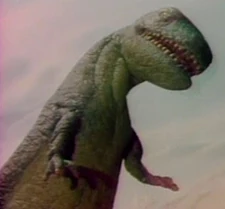
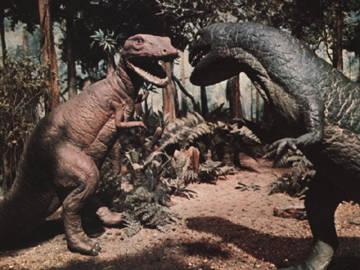
The 70’s Grumpy and Alice.

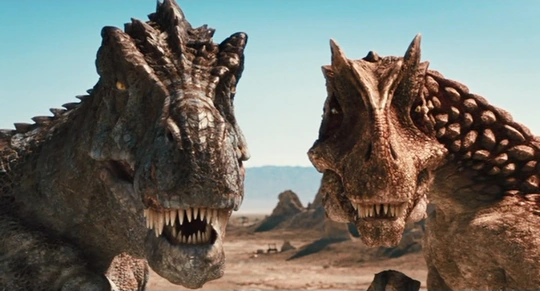
The 00’s Grumpy and Alice.

Walking with Dinosaurs

Allosaurus appeared in 3 episodes of this ground breaking BBC series.

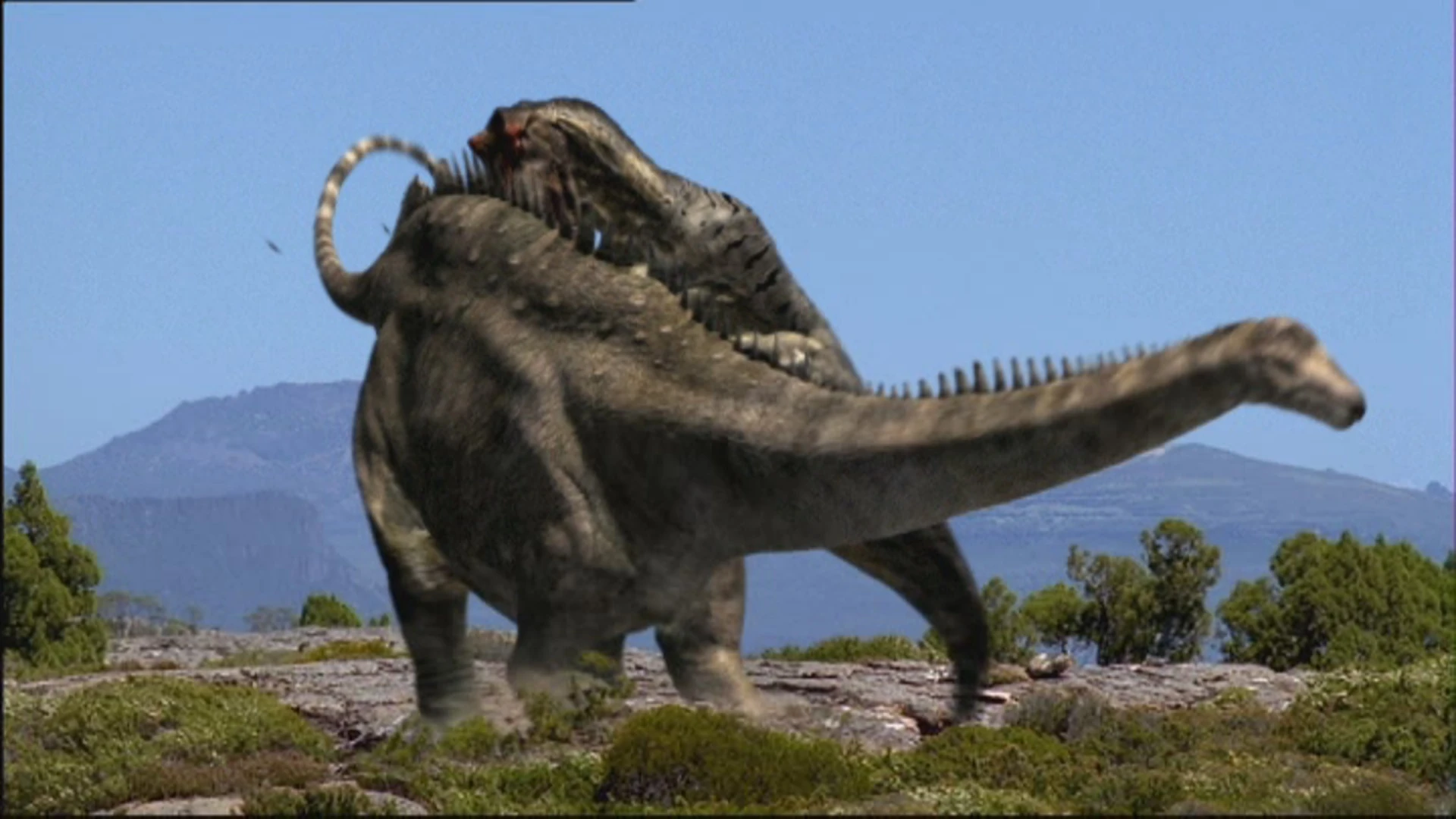
In Time of the Titans several Allosaurus attack the main protagonist, a female Diplodocus at various points in her life. The episode gives an insight into how Allosaurus may have hunted the giant Sauropods as we see the creatures use their superior speed and agility to leap through through the air onto their backs and hack at them with their hatchet like jaws.

There is also a memorable sequence of an Allosaurus confronting a Stegosaurus that uses its plates to scare the beast off. This is undoubtedly one of the most famous images from the series.

I always loved the design of the Allosaurus in this series. It looked fast, but powerful and the bright red crests on its head were very striking. I always preferred the Allosaurus in this series to the Tyrannosaurus.

In the fifth episode of the series “The Spirits of the Ice Forest” which is set during the Cretaceous period features a smaller relative of the now extinct Allosaurus which is simply referred to as a polar Allosaur.

This creature is not as big or as powerful as its Jurassic ancestor, though its still depicted as a dangerous carnivore in its own right and it actually manages to kill the main Dinosaur of the episode the female Leaellynasaura who it crushes in its jaws and then decapitates.

A young male Allosaurus is the main character in the Christmas special The Ballad of Big Al. This story was based around the discovery of a real life near complete Allosaurus skeleton that was nicknamed Big Al and attempted to try and tell the story of its life.

In many ways I think Walking with Dinosaurs helped to reintroduce Allosaurus to a whole generation of people. By the time this documentary came around Allosaurus had kind of fallen out of popular culture. Velociraptor and Triceratops had kind of taken its place. I think it was because people tended to see Allosaurus as just the second rate T-Rex.

Its a shame as Allosaurus is every bit as fascinating an animal as any other Dinosaur in its own right and in terms of story telling I think its quite a good mix of Tyrannosaurus and Velociraptor. Its big and can eat you whole like T-Rex, but its also fast and nimble like the Raptors and also like the Raptors it is also often depicted as living in packs.

Thus I think you can do a lot with it and I think this series which showed Allosaurus as a fast, strong, intelligent carnivore helped to break it away from just being the second rate T-Rex. I suppose this series was really its second big break.

The Lost World mini series

This 2001 BBC adaptation of Sir Arthur Conan Doyle’s classic novel starring Bob Hoskins restored Allosaurus to being the main villain of the story.

Produced by the same team behind Walking with Dinosaurs this is the most faithful adaptation of the novel ever made.

There are a few changes namely the inclusion of the character Agnes Cluny played by the lovely Elaine Cassidy in what was her breakthrough role and her insane father played by Peter Falk. These are more practical changes than anything else as naturally modern versions tend to include a female character to give it a bit of variety, whilst Falk’s character who strands them there is clearly designed to make Lord Roxton seem more sympathetic. In the novel its a man named Gomez whose brother Roxton betrayed on a previous expedition that strands them on the Plateau. Some versions have made this a much more important plot point and even turned Roxton into an outright villain, but this version makes him a dashing hero. At the end of the mini series in a further deviation from the book he stays in the Plateau and marries a native woman who he rescued from n Allosaurus. He also keeps an Allosaurus skull in their tent as a trophy!

All of Allosaurus’s sequences are taken straight from the novel. It attacks the camp fire and chases Malone (and Agnes) into a pit, though here it also falls in with them and becomes impaled on the spikes below. It also is shown to attack the village too (though here it is summoned by the Ape men who are kept prisoner by the humans)

This is the first ever adaptation to include the Allosaurus’s attack on the camp. I don’t know why as it always had the potential to be a spectacular sequence.

Tyrannosaurus Rex isn’t even mentioned in this film which is refreshing. As much as I like T-Rex (its my favourite Dinosaur) it is the main Dinosaur in just about every adaptation of The Lost World after Willis O’Brien’s original version. So its great to see Allosaurus back as the king of the Lost World once again.

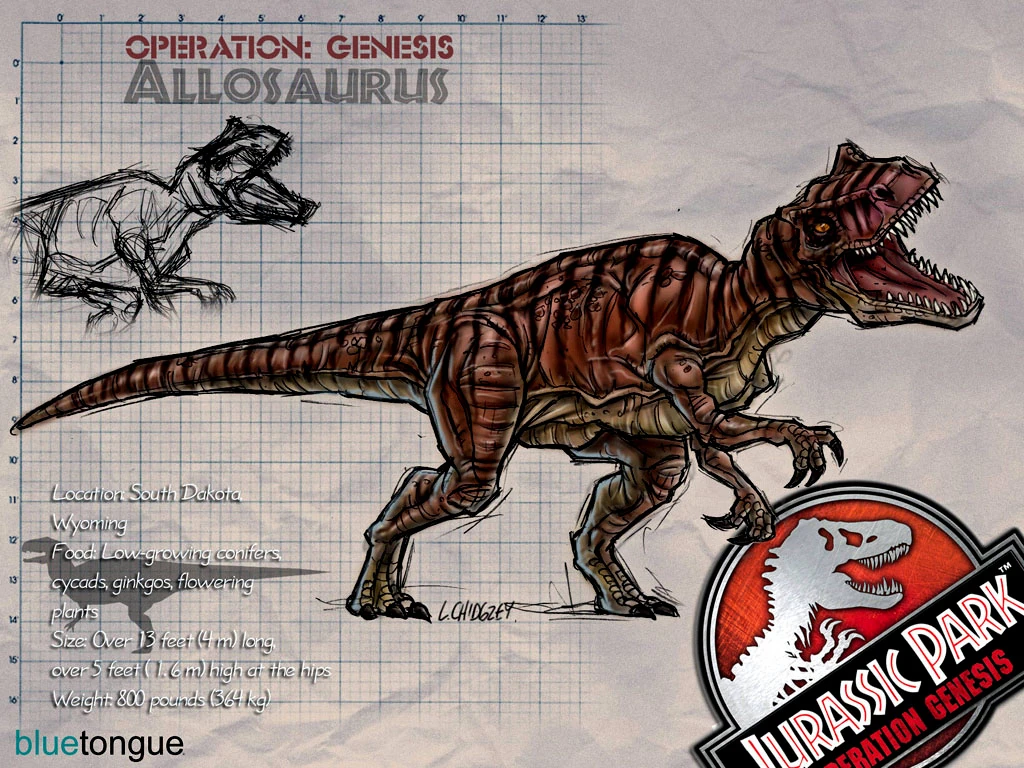
Jurassic Park Operation Genesis

Allosaurus appears in this game based on the Jurassic Park franchise. Its a shame that it has never appeared in any of the films even in just a cameo but at least it has been represented in the games.

The Allosaurus is a medium sized carnivore. It can’t take down the big predators, but it is still powerful enough to destroy vehicles and swallow visitors if it escapes in one bite. Its one of the most aggressive Dinosaurs in the park too.

Dino Crisis 2

Allosaurus appears regularly throughout this game. I think this game which has always been my favourite Dinosaur game makes use of the Allosaurus better than many other forms of media.

Here it is portrayed as a big and fast carnivore that travels in packs. It helps to stop it from just falling into either shooting endless crafty Raptors or running away from an unkillable T-Rex like in the first game.

The Allosaurus can pick you up in its jaws and thrash you around, though it can’t swallow you.You will first encounter one as Regina when you are trying to rescue Dylan. It makes its entrance by knocking a car off a cliff.

The best thing to do is shoot it at the side as its head is very heavily armoured.Also if you shoot at its head not only will you not kill it but it will piss it off until it goes bright red and feral. In this state it becomes twice as strong and fast.

You will encounter it at various points including one scene where you have to travel through a nest of Allosaurus’s where you will have to signal your partner to blow them up.

The Allosaurus also plays an important part in the plot when it kills Dylan’s best friend David. Poor David dies a heroes death as he sacrifices himself to save Dylan. Throughout the game Dylan blows the eye out of a Tyrannosaurus Rex and blasts dozens of Raptors yet its the Allosaurus that gets him in the end. I love the final crunch you hear as the Allosaurus tears him apart off screen. Even Regina whose seen more than her fair share of gruesome Dinosaur attacks can’t look at what happens to David.

Thanks for reading.

Ferne McCann as Amy Winehouse

It was recently announced that there will be a biopic based on the life of Amy Winehouse that will be directed by Kirsten Sheridan.

According to some rumours Noomi Rapace who is best known for starring in Promethius the prequel to the Alien film series will play Winehouse..

Now its early days yet and nothing has been confirmed. I have no problem with Rapace playing Amy. She doesn’t look like her, but she is still fairly exotic looking and she is a great actress too so I’m sure she will be great in the role.

Still for all I know its all a lot of smoke and Rapace isn’t even in the running. Until she is confirmed for the role then I see no problem with suggesting another choice for the part. That is if there is even going to be a film. Movies about Alex Harvey and Jimi Hendrix have been stuck in development hell for years so we will see how things go with an Amy movie.

Now my choice for Amy is Ferne McCann a reality tv star best known for appearing in The Only Way is Essex and I’m a Celebrity Get Me Out Of Here. She is also a host of this morning. I have never seen a single episode of TOWIE and I admit I have no real plans to, but I did see her on I’m a Celebrity. I even voted for her.

Now the reason I think Ferne would be good is that she really bares quite a startling physical resemblance to the late soul singer.

She has a very similar shape of face and mouth and her nose is very similar too.

They also have a very similar speaking voice too. I think that people who look alike often sound alike too and in Amy and Ferne’s case they have the same accents, the same mannerisms, expressions. Its quite uncanny.

Not to get off topic but its cool that John Hurt was one of the other guests on that show clapping Amy as she went out. 

You can see how Ferne certainly would look and sound the part. Also I think that perhaps she could somewhat relate to Amy Winehouse too as she does come from a similar back ground to Amy in that both are/were working class women from London who were somewhat more unusual, but still managed to shoot to fame anyway. Ferne also it seems sadly suffers from many of the same insecurities as Amy too.

Amy Winehouse was always very insecure about her appearance and in the last few years of her life she even wanted plastic surgery. She felt her nose in particular was unattractive and wanted to change it as you can see in this link below.

Amy Winehouse wants to fix her witch like nose

Ferne similarly has often spoken about how she would like to change her nose too and has come close many times to having an operation done to change it.

Ferne admits she wants to change her nose

I personally hope she doesn’t change her nose as I think she looks gorgeous the way she is and plastic surgery is never the option. Also her nose ironically I think is part of what makes her so beautiful because its so striking.

Any way getting back on track you can see how Ferne might be able to relate to Amy more so than say a big Hollywood actress would. The two of them were an odd combination of being quite strong and even strident in some ways, whilst very vulnerable and self conscious in others.

Now whilst Ferne may have many of the right qualities for the role the most important thing is can she act?

Well whilst she is best known as a reality star Ferne has recently moved into acting. She was cast as Myrtle in a west end production The Great Gatsby and she has recently won a role in a Hollywood film as well. So it seems that she must be a professional actress at least in order to get such high profile work. On top of that she can also sing too which would obviously be important for playing Amy! I sadly haven’t seen her in the Gatsby so I can’t comment on her acting personally but still whilst she may be at the start of her career in a few years time she could easily be a reasonably respected actress.

Remember Billie Piper was just a pop star, a faded pop star when she was cast as Rose Tyler in Doctor Who. After that part she went on to become a very successful and international actress.

So perhaps Amy Winehouse could be the role that launches Ferne McCann’s career.

Whatever the case I think Ferne should be considered for the role at least as she certainly does have the right look, voice and persona for the late Queen of Camden.

Edit Update

Since I wrote this sadly Ferne got a nose job. It thankfully wasn’t that extreme and she still does look great, but I really wish she hadn’t changed her nose as she was such a unique beauty the way she was.

If you are reading this Ferne please, please, please do not change anything else about yourself. You are gorgeous just the way you are.

Despite her surgery I think Ferne still looks like Amy. Here is what she looks like post her nose job.

She still looks amazing and I think she would also still be a good match physically for Amy, particularly the Frank era Amy.

Thanks for reading.

What If Dan Dare Had Been Adapted As A Television Series In The 60’s

Dan Dare has never been adapted as a live action series. There have been a number of radio adaptations over the decades and there is even another audio series scheduled for release this year, but sadly the Pilot of the Future has never really had that big a life outside of the comic book medium.

In this article I am going to explore what might have happened if there had been a Dan Dare television series in the 60’s. Who could have played Dan, The Mekon, Digby, who would have written for it, how would the series have tackled bringing to life the terrifying monsters, impressive spaceships and bizarre planets to life?

Pretend that the subsequent review fell through a portal from an alternate universe where Dan Dare was adapted to tv in the 60’s.

History

In 1965 Britain was in the grip of Dalekmania. Nobody could have predicted the success of Doctor Who, not even the BBC themselves who had expected it to run a mere 13 episodes.

Ultimately thanks to Terry Nation’s fabulous creations the Daleks Doctor Who had taken the entire country by storm and ITV naturally were somewhat envious of the success. The BBC were not only winning the ratings war thanks to the Daleks, but they had also made a fortune on spin off material, comic books, toys, costumes, stage plays, even a big screen film adaptation starring Peter Cushing. For a television series to produce this kind of merchandise and material was at that point completely unprecedented.

ITV wanted to produce a science fiction series that could rival Doctor Who and allow them a chance to cash in on the new sci fi craze.

Many new proposals for science fiction series were considered, but ultimately ITV turned to the Eagle’s flagship character Dan Dare.

Dan Dare had been Britain’s most popular comic book throughout the 1950’s with sales at one point reaching as high a figure as 3 million. Though its popularity had declined somewhat throughout the 60’s ITV still felt that it was a good candidate to base a television series on as it already had a large fan base and audience. The series script editor was David Whitaker who had just left the same position on Doctor Who itself. The series was produced by Barry Letts meanwhile who would later go on to work on Doctor Who.

ITV were determined to make this series seem more sophisticated than Doctor Who however and thus not only was it allotted a larger budget, but it was also made in colour. The effects for the series were initially supplied by Ray Harryhausen using his stop motion process. Sadly however as this was too time consuming he was dropped from season 3 on. Many viewers felt this was to the detriment of the show. Dan Dare remained the only tv work Harryhausen did throughout his long career.

The cast included some very well known actors including horror icons Peter Cushing, Christopher Lee and Vincent Price. The part of Dan meanwhile was given to a then relatively unknown Nicholas Courtney who would ironically become well known for appearing in Dan Dare’s rival Doctor Who as Brigadier Alistair Gordon Lethbridge Stewart.

The series was initially quite popular and would draw in audiences of round about 8 million for its first few series. Much praise was heaped on its special effects and strong cast, and it also increased sales of the Dan Dare comic book which at that time were in a slump.

The show also broke new ground by being the first British series to feature a black actor among its lead cast. A then 14 year old Don Warrington who played Flamer. This provoked some controversy among fans of the original comic strip for deviating from the source material by changing Flamer’s ethnicity. Still the producers argued that this was close to the spirit of the original comic book series as it promoted equality by depicting a multi ethnic version of the future where there was no prejudice. The series naturally drew many comparisons to Star Trek due to its multi ethnic cast and up beat, optimistic tone.

Sadly the series ultimately did not have the same staying power as Doctor Who. Its viewers and quality began to dip after series 3 and after a 5 year run it finished in 1969.

The series throughout the 70’s would be sold to other countries where it would develop an audience. Ironically the original comic book version of Dan Dare had never really had a life outside of the UK. The series would catch on in America in the late 70’s, early 80’s following the success of the Star Trek movie as well as Star Wars and even Doctor Who itself which finally managed to catch on in America.

This coupled with the rise in popularity of sci fi in general, and the success of the new Dan Dare in the revamped Eagle ultimately made ITV revive their Dan Dare series in 1984. This sequel series would be produced by another Doctor Who veteran Philip Hinchcliff who had been a fan of Dan Dare as a child, having based the design of Davros, the creator of the Daleks on the Mekon.

This series was based on the 2000AD Dan Dare comics and featured none of the returning cast from the original. Despite this it was intended to be a sequel and it utilized the idea from the 70’s series that Dan Dare had not only be cryogenically frozen for over 200 years, but that he had also been horrifically scarred in an accident which resulted in his whole face being reconstructed to look different using surgery, which in turn allowed another actor to play him.

The producers had originally wanted David Bowie to play Dan as the 70’s version had been based upon his Ziggy Stardust persona. Sadly he was busy with other commitments. Bowie later expressed regret over this as Dan Dare had been one of his favourite childhood heroes. The role eventually went to a young Iain Glen who would later become best known for playing Ser Jerah Mormont in Game of Thrones. Among the shows other cast included Tim Curry, Rik Mayall, Adrian Edmondson and Tom Baker. Reflecting the comic books the tone of the series was much darker with main characters more likely to be killed off. It was seen as a spiritual successor to the recent Blake’s 7 this way by many critics. The series theme was written by Brian May who had been a life long fan of Dan Dare.

Much like the original the series was a success at first and ran for 5 series until 1988. Its decline in ratings during its final few years was attributed to the decline of the popularity of sci fi in general in the UK. Indeed next year Doctor Who itself was cancelled after 26 years, whilst in just a few years time the revamped Dan Dare would finish after a 13 year run too.

In the decades since there has been talk of another sequel or a reboot which has sadly never come to pass. Big Finish did produce an audio series based on the 80’s series which saw Iain Glen reprise his role as Dan, but sadly to date there has been no tv revival yet of the pilot of the future’s exploits. At 10 years in total it remains the second longest British science fiction series and one of the worlds longest running and most iconic sci fi series.

Cast

1960’s version

Dan Dare/ Nicholas Courtney

Nicholas Courtney was perfect in the role of Dan. He not only looked the part, but he perfectly emboided the authority, and stiff upper lip, no nonsense aspects of the character superbly.

Sadly for Courtney whilst he was very popular in the role  I think he was somewhat typecast as the dashing, man’s man army hero afterwards. Certainly his other most famous role, that of the Brigadier in Doctor Who only came about because of his performance as Dan Dare. Still it was an excellent performance nonetheless and really helped to carry the series.

Naturally there is a huge debate among fans as to who was the better Dan, Courtney or Glen. Personally I don’t think its fair to compare them as they were both playing very different versions of Dan from different generations and ultimately I think they both were just as successful in capturing the spirit of each version of Dan.

At the same time however I will say that Courtney’s Dan is by far and away the most iconic. Whenever you see a spoof of Dan Dare in popular culture its always Courtney’s image they use. Indeed you will always see Dan with a moustache which the character never had in the comic books pre Courtney. On the other hand however Courtney’s Dan was perhaps a bit more one dimensional than Glen’s, though I think this was due to how it was written more than how Courtney played it.

Overall Courtney did an excellent job in bringing Hampsons hero to life.

Digby/ Michael Ripper

Michael Ripper was best known as a character actor in many Hammer movies. Digby was the only leading role he ever had. He was every inch the perfect Digby both physically and in terms of his performance. He captured the innocence, loyalty and somewhat bumbling yet resourceful nature of the character excellently.

Sir Hubert/ Andre Morell

Andre Morell made a career out of playing authoritative, professorial, somewhat old fashioned characters such as Professor Watson and Bernard Quatermass and thus was a natural choice for Sir Hubert. I think Sir Hubert was a tricky character to get right as he is intended to be the old fashioned character whose out dated values such as not viewing men and women as equal (which actually reflected the norm more at the time of the original Dan Dare comics in 1950) clash with the modern day younger characters. Thus naturally its hard to make an old fashioned sexist seem somewhat likable, but Morell managed to make the character seem like more of an old fashioned gentleman than anything else which helped to soften some of his attitudes towards Peabody.

Professor Peabody/ Barbara Shelley

Barbara Shelley was the producers only choice for the role of Peabody and its not hard to see why as she was excellent, though apparently she also refused to dye her hair blonde which resulted in red haired Peabody instead. Fortunately the makers of this series kept up the feminist spirit of the original Dan Dare comics and Peabody was shown to be a capable, strong, intelligent and independent female character like in the source material. There was also no romance between Peabody and Dan either, despite the obvious chemistry between Courtney and Shelley. This was not only to remain true to the source material, but also because much like Doctor Who the series was aimed at a family audience and so therefore Dan and Peabody were both rendered completely asexual.

Shelley won great acclaim for her role as Peabody. She has said that many young women to this day have told her that Peabody directly inspired them to become scientists as it was the first time they had ever seen a woman on television play such a role.

Sondar/Christopher Lee

Christopher Lee had never heard of Dan Dare prior to appearing in the series, but he nevertheless was eager to play the role as he felt it would give him a chance to break free from his typecasting problem of always playing the villain. Sadly despite the popularity of the role I don’t think this really helped him break free as it was another monster part.

Lee was perfect in the role. His previous experience acting under make up in classics like the Mummy coupled with his strong voice allowed him to inject a lot of personalty and presence into the character. He was able to make him seem strong and powerful in certain scenes and inject a lot of vulnerability into him when he was experiencing his first emotions.

The Mekon/ Peter Cushing

Cushing was absolutely superb as Dan’s archenemy. His quiet, soft spoken voice really suited the cold, logical and scheming Mekon.

Many have compared Cushing’s performance as the Mekon to his later more iconic role as Grand Moff Tarkin. Both icey, ruthless intergalactic tyrants. Personally though I prefer The Mekon as I feel it gave Cushing more to do and it was brilliant watching Cushing as the villain go up against Christopher Lee as the hero too. It was just a total inversion of what we normally see in their most famous collaborations.

The make up for the Mekon was spectacular too. Sadly they didn’t have the effects to make the Mekon hover. Instead he simply sat in a large yellow chair which completely covered his bottom half. Cushing’s naturally thin and slight frame also made him a good choice for the character too.

Cushing said that he found the extensive makeup which took 3 hours to apply very difficult to act under, but that he enjoyed playing the villain none the less and cited it as one of his favourite roles.

Xel/ Vincent Price

Xel was Dan’s second archenemy in the comics and thus he was a natural candidate to appear in the series. His portrayal in this series however was somewhat different to his comic book portrayal as he here he was depicted as a more insane, intense character. No doubt this was to tailor the character to Vincent Price’s personality more. Whilst some complained that this was a deviation from the source material personally I loved Price’s performance and I think the more crazy Xel served as a good contrast to the cold and logical Mekon. Cushing and Price obviously played off of one another brilliantly.

I don’t think Xel was quite as good a villain as the Mekon, but then again he never was as the Mekon is Dan’s ultimate enemy, but Vincent Price as an evil alien overlord is always entertaining.

80’s Version

Dan Dare/ Iain Glen

Glen’s version of Dare was a lot more intense and dramatic than Courtney’s. This of course reflected the 70’s version of Dan Dare. Just as with the comic books there were some complaints from fans about this not being the Dan they remember, but I think that Glen’s performance suited the darker tone of this series.

Whilst his Dan may not be as iconic as Courtney’s in some ways I think he was more human. We saw more sides to his character, we saw him lose his cool, make mistakes, mourn his friends like Monday and even fall in love. This series really fleshed Dan out like never before and Glen’s performance definitely benefited from it.

At the same time of course Glen had as much authority and presence as Courtney in the role.

I think that Glen’s real strength was in capturing the loneliness of this version of Dan who was very much a stranger in a strange land having been catapulted 200 years in the future.

Monday/ Tom Baker

The character of Monday was only a minor character in the original comic books, but his role was greatly expanded in the series. Tom Baker was obviously the perfect choice for the enigmatic, mysterious, otherworldly alien. He was a lot more toned down here than as the 4th Doctor. I was pleasantly surprised to see Tom give a more subdued, thoughtful performance here rather than just play Tom Baker again.

Its one of his best performances.

Doctor Ziggy Rodan/ Caroline Munro

Dan’s brief love interest from the 2000AD comics was much like Monday expanded to become the main female character in this series, effectively replacing Peabody.

Caroline Munro normally was only given smaller parts such as in The Spy Who Loved Me, so it was great to see her get a larger role as Doctor Rodan.

A lot of people didn’t like the romance between Dan and Ziggy as they felt that Dan much like the Doctor was better as an asexual character. Still I must admit I enjoyed it as I felt that Glen and Munro had good chemistry with one another.

Bear/ Brian Blessed

One of Dan’s best friends in the comic books, Bear’s character was changed somewhat from his comic book persona. In the 2000AD comics he was just a slow witted, lumbering character who spoke in third person. Here he was merged with Rok to be an alien who was a member of a proud warrior race.

Naturally Brian was superb as this character who was essentially just Vultan again. Its sad that Brian has been typecast as the big , hearty, shouty warrior guy, but its not hard to see why as no one can do that better than him.

Gun/ Bob Peck

Much like Bear this character in the comics never really had a personality. He was really just one of Dan’s men with the gimmick being that he had a gun for a hand. This I feel gave both Bob Peck and the writers of the series a chance to really start from scratch in creating a new character.

Bob Peck was an excellent choice for the character as he brought a lot of gravitas and presence to what would have been a fairly bland supporting character otherwise.

Two of Verath/ Rik Mayall and Ade Edmondson

One of Dan’s more unusual enemies, the effects used to bring this character to life were absolutely superb. Some fans have said that the effects look somewhat dated but I think they still hold up.

Of course what really makes the Two of Verath such a wonderful character are the performances of Rik and Ade. Both spent their whole careers playing characters who hated each other but were forced to be together anyway. Thus its only natural that they would be the perfect choices for these two criminals who were literally sewn together. That’s all the two are basically is just Eddie and Richie if someone stitched them together, but it doesn’t matter as its hilarious.

At the same time however whilst the Two of Verath did bring a lot of dark comedy to the series I also feel that they could be very menacing too. The thing about Rik and Ade’s comedy act is, if placed in a serious environment then it can actually be quite scary.

The characters they normally play like Richie and Eddie are violent, sadistic, homicidal perverts, but obviously in something like Bottom they are so cartoonish then its funny. In this instance however it takes on a very dark tone.

The Dark Lord/ Tim Curry

One of my favourite actors, the Dark Lord one of Dan’s biggest enemies in the comics was not quite as colourful as the Mekon. He was a bit more of a straight forward, generic evil space emperor, but Tim Curry’s gloriously over the top performance manages to elevate the character to being one of the most genuinely entertaining villains in television history.

You can tell that Curry loved playing this character as he just absolutely chews the scenery in every scene he’s in with absolute relish. Much like Vincent Price’s Xel in the original series this helps the character to stand out somewhat from the cold and logical Mekon.

John Hurt/ The Mekon

According to Philip Hinchcliff Peter Cushing was approached about reprising his role as the Mekon from the original 60’s series. Sadly Cushings ill health and advanced age meant that he would not be prepared to undergo the heavy make up for the role once again.

John Hurt was cast by Hinchcliff due to his previous experience acting under make up in The Elephant Man and his strong, distinctive voice.

No explanation is given as to why the Mekon looks different in the show itself, though the make up applied did look somewhat similar and he was given a similar large yellow chair that once again did not hover. Hurt was short and much like Cushing had a slighter frame which made him a good choice for the character.

Hurt’s Mekon was a more emotional character than Cushing’s. Though he generally kept his cool he was shown to be a more bitter hateful character as seen when he enjoys torturing Dan Dare in their first clash.

Hurt was absolutely superb at playing the more sadistic, flamboyantly evil version of Dan Dare’s archenemy.


Thanks for reading.


My Top 10 Doctor Who Episodes

At the current time of writing anyway. I find that my opinions on this show can sometimes change though there are a few episodes that always remain my favourites, but still my tastes and opinions can vary over time as anyone’s can and this list reflects my top 10 at the moment.

10/ Time of the Angels/Flesh and Stone

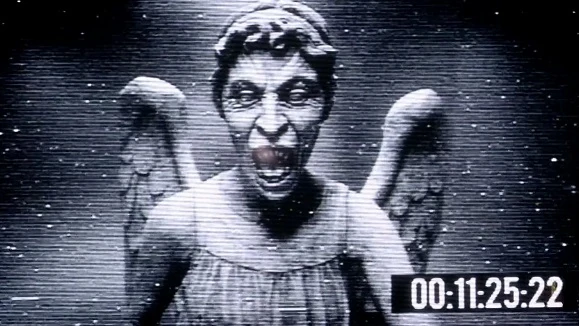
A lot of people felt that the Angels were not as strong in their later appearances but I disagree. I felt this was one of the greatest base under siege stories the show has ever produced. Its got everything you could want from a Doctor Who story. Great ideas, fantastic set pieces, compelling supporting characters (particularly Iain Glenn’s character), scary monsters, spooky atmospheric moments and brilliant action.

9/ Pyramids of Mars

One of the most genuinely terrifying Doctor Who stories ever made. This adventure is a classic haunted house story and features some of the darkest moments in the shows 50 plus year history such as when the possessed Marcus Scarman murders his own brother.

What really makes this story stand out however is Gabriel Woof’s amazing performance as Sutekh. He has easily one of the best voices of any villain. Calm, soft yet with a hint of quiet rage bubbling under the surface. His delivery of lines like “I am sutekh the destroyer and where I tread  leave nothing but dust and darkness. I find that good” is truly chilling!

8/ The Waters of Mars

David Tennant’s best story, this features one of the shows most frightening monsters in the form of the flood which plays on body horror and the fear of possession. It plays on an interesting idea of the Doctor a time traveller landing somewhere important like say the titanic where he knows something bad is going to happen, but has to let it happen anyway because its an important event in history.

Lindsey Duncan is also a brilliant, non sexualized Ellen Ripley style heroine and the end of her story is one of the darkest moments in the series.

7/ Earthshock

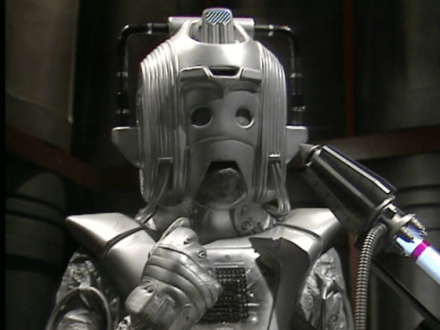
Easily the best Cyberman story in my opinion. Its plot is somewhat straight forward, but by no means poor and what makes it so strong is both its superb direction and the fact that it arguably features the most menacing and effective versions of the Cybermen to date. I not only liked the designs of them in this story, but David Banks is also the best Cyber leader and the monsters actually are only beaten by a fluke too.

6/ The Day of the Doctor

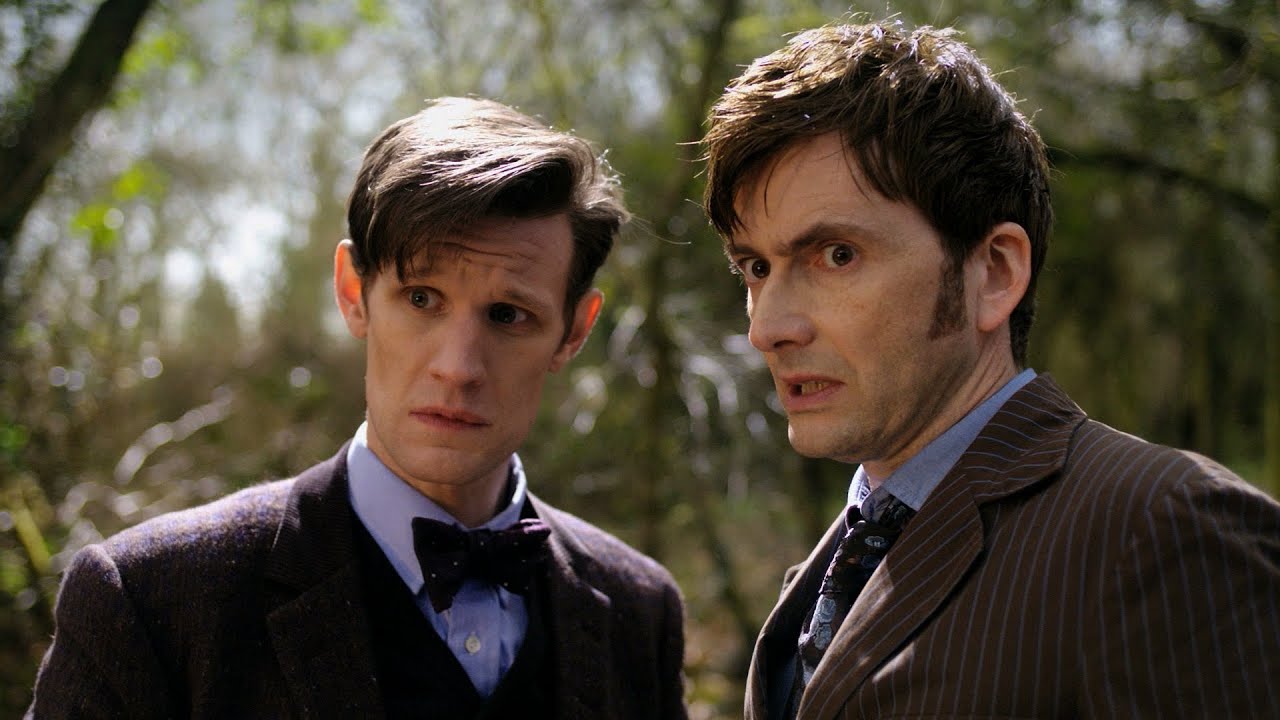
The best anniversary story in my opinion. I suppose you could consider this Tennants best story as he is in it, even though it isn’t in his era. Everything about this story is a joy from start to finish, from the fun with the Zygons to the three Doctors interactions with one another to the surprise twist at the end.

5/ The Web of Fear

My fave Troughton story, this adventure is just a straight forward monster romp, but it doesn’t matter as its superbly directed (it is Douglas Camfield) it moves along at a superb pace and it introduces the Brigadier! The Yeti attacking convent gardens is one of the greatest scenes in the entire history of the show.
4/ The Daleks

The first appearance of the titular monsters on the surface this is a fun, boys own adventure but underneath its actually one of the deepest Doctor Who stories ever made that is a powerful comment on race hatred, fascism, the threat of nuclear power, the horrors of war and even just standing up for yourself. Its a masterpiece in many ways and an important piece of British tv.

3/ Inferno

One of the best alternate universe stories ever made, this adventure offers a deep insight into the main characters of the series through their counterparts. It also has some of the darkest material in Doctor Who’s long history when we see the alternate world burn. I would also rate this as Nicholas Courtney’s greatest performance in the series too.

2/ Vincent and the Doctor

Narrowly missing out on the top spot, this story features what I think is one of the most beautiful and mature depictions of depression of any television series. Its impossible not to be moved by the final moments of the episode. Yes its overly sentimental but when dealing with Van Gough its hard not to be and Tony Curran is superb as the tortured artist.

1/ Genesis of the Daleks

Yes I now its a predictable choice but that’s only because it is the best in my humble opinion. Everything about this story works. Its plot, its dialogue, the performances, the sets, the direction, even the lighting. Michael Wisher is excellent as Davros one of the shows most insane, unpredictable and genuinely loathsome villains whilst the Daleks themselves have never been more alien and genuinely monstrous. Its just perfect.


Dinosaur Spotlight 3: Allosaurus

Allosaurus was the lion of the Jurassic. Though it was much smaller than the likes of say Tyrannosaurus Rex, it was still the largest predator in its environment and preyed upon some of the mightiest animals ever to live on the planet such as the gigantic Sauropods.

At one point it was one of the most famous of Dinosaurs, but sadly in recent decades it has been somewhat usurped in popular culture by other giant killers such as Giganotosaurus and Spinosaurus.

Still we know more about Allosaurus than most other Dinosaurs as there have been considerably more skeletons discovered of the beast over the years than the majority of other Dinosaur species.

Description

Allosaurus was a medium (by Dinosaur standards) sized carnivore. It could reach a maximum length of 39 feet long, with a height of 13 feet and a weight of 2 tons.

Allosaurus lived during the Jurassic period 150 million years ago. It belonged to a group of large meat eating Dinosaurs called the Allosaurs who flourished throughout the Jurassic period and the early to middle Cretaceous. They also included Giganotosaurus and Carcharodontosaurus two of the largest meat eating dinosaurs of all time.

Allosaurus lived alongside other giant predators such as Ceratosaurs with the two occupying different niches to one another. It is believed that Ceratosaurus may have been a pescovore. Allosaurus also lived alongside giant herbivores such as Diplodocus, Apatosaurus and Stegosaurus, all of which it may have preyed on.

Allosaurus was first discovered during the middle of the bone wars in the late 19th century. The first bone fragments were found in the year 1869, but it was not named until the year 1877. It was called Allosaurus Fragilis by Othneil Marsh which means Odd or different lizard.

It was originally thought that female Allosaurus’s were larger and more powerful than the males, but the evidence for this is no longer considered valid. Now no one knows whether the males or female were larger for any species of Dinosaur. It is possible that males may have been larger like most modern day reptiles and birds the living relatives of the Dinosaurs, or its possible that like modern raptors (birds of prey) the females may have been bigger.

Scans of its brain case reveal that its brain was virtually identical to that of a modern day Alligator meaning that it most likely would have behaved in a similar fashion and had similar levels of intelligence. Alligators have a higher level of intelligence than certain species of cats and dogs and therefore Allosaurus most likely would have too.

How Did Allosaurus Kill Its Prey?

Allosaurus was most certainly a predator. There are several pieces of direct evidence for this. A stegosaurus skeleton has been found with an Allosaurus bite mark on one of its plates that has healed, whilst at the same time another Allosaurus skeleton has been found with slash marks from a Stegosaurus tail that have similarly healed. There have also been footprints discovered made by a large sauropod Dinosaur with the footprints of an Allosaurus following behind.

Several other Allosaurus specimens have been found with broken bones and gruesome injuries that have clearly been gained in conflicts too.

Whilst some may dismiss these as rare occurrences its important to remember that given how rare the fossil record actually is this seems unlikely. In order for so many cases of active predation by Allosaurus on other animals to be preserved it would have to be happening fairly regularly.

Despite its size however, Allosaurus is believed to have had among the weakest bite forces of any meat eating Dinosaur.

The reason for this was because Allosaurus didn’t need a massive bite. Instead it would open its jaws much wider than that of most other meat eater, and then swing its head like a hatchet at its victims allowing it to cleave off huge pieces of meat. In order to do this more effectively Allosaurus skull was also much stronger and more reinforced than those of other predators too.

Allosaurus could open its mouth even wider than T. rex.

Allosaurus was also among the fastest of all the large meat eating Dinosaurs. Allosaurus could run at 35 miles per hour. This is almost four times as fast as an African Elephant.

Finally as if that wasn’t enough Allosaurus also was very strong and durable. They could survive injuries that would have killed other animals. One specimen, a sub adult nick named big Al had 18 major injuries including smashed ribs almost all of which had healed.

All of these factors made Allosaurus a very effective predator of some of the largest animals ever to live on the planet.

There is also a possibility that Allosaurus may have swarmed their prey in groups too. Contrary to popular belief, they most likely would not have hunted in coordinated packs like wolves, as such behaviour is not known among Archosaus. Still swarming behaviour is certainly possible, and Allosaurs may very well have been social animals too. There have been many Allosaurus specimens that have been found together, but all this proves is that they died together for now.

Thanks for reading.

2 years of this blog

Well here we are at the two year anniversary of burronjorsramblesandbabbles. So far this blog has had over 86 thousand views.

Initially this blog started out as mostly about Doctor Who, but in the past year it has branched out to include articles on so many different things such as Dinosaurs, horror movies, comic books and various other genre series. The most popular subject is still Amy Winehouse. The articles I wrote about her have drawn far more views to this blog than anything else.

I’d like to thank everyone who has supported this site so far and I hope you stick with me as I don’t intend to go anywhere any time soon.